

Organic chemistry is a very challenging course. It requires a lot of time and dedication in order to accomplish perfection in it. Organic chemistry is a course that revolves around the element Carbon. Carbon reacts in our everyday lives and we do not even know it. This course focuses on the different reactions that happen with Carbon. These reactions do not contain something that only has one Carbon; there are various carbon chains or rings. Like a hexagon in organic chemistry is considered to be hexane because there are six Carbons on each end of the hexagon and the "ane" symbolises that this ring has only single bonds. There are plenty of topics and symbols to learn in organic chemistry, but that would be further explained if one took the class. Organic chemistry does in fact contain something very important to understand. Organic chemistry contains a very important topic which is isomers. Isomers are known to be "different compounds with the same molecular formula." (1) There are different types of isomers that one must know which are constitutional isomers and stereoisomers. Constitutional isomers are important but stereoisomers are something that is known to be more important in this text. Stereoisomers are known to "differ only in the way atoms are oriented in space." (2) Within stereoisomers contains two different isomers that are very important which are enantiomers and diastereomers. Diastereomers are very important in organic chemistry, but enantiomers are favored in the course and in this text as well. Enantiomers are "mirror images that are not superimposable." (3) Enantiomers may look the same but they are very different when comparing one another. Enantiomers have the same physical properties which are same melting point, same boiling point, etc., but they do differ in the way they deflect polarized light. One enantiomer may deflect polarized light a certain way as for the other enantiomer will deflect light the same distance but in opposite directions. Enantiomers may have the same physical properties but they also have different chemical properties. Enantiomers may react differently with even our human senses. This text talks about how an enantiomer and its two configurations react differently with our senses mainly our smell. An example of such an enantiomer is limonene. This enantiomer contains two configurations which may look exactly the same but give two different smells. The R configuration will gift orange smell as opposed to the S configuration which will give a lemon smell. These two enantiomers are represented in my artwork as a visualised 3D representation that is considered to be an enantiomer world.
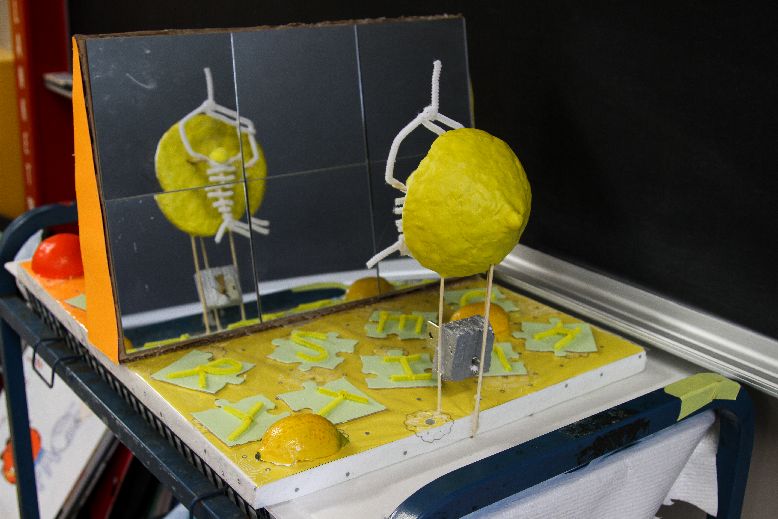
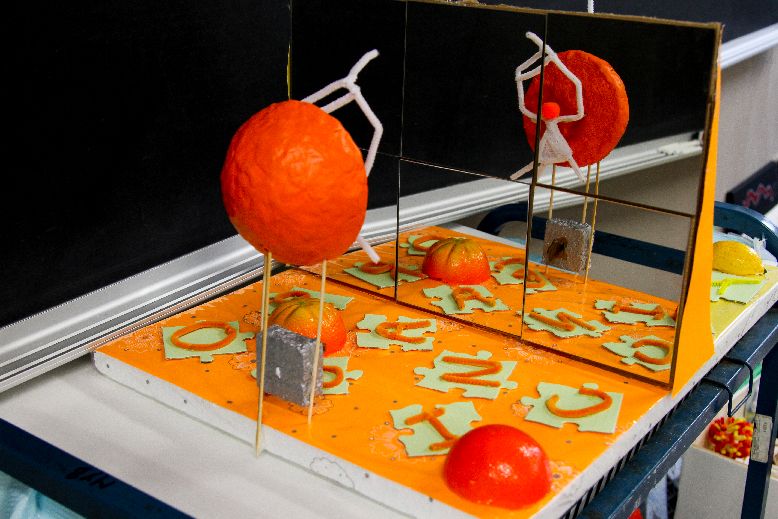
The artwork that I decided to do was a 3D representation of an enantiomer world. As I have explained above, an enantiomer has two configurations. These enantiomers are known to be non-superimposable mirror image of one another. Limonene is a molecule that has two enantiomers whereas it's two stereoisomers play a different role in our everyday life. We know that the R configuration of limonene gives off an orange scent and the S configuration gives off a lemon scent. That is why I decided to do my 3D model of enantiomer and its configurations that are separated in their own so called world. On one side of the mirror, I had the R configuration enantiomer in its own personal orange world as for the S configuration enantiomer was also in its own personal lemon world. To start off with the base, I decided to use a Styrofoam base. I figured that since this project would be big, the most practical type of material would be a Styrofoam base. Using a Styrofoam base was practical, because it was big enough to accommodate any measurement that suited me and also it was easy to work with including light enough to transport. This big project needed to be travelled to school and I figured the easy way would be with a Styrofoam base. The material used on top of the base was first two posters cut in half which were also covers in see-through wrapping paper. The Styrofoam base was half covered in orange poster to represent the orange world as for the other half was covered in yellow poster in order to represent the lemon world. These two colors differentiated between the two worlds. Since it was considered to be two different worlds, I wanted to make the base look more like the ground outside with flowers as if it was a spring day. I wanted to find a material that would show the different colors of the two posters in each world and which will also give a design which contained flowers. As I was looking for material, I thought of a practical thing to use which was see-through wrapping paper. See-through wrapping paper was the best because we are able to see the two colors and it had a design of flowers which made it look more as if it were grass on a spring day in each of these worlds. On top of this colorful base, I wanted to also add something that was original and creative. When I was shopping for materials, I saw something very unique, which is puzzle pieces. I bought these puzzle pieces because I found them being very unique. I took every puzzle piece and I stuck a letter on each piece. When you added all the pieces together, it had spelled out "Organic Chemistry". Since both of these words were two long, then I had placed each other on either side. I thought I was done with the base at this point but I thought of something very nice to add as well, I bought a fake orange and a fake lemon from the dollar store; I cut both of these fruits in half and place each half on the base for their own world. This fake fruit showed also the type of fruit they rly are and the way they look like. The base was done and I had to continue on more important parts of the project. In order to represent my project as it being a mirror image molecule, I decided to make a mirror base that would be standing in the middle of the Styrofoam base so that the two stereoisomers are at opposite ends. The mirror portrays the image of the two enantiomers being the mirror image of one another which may look like the exactly same thing but serve as two completely different things. One configuration gives off an orange scent in its orange world as for the other is a lemon scent and that will be in the lemon world. In order to represent both the lemon and the orange, I decide to take a big Styrofoam ball and cut it in half. One half was for the orange, and the other half was for the lemon. In order to differentiate between orange and lemon, each halves were covered with orange clay and lemon clay, respectively. I cut each fruit in half in order for each enantiomer to be representing as coming out of the fruit in a 3D way. The two enantiomers were made with bendable wires that are also covered in fuzzy material. Each enantiomer was made respectively of their configuration which also included their wedges. The ways to differentiate the two enantiomers were by their wedges and in order to do that, the two configurations should be represented according to the fruit scent they give off. Each enantiomer was placed in its proper place of smell as their own enantiomer world.
Organic chemistry is everywhere around us. It is in our everyday lives. It is in the food we ate, the medication we take and it is something we do not know about. Organic chemistry is a very tough course but it is worth taking it since it is everywhere around us.