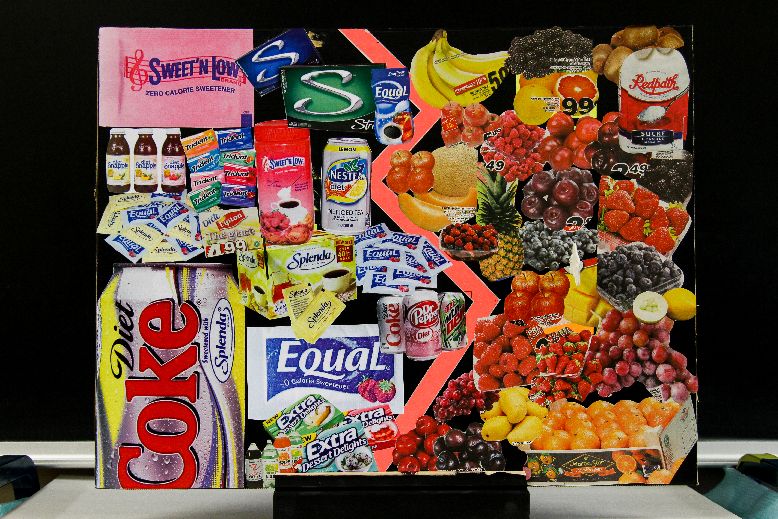


My artwork depicts artificial sweeteners versus sugar. My main motivation in choosing this topic is my interest in food and nutrition. These days many of the products that we purchase at the local grocery store contain a handful of ingredients we scarcely recognize. A common one is artificial sweeteners, of which there are many different types and brand names.
The main big idea this piece focuses on is that molecular shape is a crucial feature in chemistry. The artwork consists of a collage, which is separated into two sides. On the left side is a portrayal of artificial sweeteners. On the right side is a representation of sugar in its most natural form. To depict artificial sweeteners, the collage includes pictures of diet sodas, gum, and packets of brand name sweeteners. To represent sugar, I used images of fruits. The reason why I chose to symbolize sugar in the form of fruits was to create a clear contrast between artificial sweeteners and natural sugar.
Another important feature in my artwork is the presence of two keys that are protruding through the board on which the collage is displayed. These keys represent they lock and key mechanism of artificial sweeteners and sugar. Although these substances have a different chemical make-up, they have the same molecular shape. When an artificial sweetener or sugar is consumed, it acts as a key that binds to an active site. This active site is a taste receptor protein that is present on the surface of our tongues. In the lock and key mechanism, the active site plays the role of the lock. Each molecule that we taste has an extremely specific shape and fits perfectly onto its given taste receptor protein1. As an illustration, when we consume salt, it binds to a salt receptor protein (active site). A nerve signal is then sent to the brain and the salty taste is then registered. Not only is this mechanism extremely important, it is also very interesting. As such, I knew it had to play a role in my artwork. There is one key on the left side (depiction of artificial sweeteners) and one on the right (sugar representation). These keys have the exact same shape, in order to emphasize the fact that these substances do indeed have the same molecular shape. Moreover, the key on the left is painted in black and they key on the right is painted in white. This was done as to highlight the contrast between these substances. The reason why black was chosen for artificial sweeteners key is due to controversy surrounding them. There are many sources that advertise the negative health effects of these substances, particularly aspartame. The reason why white was used for the sugar key was to stress its natural occurrence in many substances, such as fruits. In addition, black and white are the most contrasting shades available and I wanted to emphasize the stark difference between these molecules (in terms of their composition, not their shape of course). The reason why the keys are protruding through the cardboard is to depict the perfect fit of the key to the lock (lock and key mechanism). This was to help provide a clearer visual representation of this mechanism.
Another big idea that is involved in my piece is that there are residual forces between molecules. In fact, it is because of these intermolecular forces that there is an interaction between the artificial sweeteners/sugar (the key) and the active site (the lock) to begin with. Specifically, these residual forces are responsible for bringing the key to the active site. Without these intermolecular forces, there would be no way for us to register a taste to any molecule. The intermolecular forces are crucial. Although this particular big idea is not depicted in my artwork, it definitely ties into the chosen topic.
The next big idea pertaining to my artwork is that chemical bonds form when electrons pair. These molecules, artificial sweeteners and sugar, are complex and are formed due to the sharing of electrons between atoms. This electron sharing forms the chemical bonds between several atoms. These bonds truly hold the molecule together. As such, their role is vital.
The last big idea in chemistry that is part of my artwork is matter is atomic. This is quite evident; however it is easily forgotten that matter is actually composed of extremely small particles. These big, complex molecules such as artificial sweeteners and sugar can be broken down into their constituent atoms. This forms the basis for all our understanding in chemistry, as well as other sciences.