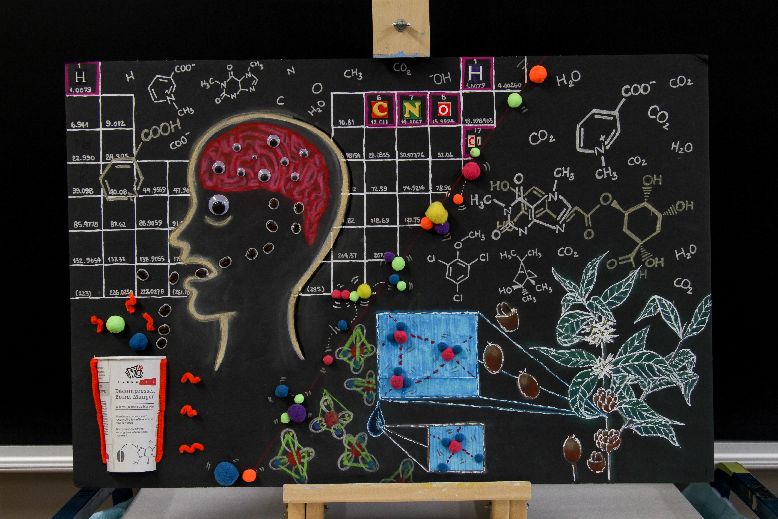


Coffee beans is the second best selling product worldwide. Its fragrance and aromatic flavor have caught human's from all senses; in the morning, before studying, or even during break time. Most people consume this beverage, but do they really know the magic behind these special beans? Inspired by how frequent people drink coffee, I decided to portray the chemistry of these beans in my art project.
The cup of coffee we drink is the result of the Coffea plant and a great diversity of chemical composition. Since everything started from a single plant, I represented it on the bottom right of the cardboard. This plant, like all land plants, possesses stems that support and elevate leaves, flowers and fruits. In order to survive, the leaves act as photosynthetic surfaces to acquire energy from the sun. While this energy is transformed into sugar, it is also transported in all parts of the plant through the phloem. Xylem is another pathway where water is transported to all organs of that plant. The way water is flowed upward is due to hydrogen bonding. Since water has a negatively charged oxygen that is covalently bonded to the two positively charged hydrogen, an attraction forms between water molecules from a hydrogen and an oxygen called hydrogen bonding. It continually breaks and forms as the molecules move within the xylem. Even water droplets are held in the form of ''beads'' by hydrogen bonding. Water molecules have four electron pairs, from which two non-bonding electron pairs repel from each other and from the oxygen atom. It gives a tetrahedral structure to the water molecule. Its polarity and molecular structure is the reason that hydrogen bonding occurs.
Every atom, or element, is represented on a special table that respects periodic properties called a Periodic Table. This table was arranged by the Russian chemist Dmitri Mendeleev. For example, hydrogen has one valence electron, one proton, one orbital, and it has a smaller radius than elements that are placed downward, so it is placed on the first row, first column of the periodic table. In other words, elements are positioned according to their metallic character, atomic size, first ionization energy, electronegativity, and so on. The different sizes and colors of the pompoms show that each one of the atoms are not the same as others.
Matter is made of atoms - Atkins; this statement is represented everywhere on the art work. Molecules are composition of atoms, which create matter. Caffeine, C8H10N4O2, is the main molecule that has caught the attention of scientists. As caffeine enters the body, it stimulates the senses and, especially the brain. What happens is that this molecule as it enters the brain, it binds to a receptor called adenosine, causing the brain cells to speed up. It also contracts the blood vessels resulting into approximately 40% blood loss in the brain. To compromise, the heart beats faster. The pituitary gland is disturbed so it releases a chemical called adrenaline. All these process cause the brain to be in alert. This is represented by the eyes popping up in the brain. Caffeine alters the balance in the body so in response, the body reacts in ways to regain equilibrium.
The coffee cup releasing orange furry metal on the cardboard shows that heat flows in only one direction: out of the system. This energy released from heat will not disappear, but rather dispersed in the surrounding. In other words, energy is conserved. When coffee is warm, the aroma that vaporizes in the air is a spontaneous process, meaning that there is an increase in entropy. The arrangement of the molecules in the liquid drink changes from an orderly one to a disorderly one which are the molecules that are flowing into air. Thus, entropy tends to increase.
The purpose of this art work was to show how one topic can explain so much on chemistry. It is fascinating how Atkins' big ideas can be shown through one single drawing. The plantation of coffee beans requires the power of chemical bonds between electrons, giving the molecule a particular shape and structure. Between these molecules, there are residual forces, such as hydrogen bonding. A cup of coffee is composed of many atoms that binds to one another to create molecules. Every atom varies in sizes, metallic character, electronegativity, and so on. Elements are arranged in the periodic table in respect to their properties. Warm coffee transfers heat and energy to the surrounding, meaning that there is no lost of energy. Molecules tend to change from a more ordered state to and more disordered state, thus increasing entropy.