

Every art piece is based on an inspiration or an interest of the artist. My interest was blood and the contents in blood that help us stay alive. A crucial protein found in red blood cells is the complex structured protein of hemoglobin. It is used to transport oxygen in the blood from the lungs to the rest of the body. The oxygen is then released to break down nutrients and transform that into energy to help organism's function.
Hemoglobin has a quaternary structure; it has four subunits that each contain the element of iron (Fe2+). These iron elements bond to the oxygen that humans breath in order to transport the oxygen throughout the body. Without the bonding of oxygen to iron we simply would not be able to live. The event of cyanide poisoning is a simple way of depicting that, without the bonding of the oxygen to the hemoglobin, we would die.
Cyanide is composed of a carbon atom triple bonded to a nitrogen atom. Each atom has two lone pair electrons. When cyanide is ingested in its gaseous state it blocks the oxygen from entering the body by preventing the oxygen-iron bond in the hemoglobin molecule. This then leads to instant suffocation. This is what my artwork is portraying.
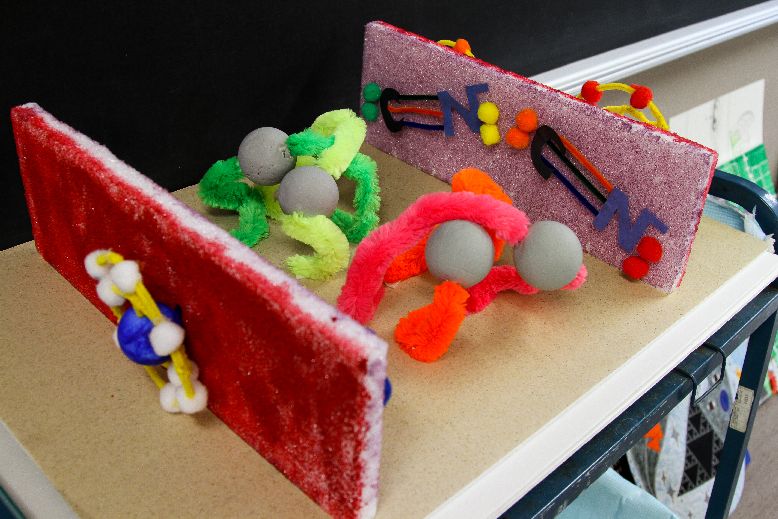
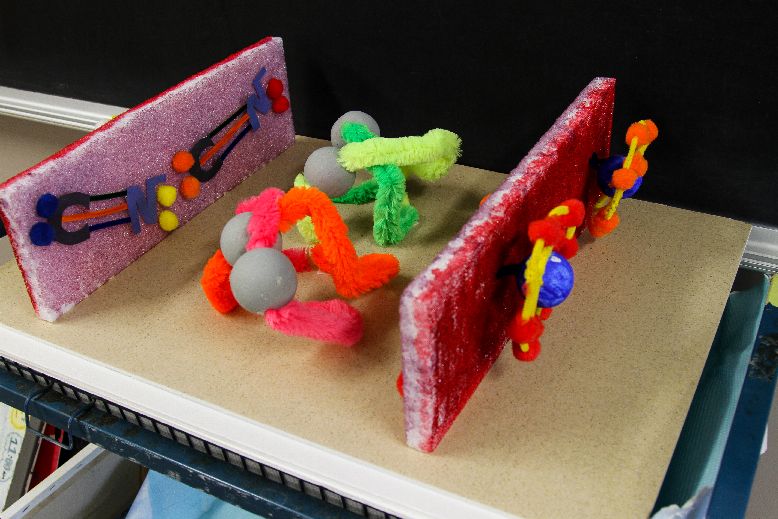
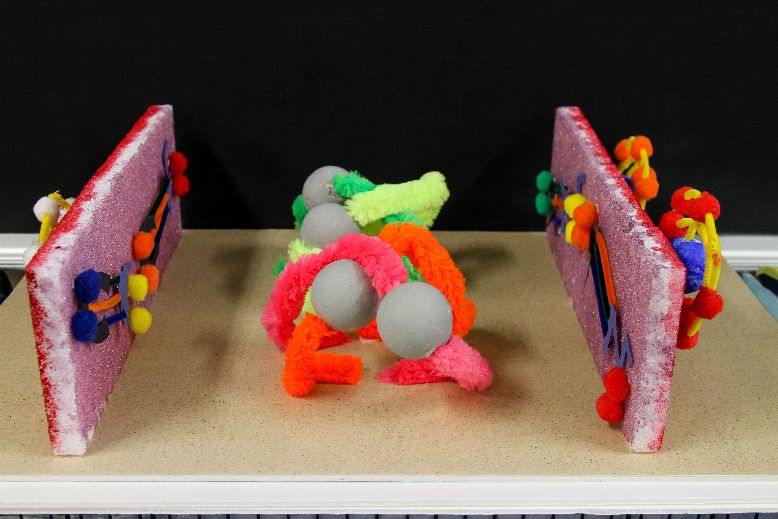
The hemoglobin is represented in the middle by four strands, which are the subunits and the gray balls are the iron atoms attached to each subunit that attract the oxygen. Even though Hemoglobin is a very complex structure, it happens to be very organized, which has to do with not only molecular structure but also entropy which is a state of disorder, hemoglobin is in a state of order at all times. If one iron atom attracts oxygen then all irons must attract oxygen. If one iron releases the oxygen then they all must release the oxygen. It is an all or nothing process and it is simultaneous. This process is very organized and it is in a state of order. The next aspect to the artwork is the wall that is surrounding the hemoglobin structure. These walls are cyanide walls on the inside with the Lewis structures of cyanide glued to the wall, which shows how cyanide is protecting the hemoglobin. The three pipe cleaners are the triple bond in cyanide and the pom poms are the lone pair of electrons. You may also notice that the walls of the inside wall are purple because cyanide poisoning leads to suffocation and when a human suffocates their face turns purple. Finally on the outside walls are oxygen atoms represented by their two electron shells containing a combined eight electrons, two in the first and six in the last. This oxygen was painted blue to represent life to show that without oxygen there is no life. The outside wall was painted red because it represents oxygenated blood and there is only red on the outside because the cyanide wall is blocking the oxygen from oxygenating blood.
In regards to the nine big ideas in chemistry, oxygen and iron were represented as atoms, which also represents that all matter is made up of atoms. On the art piece, the size of the iron balls are larger than the size of the oxygen balls, this represents elements displaying periodicity because the atomic radius of iron is larger than the atomic radius of oxygen. The arrangements of the electrons in oxygen as displayed are part of the discovery of periodicity. The Lewis structures of cyanide as well as the iron and oxygen relationship represent how chemical bonds form when electrons are shared. This idea goes hand in hand with the idea of molecular structure and the molecular structure of hemoglobin. In the complex structure of hemoglobin there must be forces holding the structure together and these are hydrogen bonds, one of the strongest intermolecular forces. When oxygen bonds to iron the iron gets oxidized. This has to do with one of the four types of reactions, the redox reaction. To go through the redox reaction it must overcome the barrier to the reaction to fully oxidize and function. As mentioned before, the idea of entropy can also be included within this artwork because hemoglobin is a very organized structure and the process of bonding to oxygen is also very organized.
As you can see, the artwork depicts the event of cyanide poisoning perfectly, which leads to suffocation. The oxygen' are being blocked by the cyanide walls that are protecting the hemoglobin molecule. This artwork also contains eight out of the nine big ideas of chemistry by Atkins.
Bibliography:
- 1. Ganong, WF (2003). Review of Medical Physiology (Twenty-First Edition). Lange.
- 2. Campbell, MK (1999). Biochemistry (Third Edition). Harcourt.
- 3. Kneipp, J; Balakrishnan, G; Chen, R, Shen TJ, Sahu SC, Ho NT, Giovannelli JL, Simplaceanu V, Ho C, Spiro TG; Shen, TJ; Sahu, SC; Ho, NT; Giovannelli, JL; Simplaceanu, V et al. (November 22, 2005). "Dynamics of allostery in hemoglobin: roles of the penultimate tyrosine H bonds". J Mol Biol 356 (2): 335-53