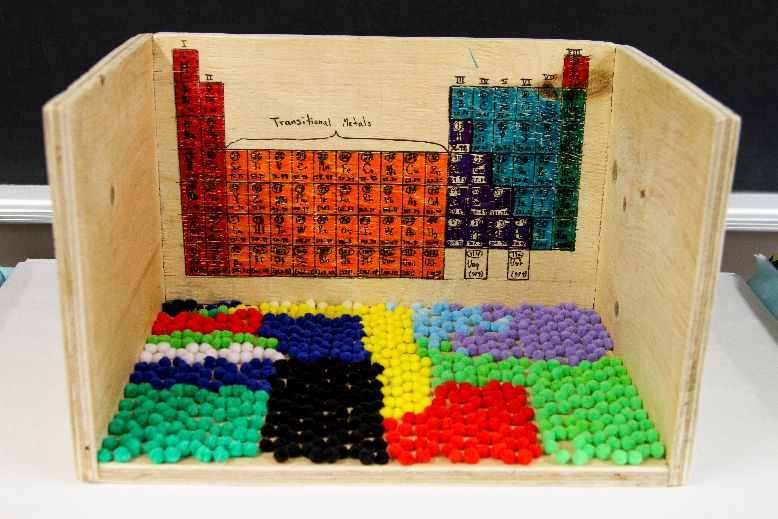


The scanning tunnelling microscope is so powerful that it is able to see atoms. It is composed of a scanning tip so fine that the point of the tip is made of one atom. The way the microscope works is easy. A current between the scanning tip of the microscope and the surface it's scanning needs to be constant throughout the whole scanning. This current flows from the tip to the electrons of the scanning surface. The reason why the current needs to be constant is because it will be able to record depths as it scans. If an atom is lower than the preceding one, the tip will lower when passing over the lower atom to keep the current constant. As the scanning occurs, the image is recorded on a computer. My simplified version of the electron microscope consists only of the scanning surface and a periodic table in the background. The reason why I chose to do the scanning tunnelling microscope is because I was always wanted to be able to see atoms. I also always wanted to see how atoms are connected and what they look like. My first idea of making the microscope was to make the scanning surface and make the scanning tip to make it seem as real as possible, but it was too complicated, so I just made the scanning surface. In this project, four big ideas in chemistry are observed.
The first big idea that I am trying to demonstrate is that matter is made of atoms. Anything in the universe is made up of atoms and the scanning tunnelling microscope can prove this statement because the atoms can be seen on the screen. Since matter is made of atoms, I decided to build a graphite structure with colored fur balls. These colored fur balls represent atoms and the reason my graphite structure is composed of different colored fur balls is to demonstrate that periodicity is another big idea in chemistry. The periodic table is set up in a certain way in order to demonstrate periodicity. The more you go right and up the more electronegative the elements get. Also, the more you go right, elements become smaller and the more you go down, elements become bigger. About my atoms, I purposely used different colored fur balls to make my structure look less appealing. This look demonstrates that my structure does not seem like it is natural. This unnatural look demonstrates that atoms can only bond with specific elements and not any types of atoms. Graphite is strictly composed of carbon; therefore, my structure should be composed of same colored fur balls. Graphite, just like other molecules, can only be formed when electrons pair. I also drew a color-coded periodic table in the background to prove that elements display periodicity. Similar colors in the periodic table show that these elements behave similarly. Since elements display periodicity, chemical bonds will only happen between specific elements. These electron pairs form chemical bonds, which is the third big idea in chemistry. In any molecule, there are many chemical bonds. In my graphite structure, the bonds formed between carbon atoms form hexagons in the structure. I also showed an image of graphite structure and an image of a diamond structure side by side. This image demonstrates that the only difference between graphite and diamond is their molecular shape. Graphite and diamond are both made up of carbon atoms, but their molecular shapes are different. Molecular shape is the fourth big idea in chemistry because depending on the molecular shape, different materials are composed. Diamond is composed of carbon, but the molecular shape of diamond is tetrahedral. This causes a three dimensional molecule called diamond. On the other hand, graphite is also composed of carbon atoms, but the molecular shape of graphite is trigonal-planar which causes the molecule to look like it is made of hexagons. Any molecule in the world is extremely well organized.
In conclusion, my project is demonstrating five big ideas in chemistry. The first big idea I am demonstrating is that matter is made of atoms, which is shown by the scanning tunnelling microscope and by my graphite molecule. The second big idea I am demonstrating is that elements display periodicity. I showed this by drawing a color coded periodic table and by making my graphite structure unappealing. The third big idea I am demonstrating is that chemical bonds form when electron pair. I showed this by making a graphite structure that shows the bonds clearly. The fourth idea I am demonstrating is that molecular shape is a crucial feature in chemistry. I showed this idea by showing a picture of the difference between graphite's molecular shape and diamond's molecular shape. Finally, my project demonstrates the four big ideas in chemistry that I find the most interesting.