

The Universe is full of mysteries. It is a net of interwoven questions that may never be answered; yet that fact has never managed to hinder human curiosity.
The idea my project portrays is one that has never ceased to blow my mind, it is the idea that we are the atom observing itself. After the Big Bang, which is said to have occurred about 14 billion years ago, both energy and matter were scattered in all directions, originating from a small, infinitely dense point. Among the matter released existed nucleons, which were particles that make up the atomic nuclei of elements. Three minutes after the expansion that was the Big Bang, the Universe was cool enough for these nucleons to come together through a process known as nucleosynthesis and form the elementary particles we recognize today as Hydrogen and Helium, which became the components for some of the first stars. Inside these stars, nuclear fusion occurred due to the intense amounts of heat and pressure, and began to form the particles that make up our periodic table, as well as everything else in the known Universe. These Elements eventually came together to form molecules, which would later form the components that make up life. Humanity is not excluded from this process, we really are made up of these very particles that came from the Big Bang, we are entirely made up of the atoms that were formed through the synthesis of the very nucleons emanated from the event that created our Universe. And through our eyes, we return full circle and observe and study these very particles.
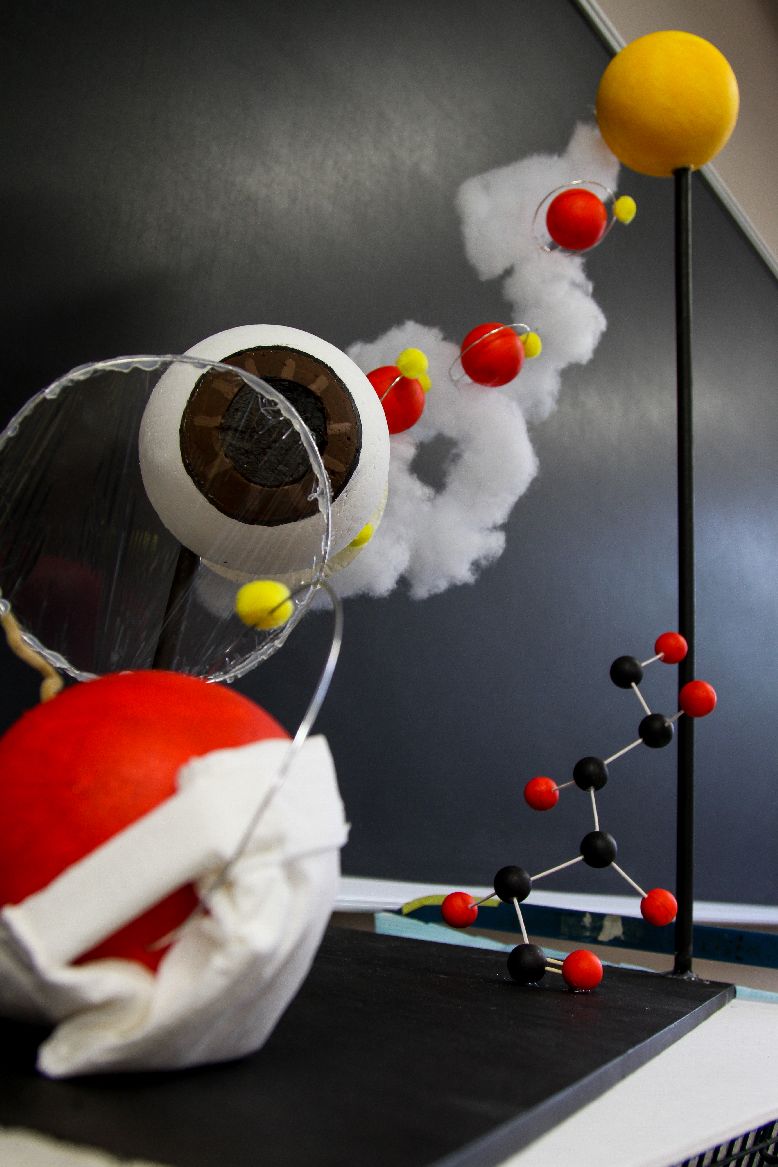
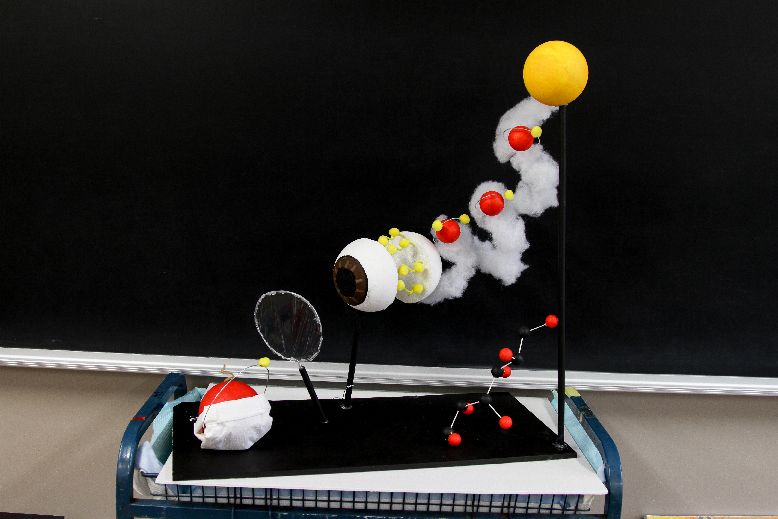
The way that my project was made tries to demonstrate this cycle that has come full circle. The sun in the top-right corner demonstrates the source of all the atoms that make up life, which are represented by the spiraling cloud that finally leads into the eye. This eye is meant to show the life that these atoms have come to create, and the fact that this life is going back and studying its parent particles. By looking through devices such as the scanning tunneling microscope (represented by the microscope between the infant particle and the eye), we are able to observe atoms and molecules, and try and figure out the ways used by the masterminds of the universe to create us. The atom in a diaper in the lower-left corner only enforces the idea that by looking at these particles, we really are looking at ourselves in our state of fundamental infancy.
By focusing on the creation of elements, and the fact that these elements later grouped together to form life, my project manages to demonstrate many of Atkin's big ideas in Chemistry. The most evident, yet most important is the idea that matter is made of atoms. Literally all matter in the Universe can be seen as a puzzle, where atoms come together in specific shapes to form the constituents of our reality. This highlights another big idea, one that is just as crucial as the idea that matter itself is made from atoms. This idea is that Molecular shape is a crucial feature in chemistry. The three-dimensional shapes assumed by atoms coming together determine almost all of the properties a molecule will have. Due to molecular shape, characteristics such as reactivity, polarity, and biological activity are made possible. It is due to molecular shape that hemoglobin, a molecule crucial to our survival, is able to carry oxygen throughout our body and help us carry out the various processes that make our existence possible. It is because of molecular shape that enzymes are able to do their job and make almost all life throughout our world possible. The molecule leaning on the left-most support beam holding the sun represents this incredibly important aspect that is molecular shape. This location was chosen for the molecule due to the fact that it is the molecule and its shape that supports life and provides the foundation for almost all other processes that occur in our Universe.
If the idea of molecular shape is mentioned, than the idea that chemical bonds form when electrons pair is intrinsic to the project. It is because of the desire for an atom to complete it outermost shell that atoms form both ionic and covalent bonds and are able to form the molecular shapes that are so crucial. This idea was demonstrated by the yellow pom-poms connecting both sides of the eye in my project, showing that is thanks to these bonds that we may have life as we know it.
Another key idea that is demonstrated in my project is the fact that Entropy tends to increase. The Universe started out in a state of incredibly high disorder, containing mostly particles in their gaseous state. These particles slowly became more and more organized until they formed the perfect structures that allowed life to flourish. However, entropy will always increase, and this is true for life as well. Once something dies, it begins to decompose, and these pristine structures that once made up living organisms start breaking down, usually releasing gasses and allowing entropy to increase once more.
Finally, the last big idea displayed in my project is that of conservation of energy. In no matter which situation, there is never a moment where energy is simply created or destroyed. It is always conserved in an isolated system. This fact plays into the creation of life as well. It is due to the conversion of potential energy into kinetic or chemical energy, or vice versa, that atoms found themselves with enough energy to undergo the collisions that allowed them to bond and form the building blocks of life. This conservation of energy is shown in the way that my project goes full circle. The idea that atoms are created, form the shape that is humanity only to be put under the microscope paints a circular picture. This truly represents the conservation of energy as energy will always come full circle, it will be converted over and over again infinitely many times, but will never be created or destroyed.