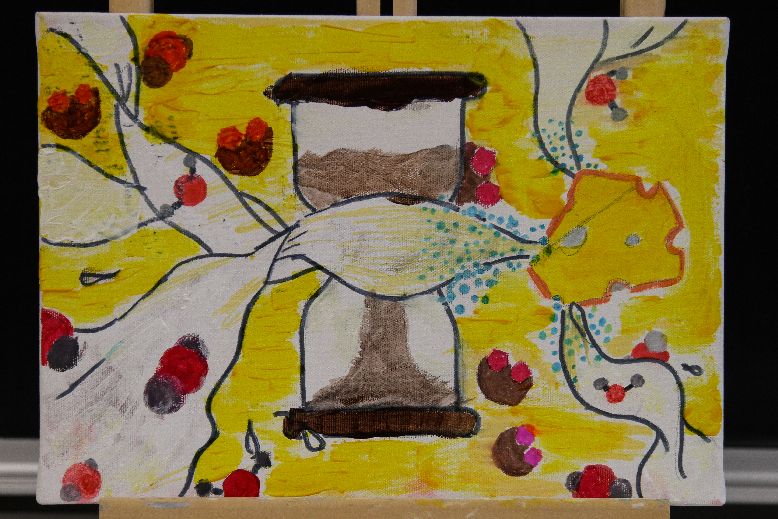


For my art project, I did a painting that is related to cheese. I found many of the big ideas stated by Peter W. Atkins in this particular topic. From a book called "The Joy of Chemistry", written by Cathy Cobb and Monty L. Fetterolf, at page 213, I learn that cheese is a mixture of oil, water, fats, calcium compounds, and milk. In the painting, the oil, fats, calcium compounds, and milk are represented by the curls. I couldn't depict the form of the mentioned substances' constituents, because the constituents are too complex, and it would take up too much space on the canvas. Instead, I decide to draw simple water molecules around the curls. From these water molecules, I am showing the viewers that every matter on Earth (in this case cheese and the substances that compose cheese) is made of atoms.
Through the molecules, another big idea in chemistry is revealed: chemical bond. In the chemistry course, we are being taught that molecules represent a cluster of atoms bonded strongly enough as to behave a single entity. In the painting, it shows that the water molecules are formed when oxygen atoms is bonded with hydrogen atoms. In the painting, the oxygen atoms are colored in red, and the hydrogen atoms are colored in grey. The type of bond that we see in this art, the bond formed by the water molecules, is called the covalent bond, which results from the sharing of a pair of electrons between two atoms. From the paring of the electrons, I could also recognize the idea of molecular geometry. In the chemistry course, the teacher has taught us that molecules will take a shape that minimizes repulsions between electron pairs. In order to portray the shape of a molecule, we have to know the steric number of the molecule, which is the sum of the number of lone pair of electron and the number of bonded electron. In this case, H2O molecules have two lone pairs and two bond pairs, which sums up to a steric number of four. Thus, the water molecules take the shape of a tetrahedral. For the molecular geometry, we also have to consider that repulsions between lone pairs are higher than lone pairs and bond pairs which are higher than bond pairs. Since there are two lone pairs in water molecules, there is a greater repulsion between the lone pairs, thus making the angle that separate the bond pairs less than 109.5 degrees. In the painting, when the water molecules are viewed at a certain perspective, the bonds formed by oxygen and hydrogen atoms are bent.
In addition, when there's formation of certain matter, we know that there will be forces. Let it be intermolecular force, London dispersion force, dipole-dipole force or ion-dipole force; mixtures all depend on forces. Although I didn't clearly show this idea in my painting, but the fact that cheese is a mixture reminds me of this essential key in chemistry. When mentioning about forces, I could also relate it to entropy, which is the level of disorder. When there is disorder, the molecules in a matter are more susceptible of interacting with each other. From my artwork, we could see that the painting is really disorganized; the water molecules, the curls and the enzymes are displaced everywhere in this painting. In my artwork, there are enzymes, because cheese is formed when enzymes, harvested from the stomach of calves, slowly coagulate proteins into solids. In the painting, the active site of the enzymes is colored in brown, and the substrates are colored in pink. "When the substrates fit into the active sit, the activation energy of the reaction would be greatly lowered."1 The activation energy serves as a mountain of barrier that the reactants have to overcome in order to form products. Thus, the presence of enzymes reminds me that in this world, there is the existence of barriers to reaction.
Finally, people would see an hourglass at the center of my painting. This picture does not portray any of the nine big ideas in chemistry, but it is essential in explaining the formation of cheese. The hourglass represents the process of aging. When the cheese is allowed to age, the result is a solid brick called hard cheese. "Aging consists of allowing bacteria time to complete the coagulating process that the enzymes started, which explains why hard cheese keeps well: it has already been attacked by bacteria and has survived."2 In the painting, the bacteria are drawn as tiny little blue dots near the piece of cheese.
In sum, through my painting, I am portraying the idea of matter being atomic, chemical bonds, molecular geometry, residual forces between molecules, entropy, and the existence of barriers to reaction.
Literature cited
1 Nivaldo, J.T., Chemistry a Molecular Approach, second edition, Pearson Education, New York, 2008, p.597
2 Cobb C., Monty L. F., The joy of chemistry: the amazing science of familiar things, Amherst, N.Y. Prometheus, 2010, p.213-214