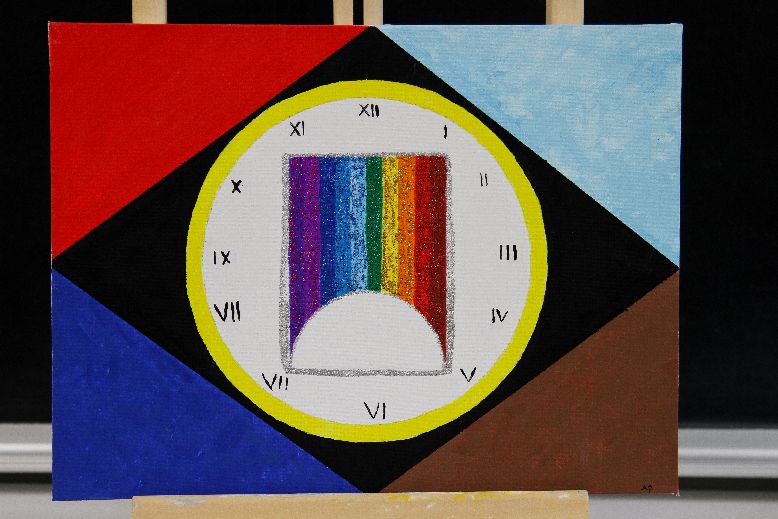


I have chosen to create an abstract painting with acrylic paint for the science art project, which incorporates the progression of science throughout history. The piece is entitled Scientific Metamorphosis to demonstrate the evolving nature of science. The three major scientific eras are depicted by a major understanding of the time. The newer concepts are placed within the older concepts to demonstrating the building of science on past thoughts and beliefs. I aimed to keep the focus on the dominant ideologies, depicting each by shapes, colors and symbolism to create a visually appeasing image which held scientific ideology.
The first section of the painting is representative of the ancient, foundational scientific beliefs and understands of the universe. The outer four corners of the canvas make up the first division of science, representing Aristotle's four elements which make up the world. The four elements (air, fire, water, and earth) are depicted in the painting by singular colors. Air, which is hot and wet, has been painted pale blue in circular motions with slight transparency to demonstrate it is part of the sky. It is placed on the upper right corner to demonstrate the lightness of this element. Fire, the second element is hot and dry. It has been painted a solid red to portray the severity of this element. Water, which is cold and wet, has been placed on the bottom left corner. It is royal blue in color with heavy slabs of paint and bubbles characteristics of water. Finally, earth the heaviest of the four elements is placed below air, the lightest element. This element is dark brown in color, painted with a gravely texture, both attributes of earth. The four elements have been placed in the corners of the painting to demonstrate Aristotle's belief that these elements made up the four corners of the Earth. They all occupy an equal amount of space to demonstrate their equal importance in the world, and in Aristotle's theory.
The second section of the painting is enclosed by a black diamond. The diamond is inside Aristotle's four elements and represents both the future uncertainty of science and the repressive nature of the pre-Newtonian era, which followed the Aristotelian science. The Newtonian era was a time of intellectual repression. During this time, any ideologies or ideas which challenged the dominant beliefs of the church were shunned. The geocentric model of the universe, with the Earth at the center of the solar system, was thought as the irrefutable account of the nature of the cosmos. Galileo Galilei had a great influence on the reformation of the scientific understanding of the cosmos. However, during his lifetime Galileo's contemporaries did not agree with his avocation for a heliocentric universe, which opposed the dominant geocentric model. Galileo was forced to recant his views, and subsequently lived the remainder of his life under house arrest. The Newtonian era is depicted by a golden circular watch, demonstrating the perfect ideology at the time. The circle also demonstrates the continuous repetition of the same thoughts and concepts due to the rejection of other, challenging views. This clock has a white face and black roman numerals, further depicting the true hierarchical order of the time. It does not hold any hands to distinguish the time, demonstrating the limits a repressive environment can created.
At the center of the painting, inside the Newtonian clock, is the final section of the piece. This division is depicted by the light spectrum, portraying the wave-particle duality discovered in the modern era of science. This section focuses on the line spectrum, showing the progression from ultraviolet purple color on the left towards blue, yellow and finally red colors toward the right. The light spectrum is enclosed by white glitter to demonstrate how together, all colors on the spectrum form white. The background of the Newtonian clock is also white demonstrating the wave-particle duality. The bottom of the light spectrum is cut off by a half circle demonstrating the role, and influence the observer may have in experiments. This final section was inspired by the quantum mechanics, double-slit experiment by Thomas Young and the photoelectric effect discovered by Albert Einstein. Both experiments demonstrated that light and electrons behave like both a wave and particle. Depending on the experiment conducted light may behave either behave like a wavelength or particle. This section was consciously placed in the center to demonstrate contemporary society's scientific understanding of the universe.
Beliefs and ideologies regarding scientific understanding of the universe, which shape different societies, have drastically altered throughout history. Scientific Metamorphosis is a visual work which aims to demonstrate the complexity of the past and its influence on the present. Furthermore, the work aims to demonstrate the uncertainty of the future of science in society.