

Science and art are interrelated. Advances in science influence the way art, in a certain century or period, is depicted. This can be seen through Picasso's early 20th century works which were heavily influenced by the newly discovered theory of relativity by Einstein. These advancements not only help us advance as a society, but also push us forward culturally, forcing us to view the world around us under different perspectives. This, by effect, influences individuals in said society to broaden their horizons when concerning traditional world views. Classic examples of these changes would be the development of existentialist theories of the universe and the dismantling of nationalist perspectives.
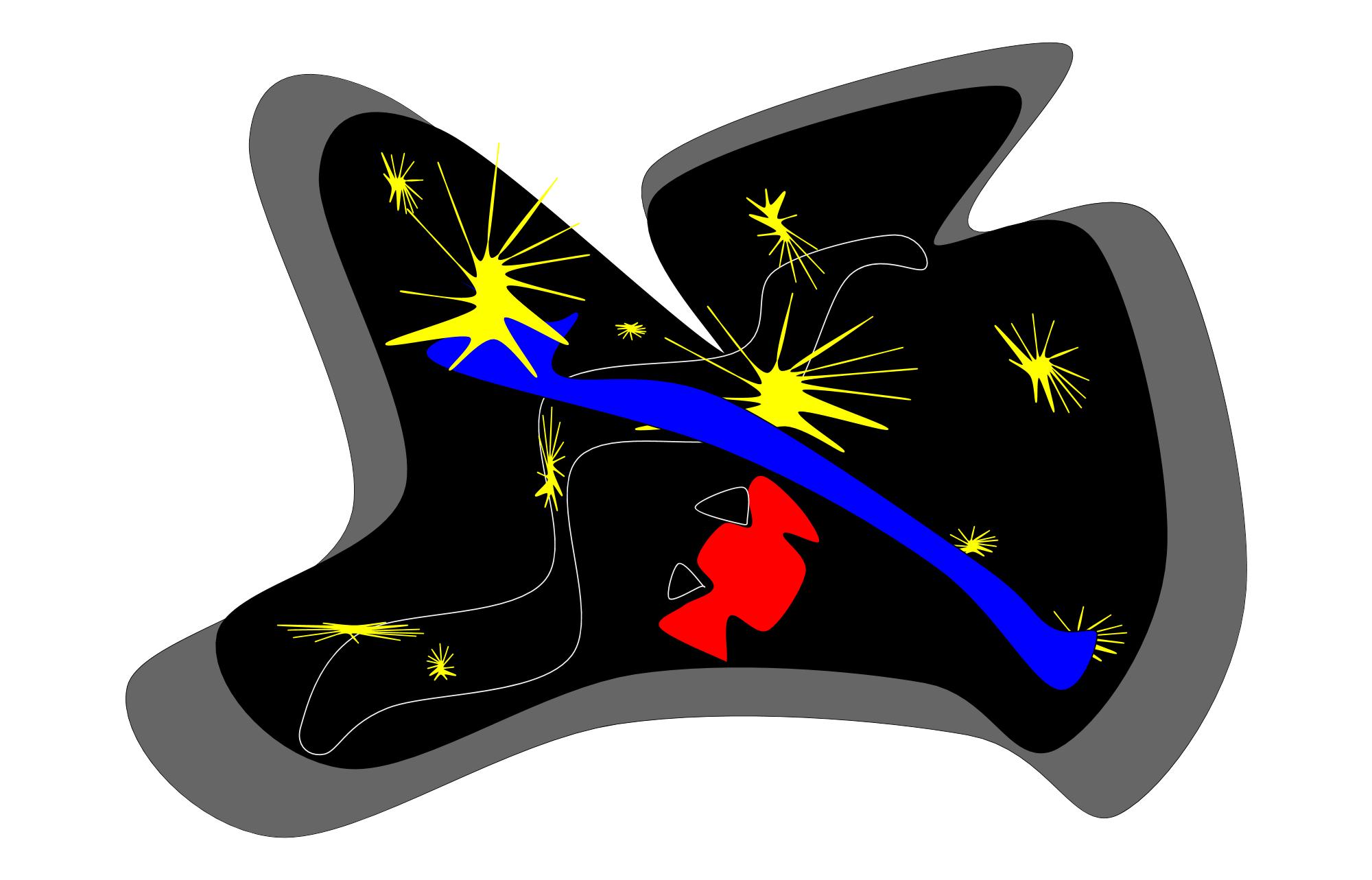
Night In Montreal attempts to recreate this existentialist, relativistic worldview that followed the inauguration of Einstein as the leading scientific mind of the early 20th century. After Einstein was proven right by Eddington, the calculable, objective world was shown to be nothing more than a fantastic illusion. That in fact, the world consisted of a chaotic, unknowable and uncertain property. Scientific endeavors could not simply prove a set of theories without the worry of observer effect or through lack of technological means to acquire said data. My artwork thus strives to capture the chaotic nature of our universe and demonstrate my subjective view of it. By creating a dark landscape strewn and populated by a desolate river, road, car and street lights, I attempt to explore the littleness of these objects which are characteristics of metropolitan nightlife. By extension, my artwork also explores the insignificance of such a landscape in comparison to the universe. This belittles human beings, interaction and events to a microscopic level. The artwork renders a subjective outlook upon the world seen around us. This subjective view destroys the objectivity and celebrates the subjectivity through which all human beings experience the world. The objects found in the artwork are also warped and are not of realistic shape. This emphasizes the subjectivity of the looker upon the landscape.
The landscape, the canvas, essentially becomes the viewer's playground where objects, discarded around in a random order and fashion are expected of movement. Movement in such a universe as found in the artwork could in no way operate like in this universe. The transition from canvas to reality, or from dimension to dimension, is abrupt and is unlikely to be similar. The way objects are placed, object would be in the impossibility for gradual movement. Movement would operate under a quantum system, where energy would propulse these objects to other locations. This movement, again, would not be gradual but instead would rely on automatic and instant movement. This is akin to the quantum theory where energy at a subatomic level does not gradually increase. Instead, a specific amount of energy must be produced or given for a change to be made. Thus the existence within the artwork, being similar to the subatomic particles, is insignificantly small compared to the large vastness of the universe.
Furthermore, the artwork deals with the uncertainty of which direction the image is in. Space and time in the artwork seems not to grasp any area, leaving a sense of uncertainty to the viewer. The uncertainty principle, on which the artwork was based on, runs prominently throughout the artwork. The dizzying orientation leaves the viewer wondering which direction is up and down. Space and time is thus in utter shambles and leaves the artwork open to interpretation. The only certainty that we are aware of is that the painting is set at night. This in no way helps the viewer since the nighttime in question obscures the background, hiding away any secret this background may reveal. This leaves the viewer inside a limbo-esque Twilight Zone environment where true certainty is lost. A Night in Montreal captures the disorder and chaos found in this universe through a subjective microcosm that attempts to, symbolically, demonstrate the unknown nature of our environment, the universe and even ourselves.
Art and science is important to the development of technology and ideas. Without which, our society would remain stagnant and be unable to progress forward. A Night In Montreal attempts to use early 20th century scientific, artistic and philosophical innovations and merge them together. This resulted in an artwork that explores quantum theory, the uncertainty principle, existentialism and relativity. A Night In Montreal celebrates these ideals and notions and brings to life another existence, or dimension, unto canvas.