

Quantum Theory defies common sense and goes beyond the world we perceive. Our perception is limited to our senses and what we expect to observe, while quantum mechanics presents unexpected and boundless conclusions of the world and matter that surround us.
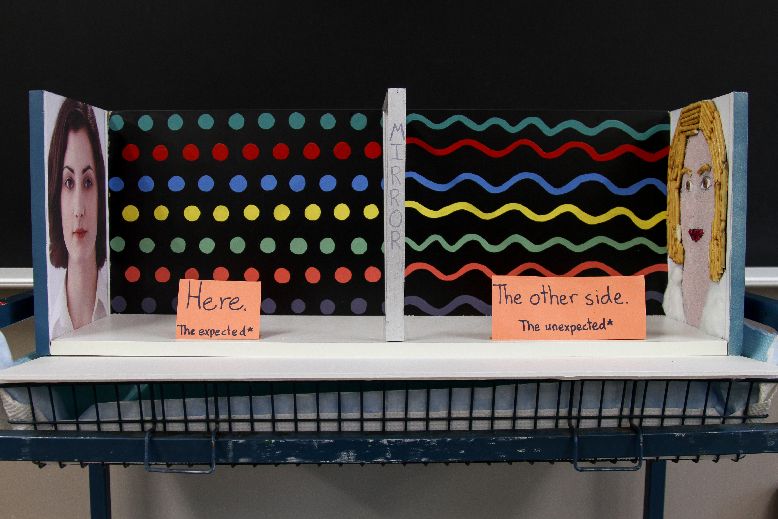
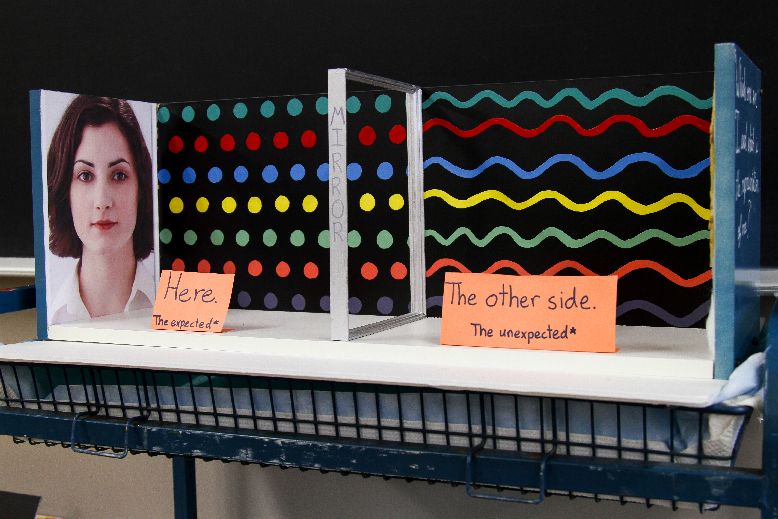
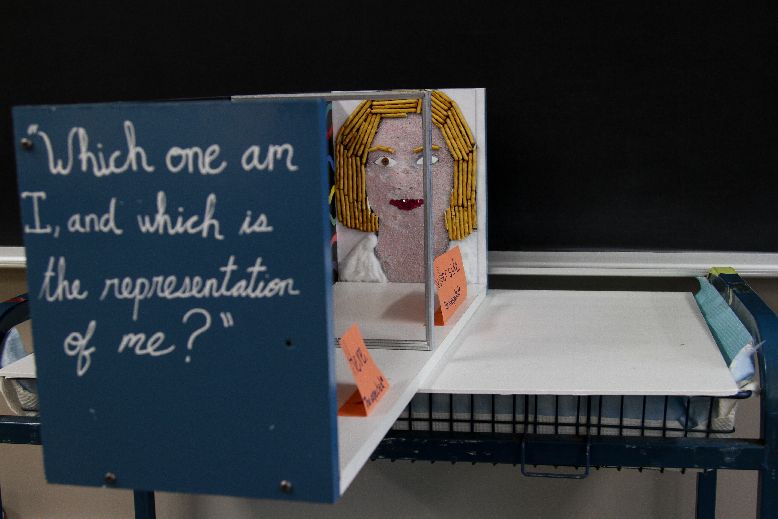
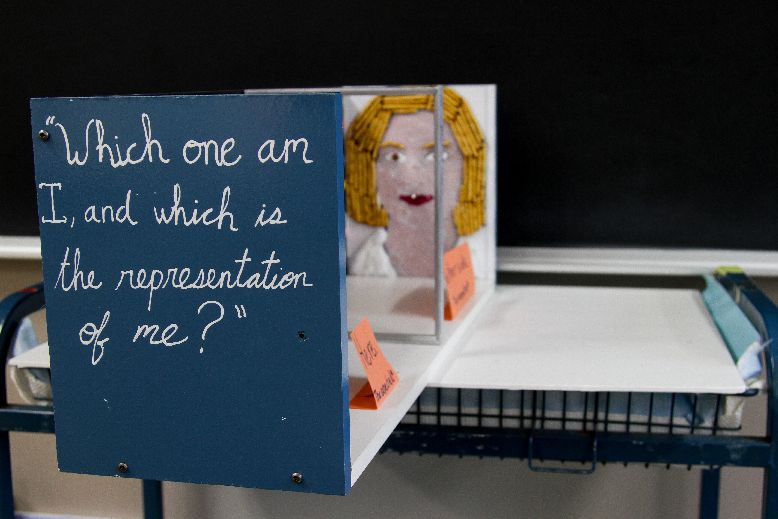
The intriguing idea of parallel universes, other dimensions, coexisting with ours, is the primary aspect explored in my project. This idea was derived from a thought experiment done by Erwin Schrödinger in 1935, which is famously known as Schrodinger's cat. This theoretical experiment consists of placing "... a living cat into a steel chamber, along with a device containing a vial of hydrocyanic acid... If even a single atom of the radioactive substance decays during the test period, a relay mechanism will trip a hammer, which will, in turn, break the vial and kill the cat."1 Quantum theory allows the cat to be both dead and alive at the same time while it is contained in the chamber, therefore within parallel universes the two states of the cat exist. In my project, there is two portraits of the same woman, one of her "normally", as we expect to see someone, and the other is a collage of her made of different materials; an unexpected appearance of the woman. These portraits are placed on opposite ends of a plank, facing one another. A silver wooden frame, representing a mirror, is found between these two portraits. The mirror acts as a division of two universes, where each universe holds an alternate form of the woman, so two realities of the woman exist at once. Moreover, behind each portrait it is written, "Which one am I and which is the representation of me?" The idea that both realities of the woman are looking into the mirror to see themselves looking differently, allows them to ask this curious question.
While the first portrait is simply a printed out picture of the woman, the second portrait, the collage, reveals another scientific idea; the world around us is completely made up of tiny atoms. I found myself inspired by the Brazilian artist Vik Muniz, who uses anything, from food to garbage, to make his art. He uses small pieces to form a huge artwork, the same way atoms form everything big and small. The materials I used were sand for the skin, cotton for the clothes, pretzels for the hair, and jewels for the lips and buttons for the eyes.
To distinguish the two universes both background design and indication by word were used. The background consists of colourful rows of dot pattern that become a wave when passed through the mirror onto the other dimension. This background incorporates wave- particle duality; where the electron can be perceived as both a particle and a wave. Scientists expected the electron to act as a particle; therefore the dot pattern was used on the side of the "normal" portrait, as one expects to see the woman. It is for this reason that the left side of the mirror, where one dimension is found, is indicated as, "Here. The Expected." Meanwhile, the electron behaving as a wave was unexpected, the same way the collage was an unexpected form of the woman; therefore the wave pattern would be used on the respective side. Comparatively, this parallel universe found on the right side of the mirror is labelled as, "The Other Side. The Unexpected."
Reference:
- http://whatis.techtarget.com/definition/0,,sid9_gci341236,00.html, November 24th, 2011.