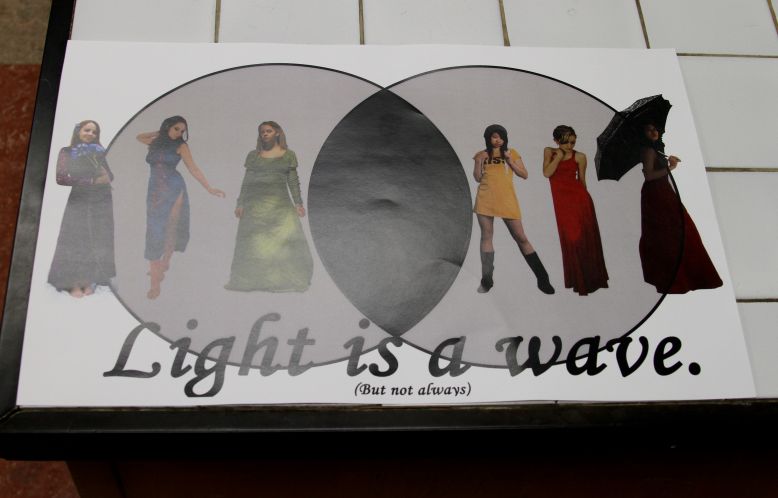
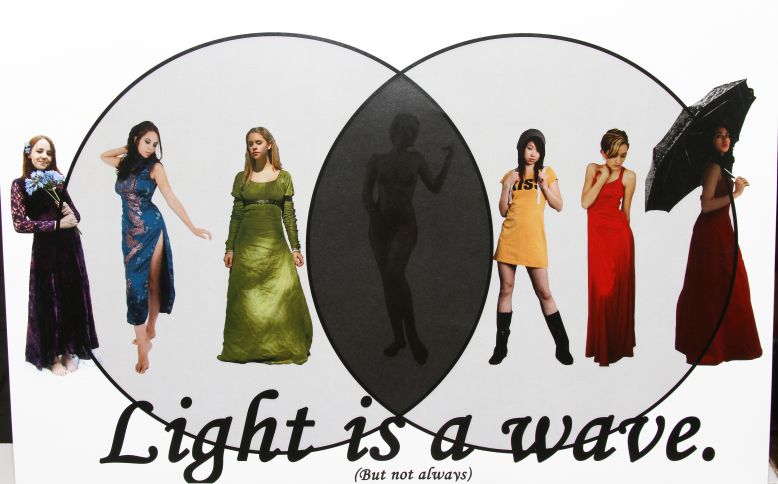


My artwork encompasses two concepts related to light, or electromagnetic radiation. The first is relatively easy to understand: the six clothing-clad people are wearing colors that roughly represent the main colors in the visible spectrum of light. It is a simple representation of the visible spectrum of electromagnetic radiation and is but a complement to the main idea. (Plus, it looks good.)
The second, central, and more important idea I was trying to get across is related to the wave-particle duality concept present in quantum mechanics. My artwork proves that light is a wave by demonstrating how light can be effectively canceled out by two overlapping linearly polarized filters placed in a certain way. Unfortunately, due to light’s wave-particle nature, it does not always behave like a wave, and hence the addendum “but not always” under the first statement. My artwork entices people uninitiated to the realm of quantum to unknowingly open Pandora’s Box when they speculate and search for what I mean by ‘light is a wave but not always’, and it gives people familiar with quantum concepts a nice feeling of recognition as they recognize the paradoxical dual nature of light. In addition, my artwork demonstrates how light behaves like a wave in a way that rivals the effectiveness of the photoelectric effect in demonstrating how light can behave as a particle.
In order to understand why I can assert that light is a wave in my artwork, let us first explore what a polarizer is and what it does. Theoretically, one can imagine the polarizer as a tightly spaced wire-grid. Electromagnetic waves, as their name implies, have an electric, as well as a magnetic field about them. If an EM wave having a component of its electric field parallel to the wire-grid approaches and attempts to go through it, there is interaction between the two. The electric field sends electrons moving across the wires. This causes the wires to behave like the surface of a metal that is reflecting light, as metals, just like these wires, have a cloud or fog of valence electrons that are almost free of their attraction to protons that can move easily over the metal’s surface. Thus, the light is mostly reflected back, with a small part converted into heat by resistive heating. Only the waves their electric fields perpendicular to the wire-grid pass through, since they induce just about no electron movement over the wires, so the wire-grid does not behave like a metal to these waves. Any material that causes this phenomenon polarizes light, and can be called a polarizer.

From the image above, we can easily notice that after passing through the wire-grid polarizer, only the waves oscillating perpendicular to the wire-grid made it though. Therefore, one can imagine when two linear polarizers are placed one after the other, with their wire-grids exactly perpendicular; they end up stopping all of the EM waves, leaving blackness, or lack of any EM radiation immediately behind them. When two linear polarizers overlap without their grids being exactly perpendicular, we observe that some of the light still passes through, like in the case of my artwork. In fact, one can observe a progressive darkening of what lies behind two overlapped polarizers by rotating them until their grids become perpendicular to each other. This conclusively proves that in this case, light is behaving like a wave and not behaving like a particle because if it were the latter case, the direction of the grids of two polarizers that are overlapped would not vary the brightness of the light passing through them. Today, the most common form of polarizer is made of a plastic—polyvinyl alcohol—with their molecular chains stretched and aligned in one direction and rendered conductive with the use of an iodine dopant. They are present in sunglasses, camera lens filters, LCD displays, and serve the purpose of reducing glare and reflections, thereby enhancing clarity, contrast, and color, like in the second photo below.

- http://en.wikipedia.org/wiki/File:Wire-grid-polarizer.svg
- http://en.wikipedia.org/wiki/File:CircularPolarizer.jpg