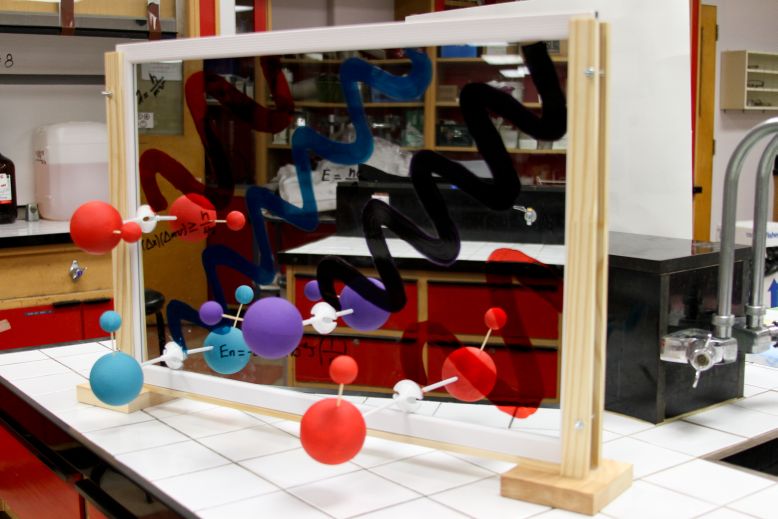



This art project is based on two things: the painting of “Not to be Reproduced” painted by René Magritte in 1937 and the Wave-Particle Duality Principle of Quantum theory. Magritte’s painting depicts a man looking into a mirror. Physics will tell us that the reflection the man will be the front of his body; instead he sees his back while a book on the mantelpiece is correctly reflected. This painting is illogical and does not follow common sense. Quantum theory is the same; it has no room for common sense.
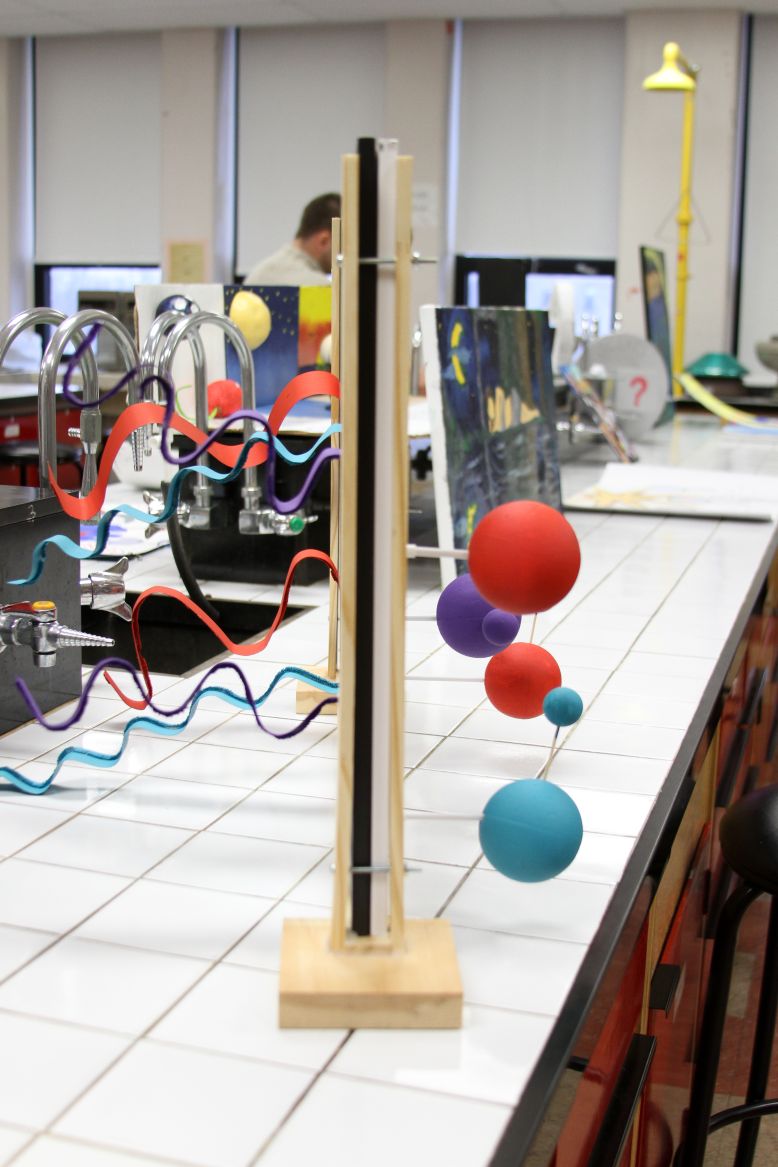
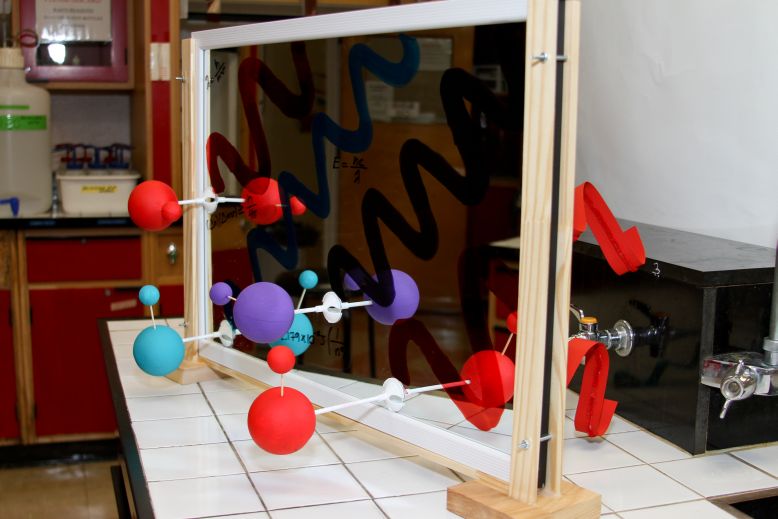
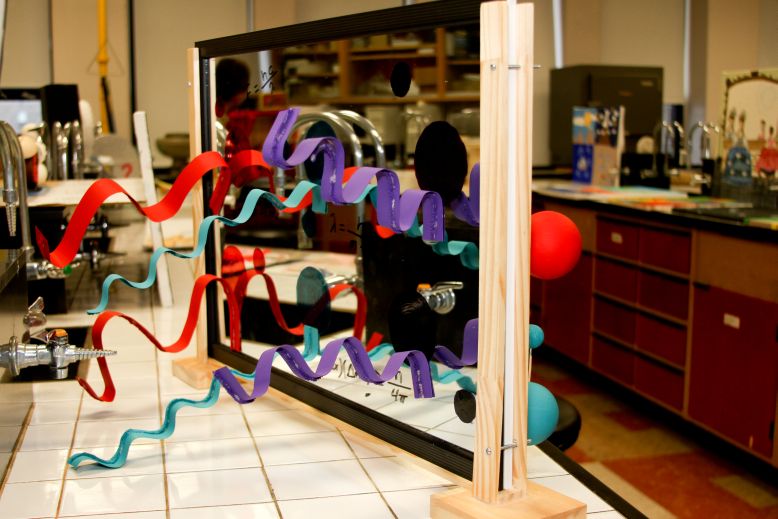
Wave-Particle Duality states that matter has the properties of a particle but also that of a wave, depending on the experiment matter is observed in. This art project consists of two mirrors. One mirror has a white border and the other has a black one. This is to emphasize difference and how an electron can have two different set of properties. On the white-bordered mirror we see hydrogen atoms looking into the mirror. Instead of seeing their reflection we see waves (that are painted on the mirror). On the other side the exact opposite is happening. Waves are going into the mirror and what we see in the reflection is hydrogen atoms (again painted on the mirror).
The reason Magritte’s painting can be so easily connected to Wave-Particle Duality is not the inaccurate reflection of the man but the book on the mantelpiece. The book has a correct reflection. This can be connected to that fact that if we observe the electron during a double slit experiment we see it forming the interference pattern of matter. But if we do not observe we see an wave interference pattern. The book in the painting can be considered the observer.
Even though this is an art project there are some scientific facts present in it. For example if you were to measure the wavelength of the painted waves on the mirror you would see they are closely similar to actual wavelengths of the hydrogen’s emission spectrum by a scale of 1 cm = 50 nm. Due technical limitations and the difficulty of bending aluminum to precise lengths the waves on the black-bordered mirror are not accurate but still red has a longer wavelength then that of violet. Only the colours a hydrogen atom emits were used, that of red, turquoise and violet. The amplitudes are of varying size for each wave to emphasize that the amplitude does not play an important role in the amount of energy a wave has. This is to emphasize Enstein’s Photelectric Effect. Another interesting fact you will see is that the electrons orbiting the hydrogen nucleus have a different radius depending on the colour they are emitting. This is to emphasize that colour emission depends on the amount of energy is emitted which depends on the electron jumping from a higher orbit to a lower one. For the nth energy level the electron is located on, n cm of gap was made between the electron and the nucleus.