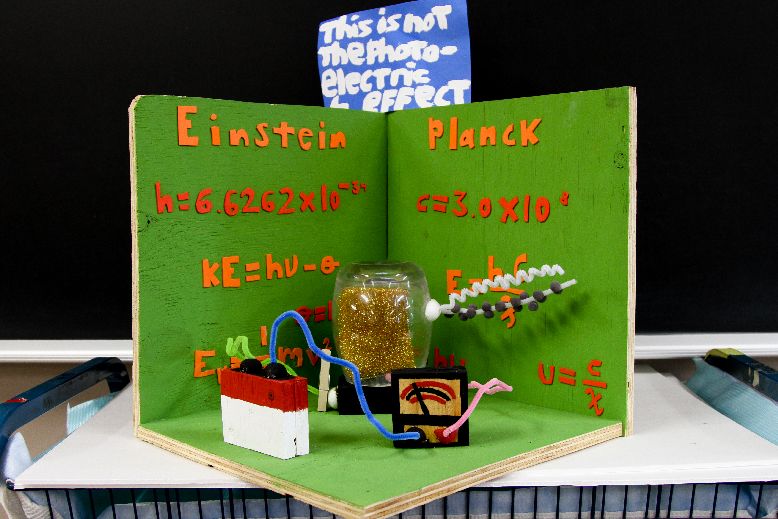


For my art project I chose to look into Einstein's photo-electric effect experiment by creating a wooden model. This experiment is an important aspect to the study of Quantum theory because it demonstrates the wave-particle duality of light. The wave-particle duality of light is the concept that light can act either as a wave or as a particle depending on the experiment being done (based on perception). Quantum theory is so fascinating because of the concepts that it encompasses that the human brain has trouble grasping or imagining; the total defiance of common sense. In order to understand the photo-electric effect, it is necessary to imagine light as a particle known as a photon.
Prior to the discovery of the photo-electric effect, it was thought that light was only a wave whose behaviour was adequately described by classical electromagnetic theory i.e. electric and magnetic fields from light waves propagate through space. This experiment put this classical description into question because it showed that light can also act as group of photons. This experiment was done by shining light of different energy levels (different colors / frequencies) at a given metal. Einstein observed that metals have specific threshold energy that allows for the ejection of an electron. Einstein observed this property in metals; however it applies to all atoms. What this means is that by shining a light at the threshold energy on a given element, an electron can be removed from the atom. Once this threshold energy has been reached, any excess energy (lower wavelengths than the required threshold energy) can be converted into kinetic energy (Ek = hν - φ). This excess kinetic energy will decide the velocity of the ejected electron (Ek = ½ mv2). The higher the amount of excess kinetic energy, the faster the electron will move once it has left the atom. However, if the threshold is not reached, there will be no ejection of electrons or excess kinetic energy.
Einstein realized that the determining factor in this experiment was the energy level (frequency) of the light being shown onto the metal and not the intensity (amplitude) or duration. A metal will not emit electrons if the threshold frequency is not reached even if you increase the intensity of the light (make it brighter) or shine the light at the metal for longer. The intensity and duration of the light wave does not affect the dislodgement of electrons because it simply increases the number of photons hitting the metal. It was this characteristic of the photo-electric effect that defied the classical description of light. If the threshold energy is reached and the intensity of the light is great, then there will be an effect on the number of ejected electrons; the higher the intensity, the greater the number of electrons emitted (given that the threshold energy is reached).
In addition, different metals have different threshold energies or "binding energy of emitted electron" (φ). Although one type of metal will emit electrons with a certain threshold, another metal may not because the threshold is different for different metals. This threshold energy can be applied into many formulas such as Ek = hν - φ and φ = hν where Ek is kinetic energy and hν is energy. These formulas are given on the background of my project. Other formulas that were put on the background of my project include; E = hν, E = hc / λ, Ek = ½ mv2 as well as the speed of light; 3.00 × 10⁸ m/s and Planck's constant; h = 6.6262 × 10⁻³⁴ J·s. These formulas are relevant because they connect wavelengths and also to kinetic energy and they are relevant in the study of wave-particle duality.
I used pieces of wood and different bright colors to give a good visual effect and to create a sturdy project base. On the background of my model, I put a few equations that were relative to this experiment and to the topics that we covered in class to do with the wave-particle duality of light. I wrote Planck and Einstein's names on the background of my project because they are both very important in the study of light its behavior. On the top of my model, there is a title that says "This is not the Photo Electric Effect". I put this as the title to show that perception is important in Quantum Theory. In the study of Quantum theory, sometimes things can act differently based on the type of test being done or based on perception. In this experiment, it is best to picture light as a particle, but in other experiments, it will be necessary to picture light as a wave. The idea of saying "This is not the Photo-Electric Effect" comes from Magritte's art; "Ceci n'est pas une pipe". The reason this is not the photo-electric effect is because it is a representation of the photo-electric effect.
I used a large glass as the evacuated chamber and a gold colored sponge to demonstrate the metal surface that dislodges electrons. To the left of the evacuated chamber there is a clothes hanger that is used to demonstrate the positive terminal. This is connected to a voltage source and then to a current meter. The current meter is then reconnected to the metal surface. There are also two pipe cleaners attached to the large glass evacuated chamber. One pipe cleaner is bent multiple times in the shape of a wave and the other is covered with small cotton balls. These pipe cleaners are there to represent the wave-particle duality of light. Also, the pipe cleaner that represents the wave nature of light is bent many times to show high frequency/high energy. This is because metals can only emit electrons if their threshold is reached and this is usually at higher energy levels (lower frequency light waves). The cotton balls represent the particle nature of light because the cotton balls are representations of photons. These parts represent the different aspects of the photo-electric effect experiment.