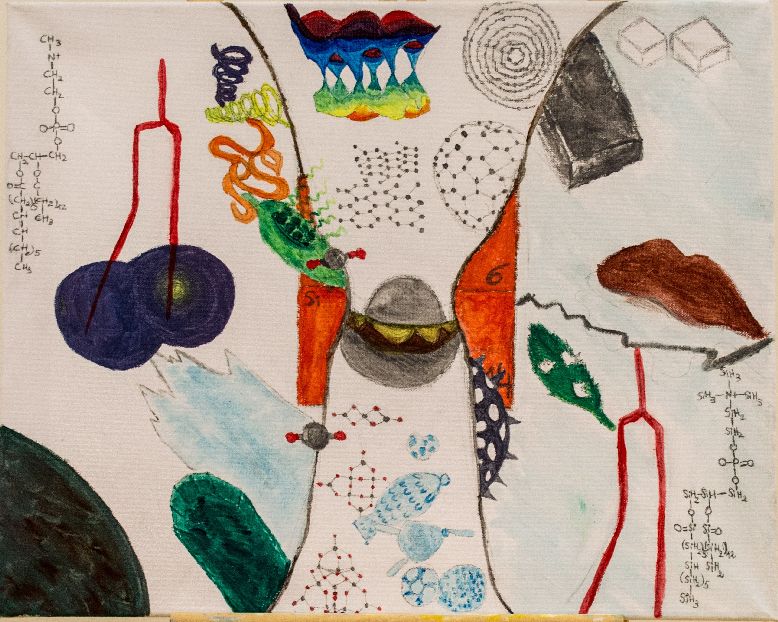


Carbon is a crucial element in the world we live in. It is the basis of the lifeforms on earth. Thus, the idea that matter is made of atoms is expressed. Silicon, which is very similar to carbon, because it is in the same family and only one period lower than carbon, could also be expected to be a component for life. In science fiction, the idea of Silicon-based life is often explored. In real life, however, from what we know, no such life form exists. Why is this so? The answer lies behind periodicity. Although the difference between Carbon and Silicon is only a period away, this has tremendous impacts which differentiate between the living and the inert. In my art project, I have explored this peculiarity by representing the different forms in which carbon and silicon can be found. I separated these two aspects inside an hourglass. At the top of the hourglass, we find carbon and all its possibilities. At the bottom, we find Silicon. Carbon can pass through the hourglass, since it can have all the structures that silicon has due to its periodicity, which, among other things, gives it a smaller size. Silicon, however, cannot have the diverse structures of carbon for the same reasons. I represented this with silicon’s atomic size, which, figuratively, by being bigger doesn’t allow it to reach the top of the hourglass, where Carbon is. When we look at the molecule CO2 and its silicon counterpart SiO2, which prove that molecules (chemical bonds) form when electrons pair, we can see how periodicity affects the state in which components are found. This, by having an effect on the residual forces between molecules. The silicate (SiO2) molecule is bigger in size than CO2; therefore, when it binds with other SiO2 molecules, its bonding, which is through dispersion (London) forces, will be greater than CO2. This explains why SiO2 is usually found in a solid crystalized state like Quartz, while CO2 is in a gas state. This difference is crucial in life, for plants absorb CO2 which floats in the air to use it as a reactant for the important process of photosynthesis. If SiO2 were to be used, plants would not be as abundant since they would have to be in areas where an important quantity of SiO2 is found in the ground in the form crystals. Moreover, us, consumers, would have a different breathing mechanism, instead of breathing out CO2, we would have to expel Crystals. The process of photosynthesis, which is an endothermic reaction, is an excellent example of the conservation of energy. Plants produce their nutrient by using photosynthesis. They are essential for consumer lifeforms, including humans that cannot produce their food. The photosynthesis process is as follows: the energy of light rays is used by plant cells to break down the reactants CO2 and H2O. The products formed are O2 and glucose C6H12O6. The energy released by the reaction is lower than the energy absorbed, making it an endothermic reaction. In this process energy is never gained nor lost it is only transferred. Also, molecular shape is a crucial feature in chemistry, when we look at phospholipids, which are chains of amino-acids composed of carbons, we see that they have a particular form. Phospholipids are what composes the outer layer of cells. They have a bent shape which allows water and other molecules to pass between the cell and its surroundings. Moreover, when we look at carbon and silicon, we see that silicon in SiO2 form binds to other SiO2 in a covalent network which has sp3 hybridization, forming a tetrahedral network. Carbon, however, has more variety it can have a sp3 hybridization, like, for example, with the covalent network forming Diamond, but it also has a trigonal planar sp2 hybridization in the case of graphene. Graphene, with its trigonal planner shape, conducts electricity as this can be seen with Dirac’s electronic band structure which looks like two rainbow colored mountain chains facing each other. With all of these differences, I decided to put on the top right side of my artwork a representation of the behaviors of carbon which resemble those of silicon, for example, solid CO2 at low temperatures, or glassy carbon who has similar proprieties to glass. At the bottom, I have put a hypothetical world where Silicon replaces carbon. I put the process of photosynthesis of plants with crystal SiO2 used instead of CO2 and a silicon based phospholipid. I also put a silicon based lifeform, which was inspired from the series Star Trek. It is dark and undefined to display the uncertainty of its existence. In the middle of my artwork, between the hypothetical and the actual behavior of silicon, I represented protozoa called Radiolaria. This species is the closest thing we have to silicon based life. Its skeleton is composed of silicon and it is believed to be one of the most ancient life forms on earth. This brings me to a theory. It is explained that life possesses a chirality or “handedness”. For example, a right handed molecule of sugar, which is composed of carbon, is a mirror image of a left handed sugar molecule. Life has developed by using only molecules of a specific handedness although carbon based materials can display both. The explanation for this can be found in the hypothesis that life has formed on the surface of silicon components. As silicon possesses only one specific handedness, it may have determined that of life. Hence, silicon could have had a much greater impact on the origin of life than we think. I am not sure about this. What is the specific reference for this theory?
References:
http://en.wikipedia.org/wiki/Phospholipid
http://en.wikipedia.org/wiki/Lipid_bilayer
http://www.answers.com/topic/graphene
http://www.chemguide.co.uk/atoms/structures/giantcov.html
http://en.wikipedia.org/wiki/Silicon_dioxide
http://en.wikipedia.org/wiki/Radiolaria
http://www.thelivingcosmos.com/TheNatureofLife/SiliconVsCarbon_12May06.html