

I have been fascinated by art since I visited the Louvre Museum in Paris when I was fourteen. I think art conveys feelings and memories for a viewer to interpret. In the past, I was too insecure aboutwa my artistic capabilities and never created anything of my own. In the artwork I created in our course, I tried to incorporate my love for history in the piece. I think the various sketches and consultations with the teacher gave me the confidence to create a work to the best of my abilities.
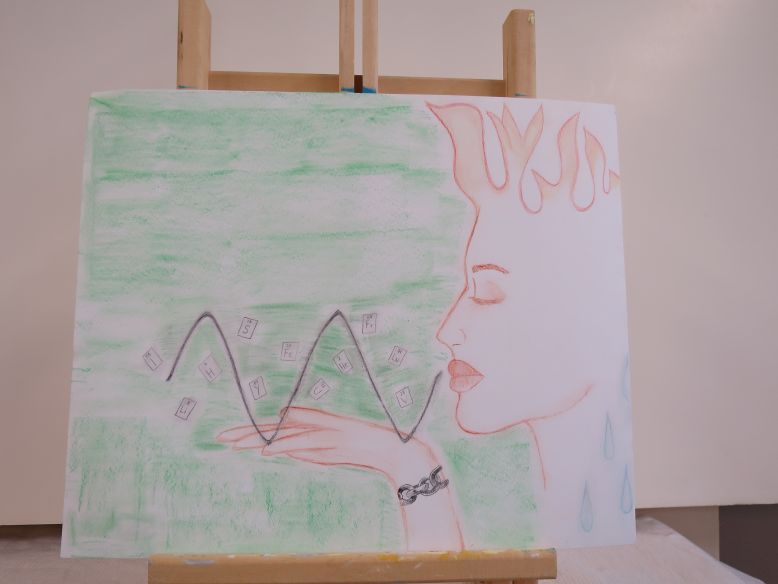
In my piece, I drew the profile of a female face in sepia pencil. I chose a sepia tone instead of a black tone for aesthetic reasons (the black would look too harsh). In addition, the brown colour is meant to symbolize the female’s unity with earth, one of the elements in Aristotelian cosmology. I chose to draw a female figure because in several ancient myths, women are associated with the earth. For example, in the Greek creation myth, the mother of the Titans, Gaia, is associated with earth itself. In addition, the ancients believed man was entwined with the functioning of the universe. Therefore, in my artwork, the female’s flesh represents earth.
Next, I drew the female figure’s hair as flames to represent the element of fire. In addition, I drew water drops on her neck to represent the element of water. Water is a human’s source of life and I wanted to incorporate this in my art. I also drew breath flowing out of her mouth to represent air. At the beginning of the semester, we studied Aristotelian cosmology and I wanted to include this in my artwork. This cosmology was the foundation for all the belief systems proceeding it. As we saw in our course, this is why the Greeks are considered to be the founders of many disciplines such as physics and mathematics.
Next, I drew the female’s hand across the bottom of my artwork, thus representing the transition from Aristotelean cosmology into Newtonian cosmology. I chose to draw a bracelet on her wrist in lead (a metal) to symbolize Newton’s mechanistic perception of the universe. Although he made his discoveries in the seventeenth century, his laws of [j1]dynamics are still studied in physics courses today. In addition, in our modern philosophy class in Liberal Arts, we read fragments of Newton’s works. When we examined his laws in our history of science class this semester, I realized how science and philosophy are connected.
In my artwork, I drew a wave to symbolize the female’s breath. This element of my piece represents modern science and its influence in the twentieth century. However, this element of my artwork simultaneously symbolizes air in Aristotelian cosmology. I purposely made an overlap to demonstrate how ideas, whether it be in science or another discipline, are built upon one another. For example, when we looked at ancient ideas conceived by the Greeks, we sometimes frowned upon certain concepts, such as the notion that the earth is at the center of the universe. My goal was to demonstrate how science is a continuous process and how new ideas are developed from older ones.
I also chose to have some elements of the periodic table flowing out of the female’s breath with the wave. The periodic table is an organization of the chemical elements. I drew random elements flowing out with the wave to represent the feelings of uncertainty that arose in the twentieth century. For example, quantum theory (developed in the twentieth century) is ground-breaking because it shatters our worldview and expectations of the world. In our science course, we discussed how students often expect science to provide all answers to problems and uncertainties of the world. However, certain experiments of the twentieth century proved this to be wrong. Art movements such as Dadaism, Pointillism, Cubism, and many others provide insight into how artists thought reality was a construct of the brain or of society.
Lastly, the breath of the female symbolizes how a scientific discovery can be ‘fragile’. As we saw in our course, one scientific discovery can completely dismantle an older one. This explains the title of my piece, Waving in the Wind. I firmly believe new scientific discoveries are in store for us in the future. I chose the colour green as my background to represent spring, a season associated with new beginnings. I think this is only the beginning of science and that there is much more to come.