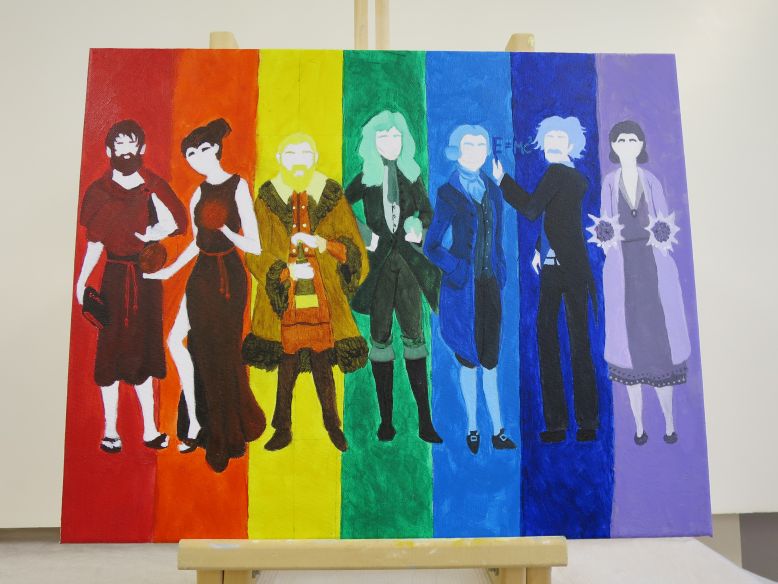


Science as a study is always changing and every generation looks at science in a different way because of new discoveries. It is the different scientists who make these discoveries and allow our views of science to continuously progress. Therefore, my piece depicts a shortened timeline of scientists examined in this class, using the colour spectrum to separate them. Each scientist is depicted monochromatically, meaning with one colour in different shades. Since the colour spectrum has seven main colours, the number of scientists I was able to paint was decreased to only seven. This meant that I had to very careful with which scientists were chosen.
The first scientist, in red, is Aristotle. He is seen in his pose from Raphael’s School of Athens, carrying a book and extending one hand out above the Earth. The fourth scientists, in green, is Isaac Newton, carrying the apple that fell from the tree and sparked some of his revolutionary ideas (such as his three laws of motion) according to the story told about him since his time. The sixth scientist, in dark blue, is Albert Einstein. He is depicted with his famous equation E = mc2 as a symbol to represent him and allow the viewer to see a large contribution of his. These three had to be within my painting as they are kind of the mascots of three very different periods in history for science. The Aristotelian view had the Earth in the centre of the limited universe for their cosmology and (much later) religion had power over the scientific advancements, making progress difficult. The Newtonian view had a heliocentric model for their cosmology and signifies a time where everything required complete certainty. The current view, that Einstein is seen to represent in this class, is a heliocentric unlimited cosmos and uncertainty is an integral part of science.
Hypatia is the second scientist, seen in orange. I thought Hypatia was a crucial character for this painting. To begin, she was the main focus of one of our first classes and remained highly relevant until the first journal. She was still mentioned after the journal, but it would be impossible to not mention her when describing the classes prior. She also realized that a heliocentric model was plausible,[j1] which is why she is seen with the Sun in one hand and the Earth in the other, contemplating their position. She is a prime example of the Aristotelian world shutting down people who are not of the major religions and is killed for her strong beliefs and independence. Galileo Galilei is seen beside her in yellow, a transition from Hypatia contemplating the cosmos to a man known for looking up at them. I depict him with his telescope as a symbol for him. Others could have been put in his place, such as Tycho Brahe who came prior, but I thought Galileo would be more recognizable so he was chosen.
In light blue is Antoine Lavoisier, who discovered the conservation of matter. Although matter can change its form and state, its weight will remain the same. I found his story as a tax collector just before and during the French Revolution to be really interesting. It was also interesting to see the help his wife gave him and, if the canvas’ dimensions did not restrict the number of people being represented, she would have been included with him. The final scientist, in violet, is Lise Meitner. She holds two nuclei, having just split one in half. Meitner overcame many obstacles in her discoveries as a woman of Jewish faith during the Second World War. She is depicted in violet which means the colour spectrum is reversed. This was done since ultra violet rays have more energy than infrared ones and the scientists who came later on chronologically made discoveries involving the creation of more and more energy. Therefore, I thought reversing it for the chronology was justifiable.