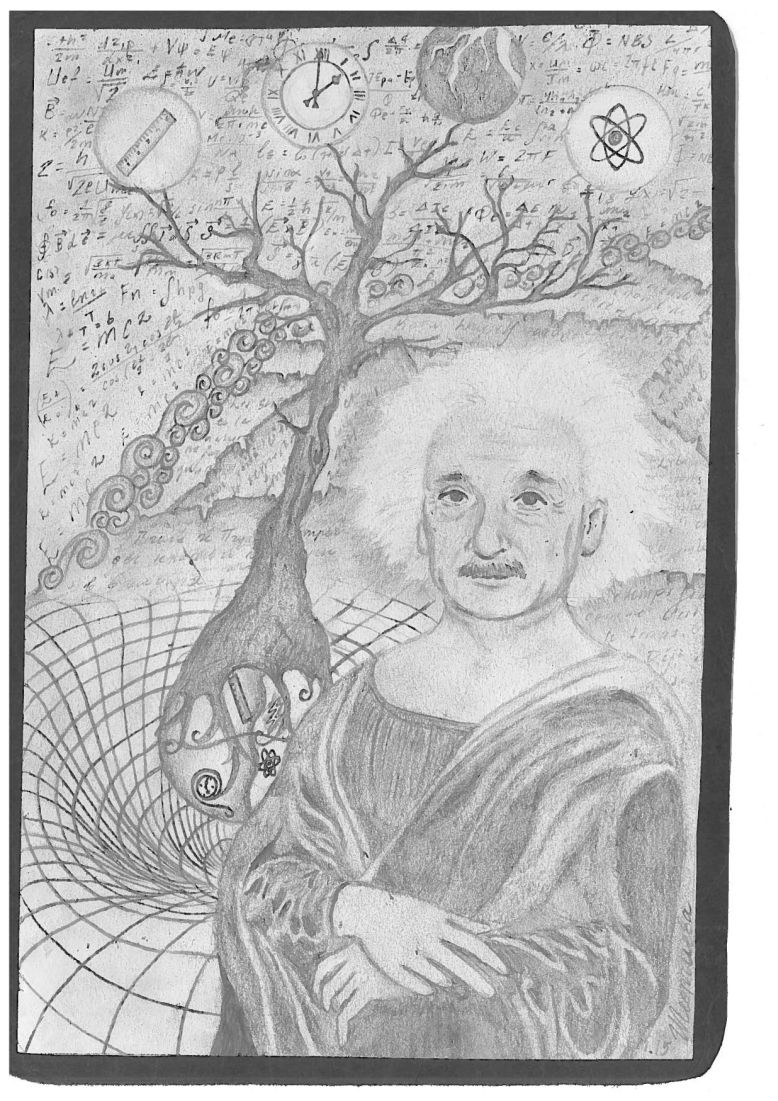


Albert Einstein was one of the most influential and important scientist in the History of Science. He turned everything upside down by asserting that only the speed of light is constant in all frames of reference. He also strongly contributed to the quantum theory by demonstrating that light is not simply a wave: it is actually made out of particles called photons. In 1915, Einstein came up with his general theory of relativity, declaring that space, time, energy, and matter were dependent and closely linked one to another. Modern physics are essentially based on this theory.
My artwork was produced with led pencils. I find that the countless shades of gray produced by such a medium blend in harmoniously and allow one to create a artwork filled with nuances. Also, the original pictures of Einstein are black and white. When we imagine Einstein, we see him in black and white. Furthermore, black and white represent ancient times. The “old ways” are also represented by the separation of space, time, energy, and matter. This way of depicting these elements refers to the Newtonian view. Newton argued that they were absolutely separate and independent. I wanted to represent both ancient and modern times. Modern times are represented by Einstein himself, the depiction of his theories and his formulas written in the background.
I was particularly interested in the blending arts and science together. They are usually seen as rather opposite: art represents creativity and imagination, whereas science represents knowledge and rationality. I wanted to demonstrate that they can be beautifully mixed together. This is why I chose to draw Einstein's head on the body of da Vinci's Mona Lisa. Mona Lisa is one the most well-known paintings. I found it interesting to merge one of the most famous scientist with one of the most renown artworks. Also, Einstein's visage and Mona Lisa's robe are visually interesting.
The background of the lower half of the drawing represents Einstein's theory of space-time curvature. Space is represented as a fabric, which bends under the weight of the planet. Thus, the bending would be more important when a planet had an important mass. This idea would explain gravity. Einstein argued that the mass of the object (i.e. the planet) would bend space when it was quite important (such as a planet's). The planet itself represents Einstein's theory of relativity. A tree takes root on this sphere. The tree itself represents knowledge, and is a nod to Newton, since the story goes that he discovered gravity after an apple fell on his head from an apple tree. The upper background is composed of a multitude of Einstein's formulas. They are meant to create an aesthetic effect, and to demonstrate the genius of Einstein (they are quite complicated, and very numerous).
Finally, I put old pieces of paper to represent our class, and the knowledge we earned this semester. We have seen “ancient” science, as well as more modern science. The old-looking paper is meant to represent that science is not only a modern field.