

In the late 19th century, the rise of the modernist movement revolutionized all aspects of life. The idea behind the movement was to introduce new methods and philosophies, different from the past. This change was not limited to traditional forms of art turning toward abstract and surrealism but extended even to sciences. Max Planck, a German physicist, was discouraged by his professor to pursue his studies in physics because everything that needed to be discovered was supposedly already discovered. At the turn of the 20th century, his discoveries of Planck’s constant and the quanta energy renounced principles in classical physics, in this way Max Planck revolutionized science.
The general idea of my artwork is based on Max Planck and his initiation of the quantum theory. My artwork, Chemistry’s Box, a reference to Pandora’s Box, acts as a metaphor to Planck’s story when people thought of sciences as something familiar and containable in a box. However, when Pandora opened the box, all the evil of the world was unleashed, when Max Planck opened the box with the introduction of his constant and the quantization of energy, he opened the chemistry door that unleashed all the unknowns and mysteries in this field.
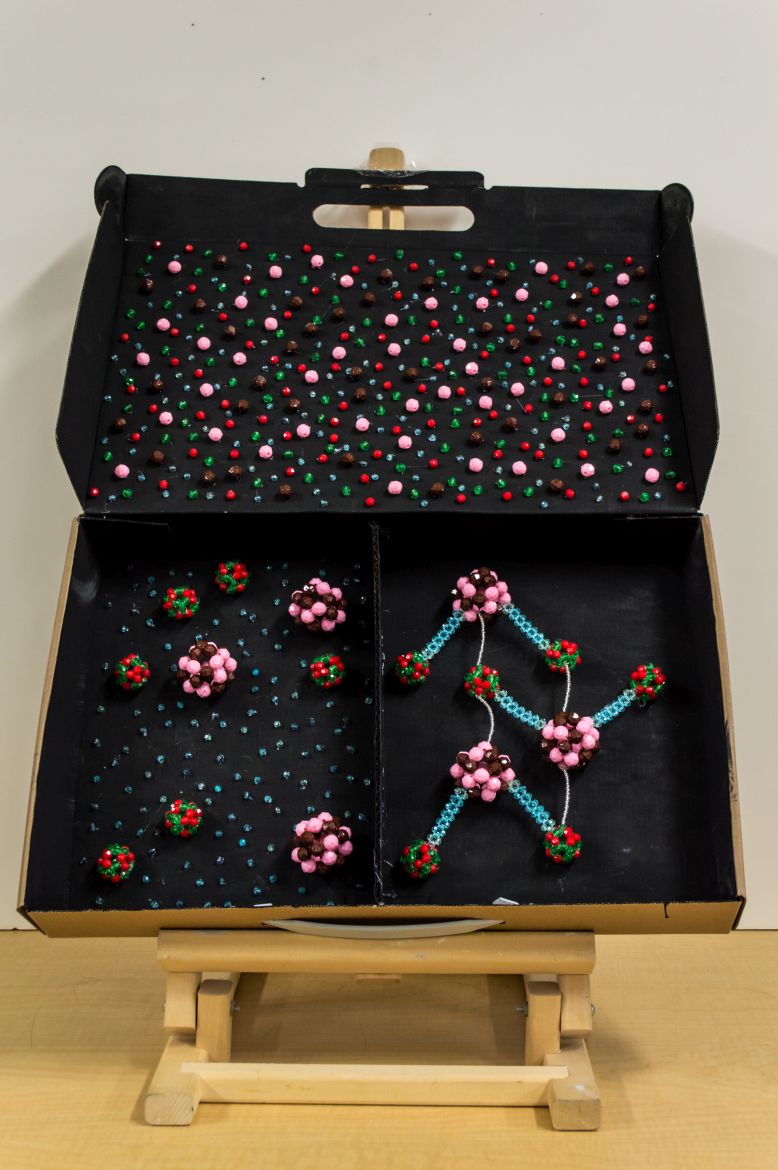
When my artwork is opened, there are two flaps showing a hydrogen bond. The flaps are the perfect size, exactly fitting the box, just as there is a precise bond length for a hydrogen bond at which the system has minimum energy. If the hydrogen atoms were any closer, there would be repulsion and if it were any further, they would be less stable as their energy would be higher. This is associated to idea #2 being “elements display periodicity” because elements in the same period seek to achieve an octet, a dual octet for hydrogen, in order to resemble the noble gas of their period. I chose hydrogen because it is an exception to the general periodic trends as it is found both on the left and right sides of the periodic table and has an abnormally high electronegativity value.
Once the flaps are opened, this represents breaking the hydrogen bond. When bonds are broken, energy is absorbed therefore it is an endothermic process. This can be associated to idea #6 where “energy is conserved.” Just as energy was released when a hydrogen bond forms initially, energy is also absorbed when bonds are broken, therefore energy is conserved.
Inside the box, two marbles can be seen. These two marbles represent how the hydrogen bond is bonded by the pairing of two electrons relating to idea #3 which states “chemical bonds form when electrons pair. The two hydrogen atoms share their electrons in which they become a pair and hence, achieve a dual octet.
Lastly, to illustrate idea #1, when an electron is ionized, it must be provided with quantized energy. This energy is released in the form of light creating an atomic emission spectrum, a set of emission lines specific to each element. When the pieces of cardboard are pulled out, since the box is divided in two equal parts where each part represents one hydrogen atom, each part is subdivided into four, corresponding to the four hydrogen emission lines. The first pullout is the transition from n=6 to n=2 painted in violet, the second, from n=5 to n=2 painted in blue-violet, the third from n=4 to n=2, painted in turquoise and finally the last from n=3 to n=2, painted in red. The length in each pullout decreases in accordance to the amount of energy released. As well, the height of each pullout increases as there is disparity between energy level transitions. Once all emission lines are pulled out, the atomic spectrum can be seen and the marble (electron) can jump up each step to eventually make its way out of the box representing its ionization. Moreover, each pullout requires a specific amount of energy provided by you to pull it out and the specific length and height of the pullout show how energy is quantized. The reason I chose a marble symbolizes the wave-particle duality. The particle-like characteristics of an electron is represented by the marble and its wave-like properties are demonstrated by its emission lines.
Chemistry’s box conveys the emotion and confusion commonly associated to modern chemistry like quantum theory because of the difficulty for people to conceive ideas of the sort. Since all these concepts are so abstracted and hard to devise, once the Chemistry’s box is opened, you are about to venture into the chemistry world and its complexities.