

Dihydrogen monoxide. One most likely would not identify it as the liquid making up 60% of our composition. Dihydrogen monoxide is a transparent fluid and is the main constituent of planet earth; it is vital to all living organisms. 71% of earth’s surface is engulfed by this chemical compound and it makes up 96.5% of the seas and oceans. Dihydrogen monoxide is one of the only chemical compounds known to have the extraordinary feature of expanding when undergoing freezing. Consequently, its solid state floats in its own liquid state. The cycle of life depends upon this compound since every living organism needs it to ensure survival. Dihydrogen monoxide is in continuous motion through a hydrologic cycle, allowing the liquid to roam freely amongst earth’s surface and atmosphere. The cycle commences with the evaporation of dihydrogen monoxide from oceans and proceeds with condensation, which gives us the clouds. The compound then precipitates onto terrestrial or aquatic surfaces and flows back to the primitive bodies of liquid – composed mostly of dihydrogen monoxide – is then re-evaporated. Additionally, dihydrogen monoxide may be released from soil through the process of evapotranspiration: plant evaporation and transpiration. A pattern emerges: dihydrogen monoxide is primordial to the functioning of our planet as with everything that surrounds us and makes us. The goal of my artwork is to emphasize the role of this vital compound in the germination of life. The intended effect is to bring sensibility and appreciation to its vast implications through the use of Peter Atkins big ideas in chemistry.
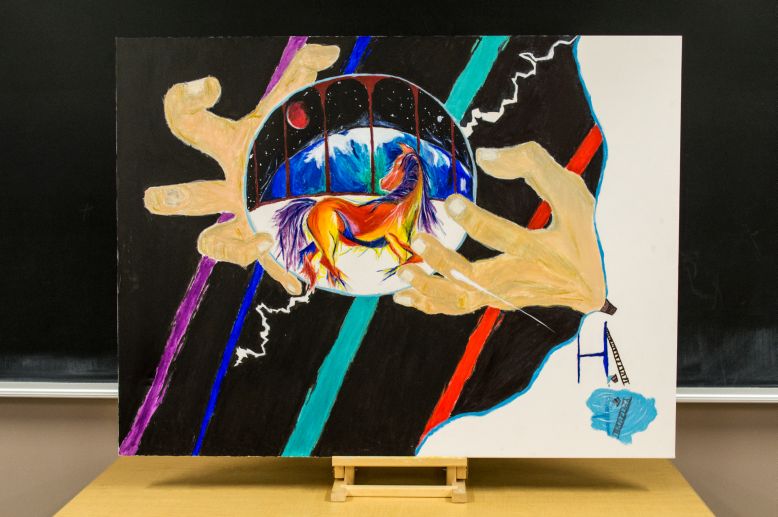
Matter is made up of atoms; Hydrogen, an element that is solely made up of one atom, is explicitly demonstrated using its atomic symbol “H”. It figures at the bottom right hand corner of my artwork, and is the starting focal point as nothing but white surrounds the element. Hydrogen represents simplicity, which expands into the diversity and complexity of the rest of the artwork. The H has a ladder resting on its side, and a bucket of dihydrogen monoxide is splashed about its left side and explodes into a collage of life, forms, and big ideas. The mirage, created using Hydrogen, expresses that the universe started as a particle and expanded in multiplying degrees of complexity, as different possibilities of endless particle combinations arose. This led to the atom: the building block of matter. Following this, the splash of dihydrogen monoxide transfigures itself into its own molecule. The center, symbolizing the oxygen atom, lies at the heart of my artwork. A comet tends to the oxygen, representing the chemical bond between Hydrogen and oxygen. The second big idea – elements display periodicity – is portrayed as the comet tends to the most electronegative element: oxygen. As oxygen is more electronegative than hydrogen, it attracts the negative charge, the electrons within the bond, towards its positive center. The molecule is polarized due to its geometrically bent structure, a feature clearly demonstrated in my artwork. The structure is caused by the distribution of electrons amongst the molecule. Since oxygen has two lone pairs, they repulse hydrogen in such a way to maximize the distance between the two elements. The valence shell electron repulsion factor allows for the positive and negative charges to be distinguished separately and thus create a dipole moment. The former is a relation to Peter Atkins fourth big idea; molecular shape is a crucial feature in chemistry.
Dihydrogen monoxide is the bearer of the hydrogen bonding intermolecular force since it is composed of two hydrogens and one oxygen. Choosing the dihydrogen monoxide molecule as the structure to my artwork brings in the fifth big idea, there are residual forces between molecules. The intermolecular force of Hydrogen bonding explains the phenomenon of its solid state floating in its own liquid state. Crystalline structures are formed when dihydrogen monoxide freezes and are maintained through hydrogen bonding. Usually, when temperatures are dropped and liquids solidify, the kinetic energy is lowered and thus molecules come closer together resulting in an increase of the density of the solid. Ironically for dihydrogen monoxide, the orientation of the hydrogen bonds causes its molecules to expulse themselves further apart and thus lowering density.
Furthermore, on the bottom right hand side of the oxygen atom we can see a lightning rod in the direction of the other hydrogen atom. This particular hydrogen atom is represented through hydrogen’s emission spectrum. Lightning was chosen to signify the bond because a significant source of energy is needed to excite the electrons in the hydrogen atom for there to be an emission of light. When an atom receives energy, the electrons get excited and jump to higher levels. As the electrons go back to their ground state, they jump down levels, which releases energy in the form of electromagnetic radiation. Some radiation may fall within the visible light spectrum of electromagnetic radiation and allow us to see an array of visible wavelengths. This concept can demonstrate the third idea: chemical bonds form when electrons pair, as the bonds are shown between oxygen and hydrogen.
In addition to Atkins big ideas, there are philosophical implications to my art. All life forms lie within the center of my artwork, in the oxygen atom. The horse was painted with vibrant colours and a loose form. The legs of the horse and the face are undistinguished which is meant to be representative of all life forms other than man. The horse overlooking planet earth is behind bars that are separating it from the universe. These bars represent all life forms, which are thought to have no self-awareness, inability to create intellectual reasoning of life. The horse appears to be in motion and is curiously and passively glancing over what lies on the other side. This expresses an ability to just be; they do not need to know why they are, as man does. The hands that envelop the oxygen molecule represent man, in his attempt to grasp Truth. The hands are trying to master all life forms by seizing, which turns into a form of control. The hands will never touch the oxygen, just as man has never seen the atom directly, and just as science is always shrouded in uncertainty. This is similar to the wave-particle duality of light: a phenomenon science still cannot make sense of. As a final note, the artwork is contained around the big idea that energy is conserved. The explosion of dihydrogen monoxide creates the central image as the central image emits a spectrum that sheds light back onto the same central image. The various elements of the artwork are interconnected with Peter Atkins’ big ideas in chemistry and through man’s nature, and that of living organisms.
If water were to be presented in this form, described as being the liquid that has brought us to existence, would one treat it preciously? Would one further dismiss its importance once its formal name is unveiled? Water was the start of life, as it is the perfect condition for it to flourish. Without the solvent of life, man is nothing.
Sources:
1. http://en.wikipedia.org/wiki/Water Retrieved: December 7, 2014
2. http://physics.stackexchange.com/questions/72841/besides-water-which-substances-are-less-dense-as-solids-than-as-liquids Retrieved: December 7, 2014
3. http://en.wikipedia.org/wiki/Dihydrogen_monoxide_hoax Retrieved: December 12 2014
4. http://water.usgs.gov/edu/propertyyou.html Retrieved: December 10 2014
5. https://www.ec.gc.ca/eau-water/default.asp?lang=En&n=23CEC266-1 Retrieved: December 9 2014
6. https://www.boundless.com/physiology/textbooks/boundless-anatomy-and-physiology-textbook/general-chemistry-2/inorganic-compounds-38/ice-floats-on-water-308-11415/ Retrieved: December 13 2014