

“The greatest scientists are artists as well. Imagination is more important than knowledge. For knowledge is limited whereas imagination embraces the entire world.” - Albert Einstein
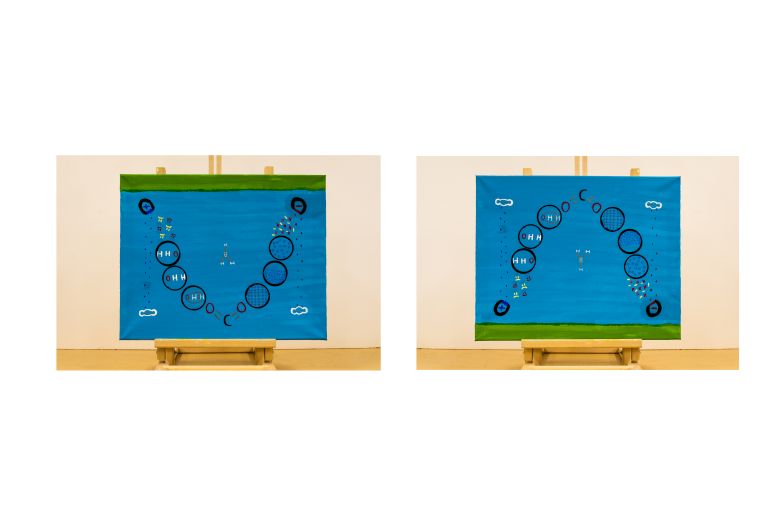
Albert Einstein, Isaac Newton, Galileo Galilei, just to name a few, pioneered different methods of visualizing sciences and mathematics. Thus, I decided to combine art, science and philosophy in my art project. My painting goes above and beyond what one would expect from a paintbrush. Hence, I conveyed six of Atkins’ Big Ideas in chemistry by contrasting concepts in my art piece. When the latter is flipped 180 degrees, one can observe a joker face smiling at them.
First and foremost, my simple landscape background is considered my canvas. Being that, it serves as a visual support to enhance significant elements of my work, such as the Big Ideas. Furthermore, I portrayed one reaction that releases energy, exothermic, by light and heat. Hence, I chose a red negative sign to represent that release in energy. On one side, there are photons that are being emitted from the exothermic reaction towards the cloud. However, the artistic cloud has a metal installed in it. For this reason, one can observe the photoelectric effect granted that the frequency is higher than the threshold required. In fact, the ratio: one photon releases one electron, is disturbed in the second half of the painting. On the other side, the blue electrons released from the absurd cloud are then absorbed by the endothermic reaction. I specifically chose a positive blue sign to illustrate absorptions, because of the associations related to the color blue, such as the cold. In fact one of the Atkins’s Big Ideas is conservation of energy and it is demonstrated by this perfectly imperfect cycle. Also, flipped 180°, it looks like the joker is crying. Indeed, BH3 is used to contrast the different concepts in my artwork. Due to the fact that boron can express an exception to Octet Rule (less than octet), it is used to separate those ideas portrayed on my canvas. BH3 has three chemical bonds in total, so that the V.S.E.P.R. model is used to structure molecules in order to minimize electron-pair repulsion. In consequence, the fourth concept “molecular shape is a crucial feature in chemistry,” is illustrated such that when my canvas is turned upside down, boron looks like a nose and that CO2, with an unusual bent molecular shape, looks like lips. By the same token, another Big Idea is “matter is made of atoms”. With regards to the colors used for each atom, I respected the CPK coloring color convention and tried to use symmetric lettered atoms, such that no matter the landscape position of the canvas the letters are read the same.
Moreover, one can observe the four states of matter: plasma, gas, liquid and solid. For the simple reason that intermolecular forces between molecules, also known as the fifth Big Idea in chemistry, determines the physical state of a substance under specific conditions of temperature and pressure. For example, residual forces for ice molecules, solid, are stronger than the forces in liquid water molecules. What is important to highlight, is that my choice of H2O is based on the molecule’s unusual properties. This is due to H-bonding, which is the reason why water has a high boiling point and that its density of its liquid state is higher than of its solid state. In addition, the third idea is that “chemical bonds are formed when electrons pair”. The bonds formed between the different atoms for each state portray this. In order to clearly showcase that concept, I added more shared bonds between the atoms when chemical bonds are stronger. For example, in the solid state, I painted an unusual triple bond between hydrogen atoms and a double bond between hydrogen and oxygen. Not to forget the use of hydrogen as the center atom, I wanted to plainly demonstrate periodicity trends, such as electronegativity with the unexpected Lewis structure of H-H-O.
In conclusion, I took Einstein’s wise words into consideration to create a chemically, artistically and philosophical piece. What is noteworthy, is that I only used a paintbrush and paint to illustrate the first six Big Ideas in chemistry purposed by Atkins.