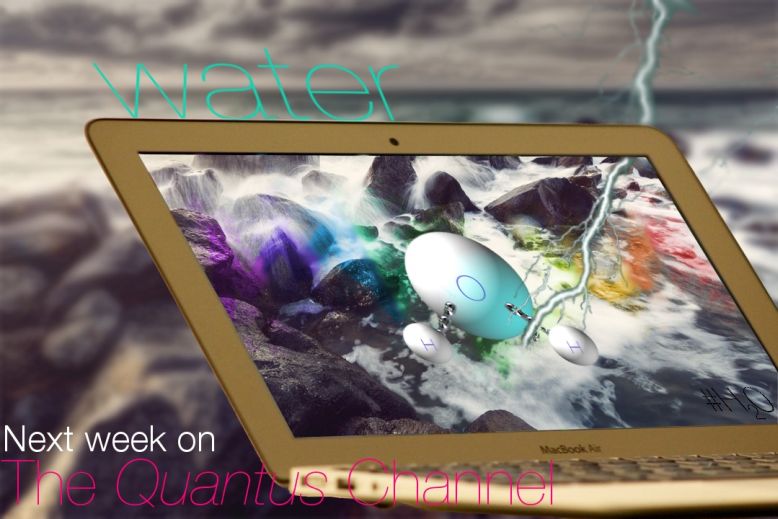


H2O is a marvellous substance. It is essential to life. This molecule has a spectacular abundance on Earth. Going over its interesting properties as a liquid, I questioned the reasons behind its perfection. Within the same train of thoughts, my mind wondered about its relation with the abstract notion of quantum in chemistry. Indeed, my artwork incorporates both of these themes into one big picture.
As we know, the water molecule is composed of two hydrogen atoms and one oxygen atom. Even though this is basic, it’s the fundamental base of chemistry. Matter is made of atoms is one of Atkins’s big ideas in chemistry. The idea of elements displaying periodicity is present in the artwork. Water would not keep its same properties if the bonds were between hydrogen and nitrogen. The representation would change as elements showcase periodicity. Like with every other molecule, water’s shape is classified. H2O has four domains, including two bonds and two lone pairs. Repulsion will happen if the electrons are not placed in a specific way. The goal for every non-bonded electron pair is to minimize the repulsion between themselves as the VSEPR concept states. Thus, water will form into a tetrahedral arrangement of electron pairs, in this case it’s called bent. Shared electron pairs form an angle of 105° between themselves in this shape. The subject is related to Atkins’s chemical bonds form when electrons pair and molecular shape is a crucial feature in chemistry ideas. In addition, water is known for having the strongest interaction force between its molecules. In fact, hydrogen bonding is what keeps water liquid at 25 °C as it is a very strong force attracting the hydrogen atom of another H2O to the Oxygen atom. Atkins recognizes this idea: There are residual forces between molecules. Before linking water and quantum together, let’s review quantum’s important facts first.
Quantum mechanics created its first sparks with Max Planck’s discovery of quantized energy. He found out the change of energy is equal to an integer times a constant times the frequency of the light. Einstein provided much information. He showed energy of a photon is equal to Planck’s constant times the speed of light divided by the wavelength. The photoelectric effect further developed quantum as it ultimately proved energy and mass are not distinct but dependant on each other. This is also true for mass and wavelength. Thus, light showcases duality. It can be a wave and a particle. Notions of quantum appear in my artwork integrated with water as a molecule.
Finally, water and quantum find harmony in my creation. Water or any matter, in fact, emits waves. De Broglie argued about this with his formula. This is represented by the visible range of colours seen on the computer screen. Notice how we cannot see any other colours outside the display. This refers to the presence of imperceptible waves in real life, the computer screen acts as a magnifier. The display is playing with light to show us colours because it uses a polarizer known for blocking certain waves. Therefore, the screen can improve the colours (and acts as a magnifier to show the structure of water). It is related to quantum (waves and particles). The addition of a lightning hints at a bond breaking (between oxygen and hydrogen). A playful reference to the energy transferred by light to break these strong bonds.
The goal of this artwork was to emphasize the relationships between multiple concepts and ideas in the realm of chemistry, but not only limited to it. Before quantum was recognized, water was only considered to be only but particles. Energy had its own relationship with waves. Thankfully, quantum mechanics brought a forced marriage between particles and waves. Successfully joining two big ideas into one powerful family. To conclude, showcasing water with quantum via art is an achievable task.