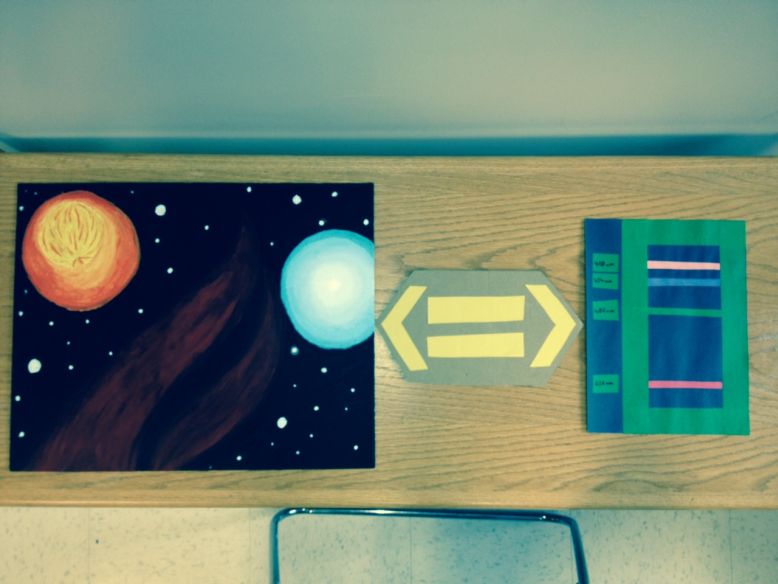


Out in space, no one can hear you scream because there is no air, and thus, no medium, through which sound can perpetuate. However, that which can travel through empty space, visible light, is capable of creating a wonderful portrait of glowing stars, planets, nebulae and all other sorts of celestial bodies. Since the dawn of our existence, man has looked up at the night sky with wonder and curiosity that is characteristic of the human nature. We’ve wanted to know what’s out there, what makes a star glow so brightly and what it might be made of. Now, with all our technological advances, we’ve come to know a great deal about the many types of occupants of the vast universe surrounding us. The way we’ve come to know what we do all comes down to light and how we’ve explored its inner workings through scientific advances. My project attempts to bring to light the way science depicts the night sky.
Peter Atkins wrote that there are nine core concepts of chemistry, one of them being that matter is composed of atoms. That idea must hold true, for without it, chemistry cannot exist. This idea is what explains the existence of light, at least in part anyway, and is one of the few big ideas explored in my project. Atoms consist partly of electrons. When an atom is exposed to energy, its electron(s) will go into what is known as an excited state, where it has absorbed energy. Electrons, however, tend to try to return to a less excited state, essentially their ground state. To do this, though, adhering to another one of Atkins’ big ideas, the electron must lose energy to become less excited, so as to follow the idea that energy is neither lost nor created but only transformed, so it emits that lost energy as light, or more specifically a photon. In a star, various elements which compose the star are exposed to energy in this same way, so the light emitted by stars is produced form the elements that compose the star. We are able to analyse the wavelengths of each type of photon produced by a star. Each element produces different photons, whose combination of wavelengths is unique to only that element. From knowing this “signature”, what is called the atomic emission spectrum of an element, shown by the light of a star, we can known which elements are present in that star. So, essentially, light, and therefore pictures, entire portraits in the sky, can be reduced to a few lines coupled with some numbers. That is the irony my project addresses, showing that a portrait of what I think is a beautiful picture of space is the equivalent of a few lines that are the atomic emission spectra of elements.
In my project, I chose to use the visible atomic emission spectrum of Hydrogen. This was to address another of the big ideas of chemistry that is the notion that elements display periodicity, or periodic properties. Hydrogen is said to make up approximately 92% of the known universe. Helium makes up 7%, and the remaining 1% encompasses the rest of the elements on the periodic table. This is all because, as you go from hydrogen to iron to xenon to uranium, the elements get more and more complex. Since hydrogen is the simplest element of them all, it is the easiest to find in the universe. Helium is the second simplest element, so it’s the second easiest to find and so on. This shows that the elements of the periodic table aren’t just put randomly on the table, they all display periodic properties and are thusly organized.
Another special characteristic that space holds is the fact that it isn’t Earth. On Earth, there are limitations to what molecules can exist, due to limited amounts of energy, or a lack of the proper conditions for formation. On Earth, though it’s true that electrons in atoms must pair for a chemical bonds to form, one of Atkins’ big ideas in chemistry, this isn’t the only condition for molecules to be able to form. In space, however, the rules change a bit, because it’s a completely different world out there, full of different environments. It has actually been proven that there are molecular species that exist in space that can’t be present on Earth, notably molecular ions. Examples include HC3NH+, H2COH+ and HCNH+ †. So, just by incorporating the theme of space in my project, I managed to touch on as deep a subject as this.
†http://www.chem.yorku.ca/profs/bohme/refs/07020911540610151.pdf