

Liquid water is a substance that seems so simple to the eye, but when observed and analyzed at a microscopic level it is very complex and important to understand. A molecule of water, more specifically H2O, is one of the many of molecules contained in visible water. It is made up of the elements hydrogen and oxygen. Two hydrogen atoms and one oxygen atom come together to form a covalent bond with their respective amount of valence electrons. This phenomenon explores the ideas of atoms existing in matter, periodicity, chemical bonds forming when electrons pair, molecular shape, and residual forces between molecules. All these ideas must be kept in mind when portraying the subject in an artistic form.
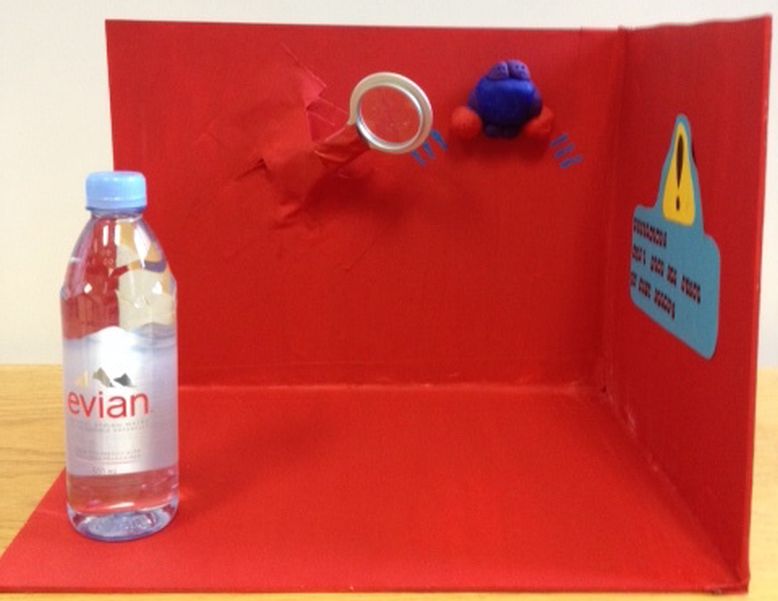
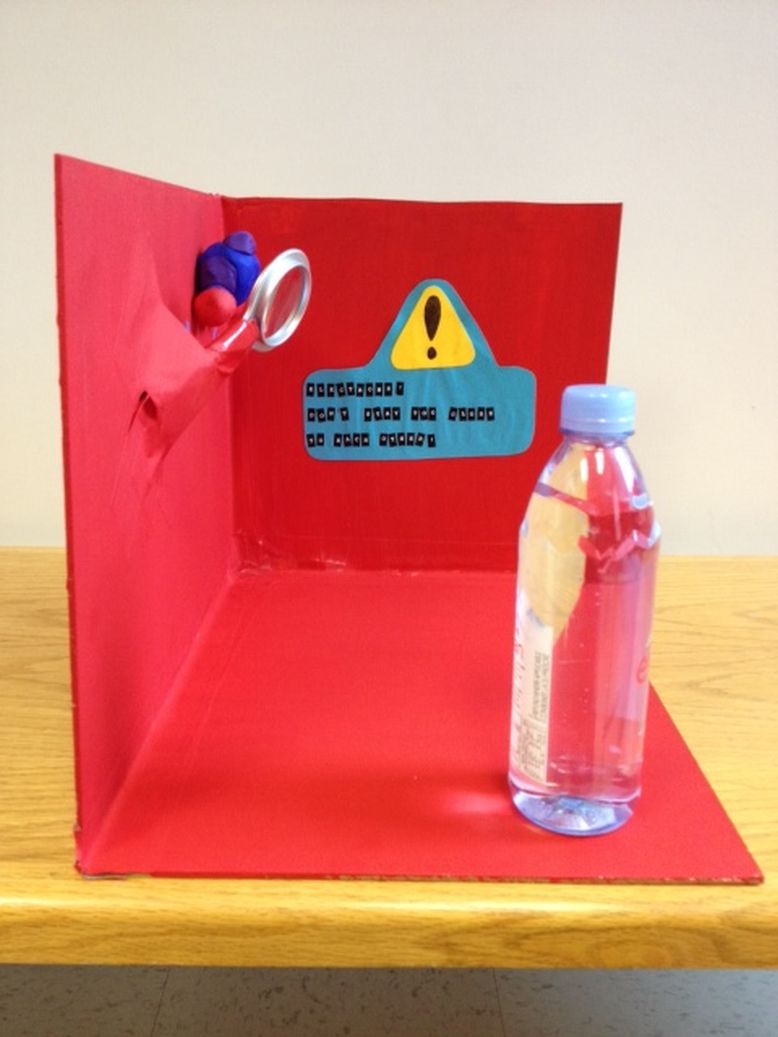
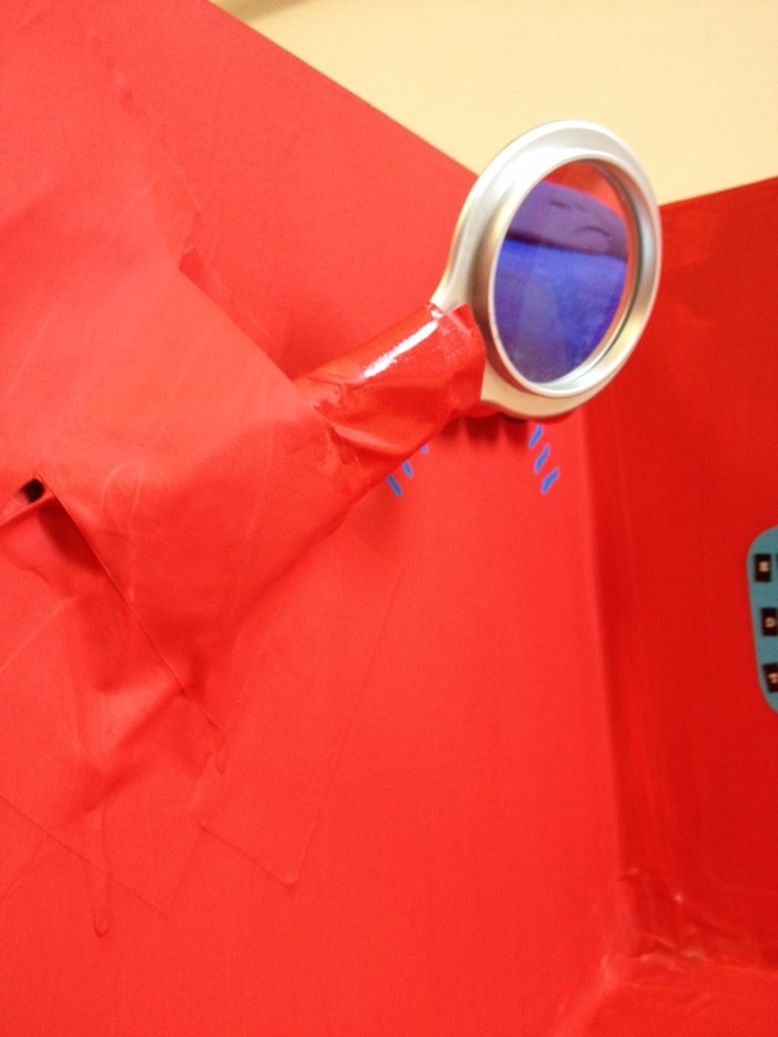
It is important to be sure that my art project exposes how matter is made of atoms as water is not just simply liquid. In order to do this, I placed a magnifying glass between the water bottle and the molecular model made of atoms which shows how when water is observed to the core, it is actually made up of atoms. For simplicity, I used Dalton's model to describe the atoms contained in the molecular model.
The bonds created between these atoms are dependent on the periodicity of the elements contained in the molecule. The periodicity of the elements display the amount of valence electrons each atom has which is crucial for satisfying the octet rule. The octet rule is when all the atoms of a molecule have a complete amount of electrons on the valence orbital when bonded with each other. Oxygen, an element in the 6A group, contains 6 valence electrons as defined by its group classification on the periodic table. The octet rule is satisfied when the oxygen atom bonds with two hydrogen atoms which each have 1 valence electrons as they belong to the group 1A. The way that the atoms bond depend on the way that they satisfy the octet rule. The atoms could either share electrons or lose or gain electrons depending on the amount of valence electrons they possess. In this case, for the octet rule to be satisfied, the oxygen must have 2 more valence electrons and the two hydrogen atoms must each have an extra valence electron. This only works if electrons pair up to form covalent bonds between the atoms of the molecule. This is also a concept that involves chemical bonds forming when electrons pair.
In order to determine between what atoms these covalent bonds exist, one must explore the factors that affect the molecular shape of the molecule. These factors include the elements' periodicity as observed previously, the amount of lone pairs, and atomic size. The valence electrons of each atom determines where it is placed as it must satisfy the bonded atom according to the octet rule. Oxygen can only have 8 valence electrons if it shares a covalent bond with 2 hydrogen atoms at both ends. The hydrogen atoms will also have full valence orbitals as they only need 2 electrons each to satisfy the octet rule. Therefore oxygen, an atom with 6 valence electrons, gains 2 electrons and each hydrogen atom gains one valence electron. All the atoms of the molecule mutually gain valence electrons in this covalent bonding. Now that the position of all 3 atoms are recognized, one must find the angle between them using the amount of lone pairs. Knowing that the H2O molecule has 8 valence electrons altogether and that there are two covalent bonds, the amount of lone pairs can be found by subtracting the 4 shared electrons from the total amount of valence electrons. Since there are 4 lone pairs in this molecule, the angle between the two covalent bonds must be 105˚ in order to best prevent repulsion. The name of this molecular shape is bent because there are 2 domains and 4 lone pairs. This is why the molecular demonstration of H2O has a bent shape in my artwork. There also a warning poster I incorporated into my artwork warning the electrons to not get to close to each other for the purpose of showing how preventing repulsion is one of the priorities when talking about the bonding in molecules. I also chose to make the oxygen atomic sphere larger than that of hydrogen because the atomic size of the atoms is an important part of molecular shapes. Oxygen is larger than hydrogen because oxygen has more orbitals.
A molecule of H2O is considered polar because there exists a difference of electronegativity in the molecule. This means that there is a tendency for the molecule to attract other polar molecules. The molecules experience a strong residual force between each other, more commonly known as the intermolecular force named hydrogen bonding. This concept is shown in my artwork where there are blue dashes to represent the force that the molecule experiences to surrounding molecules. The boiling point of water is 100 °C, which is pretty high. This is because a hydrogen bonding needs a lot of energy to cancel out the very strong residual forces between the H2O molecules. This is why at room temperature, H2O is in a liquid state, as observed in the water bottle in my artwork.