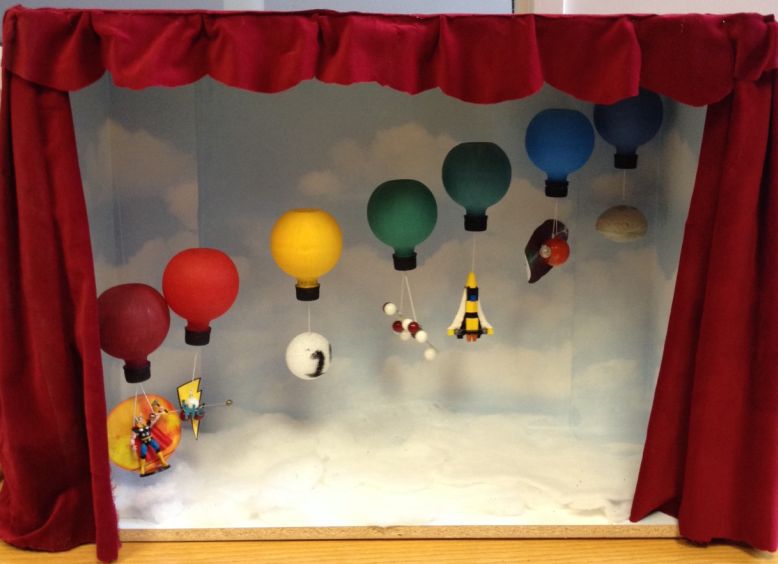
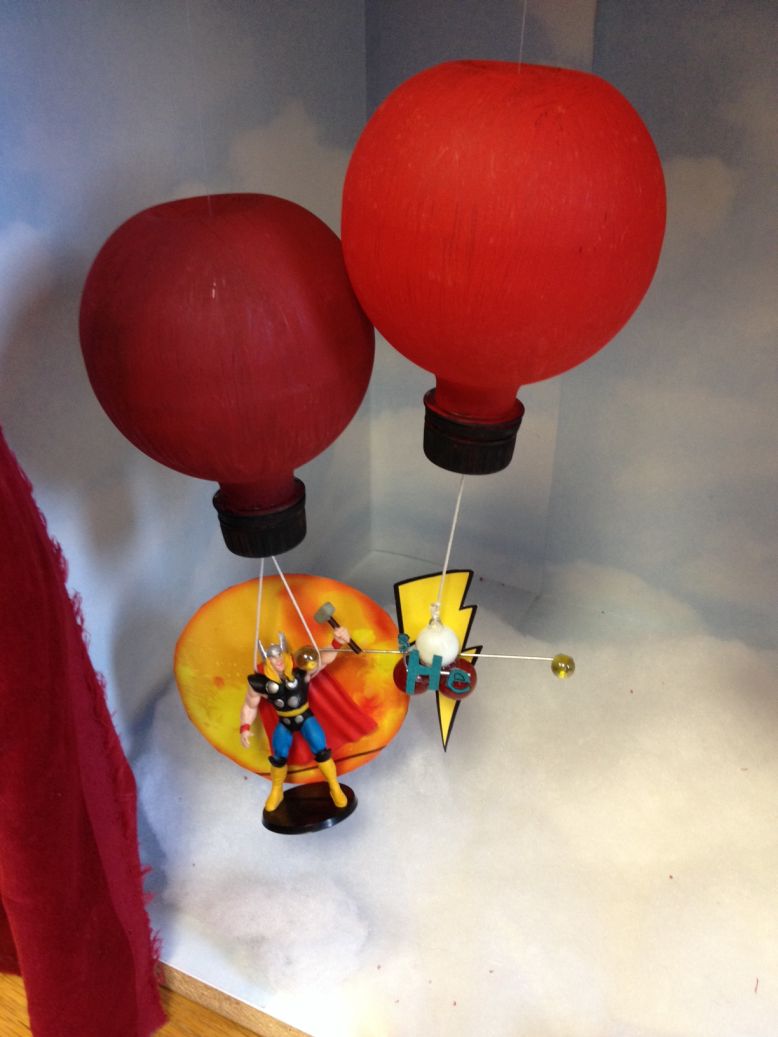


Helium is the second element on the periodic table with a profound history and great relevance behind it. Helium is commonly known for air balloons and for this reason is why my art project used an air balloon theme. The project also has a theatrical theme. The theater allowed the use of theatrical techniques to incorporate more ideas in a more discreet and artistic way. Moreover, the theater represents our universe and how our world is like a stage. Just like an actor who follows a script, Helium also follows a “script” that is governed by the laws of this universe! The project included many properties of Helium to portray; matter is made of atoms, elements display periodicity, chemical bonds form when electrons pair, energy is conserved, and also touched upon how there are four types of reactions.
One of the biggest and most groundbreaking ideas which are the fundamental part of chemistry is that elements are made out of atoms. In the theater, there are multiple representations of atoms. Firstly, Helium-3 is an atom that has a one less proton which makes it an isotope and isotopes are atoms. Secondly, helium is an atom as well, thus depicts how matter is made of atoms.
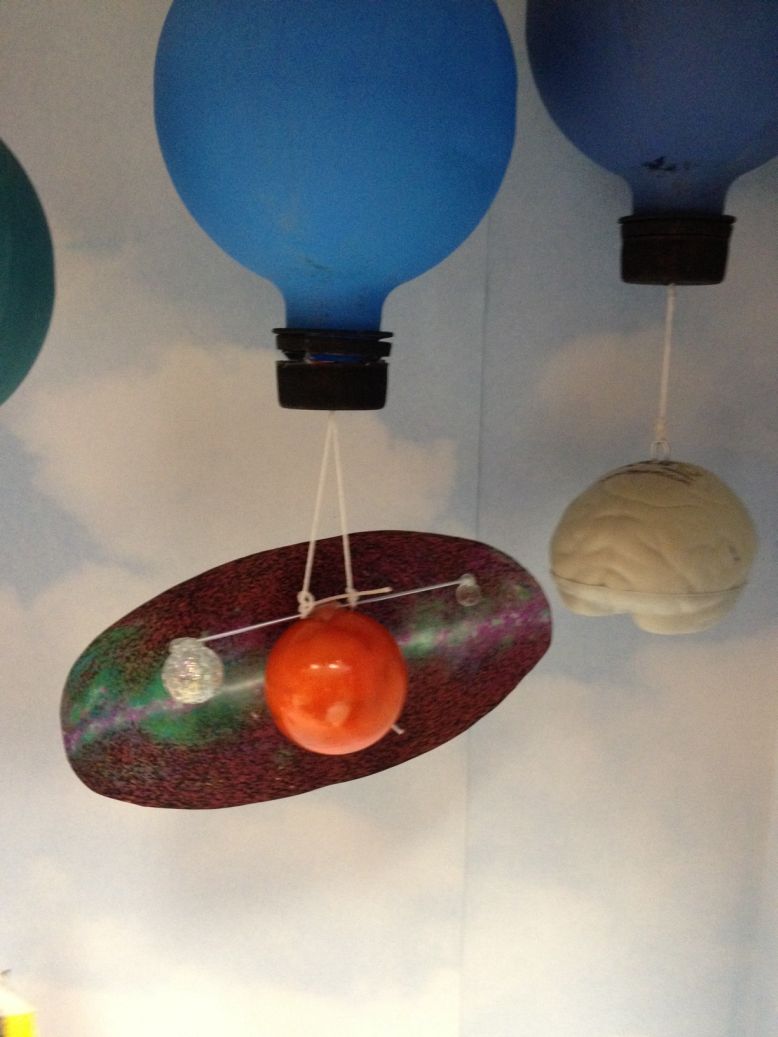
Elements display periodicity is also represented in the artwork. One of the diagrams is a picture of a WMAP which is a microwave background of the universe comparing three sizes of balls. The biggest represents Hydrogen which makes up 92% of the universe, the second largest ball is Helium which makes up 7% of the universe and the last ball represents everything else in the universe which sums to 1%. This abundance depicts how the elements display periodicity.
Helium is has only two valence electrons which fill the first “shell”, thus, helium is classified as a noble gas. Noble gasses are inert with some exceptions, for example Xenon. The setting of the art project is an open sky, where the clouds represent other elements and the airships represent helium. When an airship travels through clouds, the balloon won’t interact with the cloud except passing through it. In principal, the helium doesn’t interact with other elements and just simply moves along. Elements bond when electrons pair to fill its valence shell. However, in the case of helium, its valence shell is full, therefore, helium won’t share any electrons. Henceforth, this depicts how chemical bonds form when electrons pair.
As previously mentioned, the theater allowed the uses of theatrical techniques. However, I am no Shakespeare but I make do with what I have. In the foreground, the balloons were increasing in height from left to right. This represented energy, in the sense that the higher the energy applied, the higher the balloon would be. Also, as the balloons increased in height, they also increased in depth. The depth was to make the objects look smaller. Thus, the smaller the object, the smaller wavelength it has. Furthermore, each balloon was painted a color that was associated with its energy/wavelength. Therefore, I graphed a function (not to scale), wavelength versus energy representing the spectroscopy of helium. As energy increases, the wavelength emitted decreases. Spectroscopy depicts how energy is conserved. When energy is transferred to an electron, it absorbs the energy jumping to its specific quantized level. Then the electron emits a photon relative to the energy that was absorbed, returning the electron back to ground state. To calculate this, we use Bohr's equation, however, it can only be used for “hydrogen like” ions.
Lastly, helium is produced in stars due to the immense energy that elements are encountered with. Helium is produced by nuclear fusion in the sun. This reaction takes place when tritium and deuterium are reacted with immense heat to produce helium and a neutron. Nuclear fusion is one of the four reactions that can occur, that will be further explained in NYB.
All in all, the project expressed many big ideas and was a general success. Such big ideas came together with a beautiful coherence and described the true height of helium!