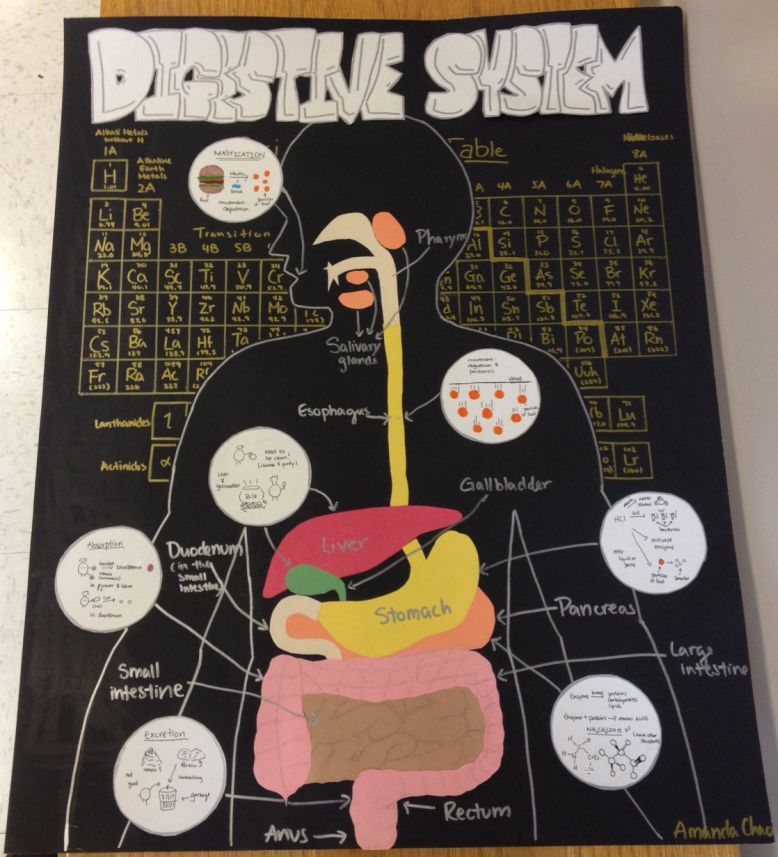


The digestive system is a unique system where group of organs work together to turn food into energy and to supply the entire body with nutrients. There are six major functions that take place during the whole process of digesting food: ingestion, secretion, mixing and movement, digestion, absorption and excretion. The ingestion is the first function in the digestive system where the mouth is the first organ that works on the food. Accessory organs of the mouth (teeth, tongue and salivary glands) break the food into smaller pieces that are then mixed with the digestives juices (saliva) that break it even more into a form where our body can easily absorb and use the nutrients. The food then travelled to the pharynx where its function is to pass the chewed mass into the esophagus. The esophagus is a long tube that delivers food into the stomach where muscular valve block the way back of the food into the stomach. The stomach secretes hydrochloric acid and digestive enzymes that continue the process of breaking down the food into smaller and smaller pieces. When the food leaves the stomach to go to the small intestine, it becomes usually liquid or paste. The small intestine has three segments: the duodenum continues the process of breaking down the food by using enzymes released from the pancreas and the bile from the liver, and the jejunum and the ileum are responsible for absorbing nutrients into the bloodstream. The food then goes to the large intestine where water is absorbed and separated from the waste, called the stool. Then, it passes to the rectum and stays there until it is released by the anus.
In my artwork, many digestive organs were represented, each with a different color in order to be clearly identified. White circles on my artwork are the representation of a close-up view of the reaction of food in that organ. In my artwork, six of the nine big ideas in Chemistry explored by Peter Atkins were represented.
The first idea of Atkins is Matter is made of atoms. Everything is made out of something, which we call atoms and these create matter. This idea is portrayed in my artwork where nutrients are made out of sophisticate molecules which are composed of atom, for example: when we eat meat, there are many proteins inside of it and proteins consist of amino acids, where there are many structural formulas for it, like CH3CH(NH2)COOH. There are carbon, hydrogen, nitrogen and oxygen atoms in it.
Elements display periodicity is the second big idea of chemistry where I drew a part of the periodic table in my artwork with their atomic number and atomic masses. Each element has different mass, like fluorine with 19 g/Mol and oxygen with 16 g/Mol. The mass of each element is one factor that determines its places in the periodic table.
Ideas number 3, 4 and 5 are the next big ideas of Atkins that are in my artwork. One of the principal functions of the large intestine is to absorb water. One molecules of water are composed of two hydrogen atoms and one oxygen atom, where the hydrogen atoms have one free electron each and oxygen six. Based on the Octet rule, oxygen will have two free electrons to share and two lone pairs. Each hydrogen can shared one electron with the oxygen to form an O-H bond. This is the third big idea: Chemical bonds form when electrons pair. Since two hydrogens are attached to one oxygen, oxygen will be in the center. Therefore, oxygen will have four domains: two lone pairs and two O-H bonds, and the shape of one molecule of water is bent with an angle of 105° between the shared pairs. This is the fourth big idea: Molecular shape is a crucial feature in chemistry. The interaction between hydrogen and oxygen from different molecules is named hydrogen bonding. It causes a higher boiling point and a lower vapor pressure than would be expected for such a small molecule. Hydrogen bonding corresponds to the fifth big idea There are residual forces between molecules. If we take hydrochloric acid that is found in the stomach, the intermolecular forces between hydrogen and chlorine will be called dipole-dipole because it is polar and the hydrogen isn’t attached to nitrogen, fluorine or oxygen.
The sixth big idea of Chemistry: Energy is conserved is represented in my artwork when proteins breaks to form amino acids in the small intestine. The net gain of energy is zero because the energy of breaking and the energy of formation equal to zero. The protein isn’t going to flee. It is being transformed in order to become a nutrient that our organs can absorb or use. Therefore, energy is conserved.
The digestive system is one complex system where many chemical reactions take place in our body. There are barriers to reaction is also an idea from Peter Atkins where it takes place in the stomach and in the small intestine by fasting up the reaction with an enzyme. Ideas seven and nine may also be in the digestive system. There are so many things we can draw with art: houses, landscapes and now, even science. We shouldn’t limit ourselves of drawing what we can see and exclude what we cannot see. Also, science should be included in some painting. We never know if someday, a painting of a molecular shape will be worth the same price as the “Mona Lisa”.