

Atoms are the building blocks of matter. For such a fundamental and omnipresent part of the material world, it continues to be a mysterious and complex system that man has yet to discover its inner workings. Until that point, we continue to create models of the atom, representations, in order to explain the phenomena that are revealed through experimental tests. An example of an experiment that has revolutionized the atomic model of the time was the doubleslit experiment, which forever changed our perception of the electron, supporting the idea that electrons could act like a particle or a wave, thus having wave-particle duality. The method of illustrating the atom is subjective; it is an interpretation of what experimental data means, and looking back at the history of atomic models, one can see how as more experiments have been done, more knowledge of the subject has been acquired, thus the models have becomes more and more complex, and abstract. What goes on in the atom, such as quanta, seems so foreign since it is a concept that is inconceivable on our scale.
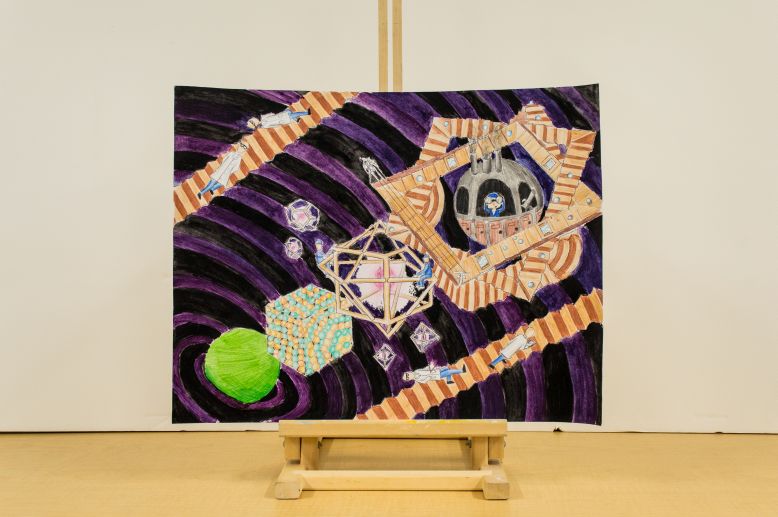
It is this exploration of the evolution of the complexity of our perception of the atom that I have focused on in my artwork. I was inspired by the artwork of M.C. Escher, the Dutch artist and creator of impossible graphic constructions. These impossible structures contained everyday objects like buildings, waterfalls and stairs and drew them in such a way that could never exist in this world, such as stairs that seem to descend in circles, never-ending. His works allow the observer to ponder on how the work was done, how could something so foreign to reality be able to be created on paper. I then saw a link between Escher’s works and the modern model of the atom. I thought that by drawing an atom that looks like an abstract little city that it could convey the almost paradoxical mechanisms of the atom, how the model takes elements we thought we knew so well such as electrons and orbitals, and define them in ways that seem almost inconceivable. Preceding the largest atom are simpler representations of the atom; one emphasizing the importance of orbital shapes, the previous illustrating of the idea that atoms bond, and the first one being a solid sphere, the original postulation that matter is made of spheres; the atom. The entire illustration was also aimed to portray some of Atkins’ big ideas in chemistry. Of course the idea that all matter is made up of atoms is predominantly shown with the variant representations of the structure. Next, the second diagram displaying the ideology that atoms can bond together exhibits the point that when electrons pair, atoms bond together. Elements display periodicity can be found in the representation that takes into account orbital shape have different structures to the left and to the right of the main one, displaying that each column of elements on the periodic table share certain characteristics. This representation also has little people with protractors and rulers measuring the shape of the atom’s orbitals, which explains the idea that atom’s have specific orbital shapes at different angles in order to minimize the repulsion between electrons (as stated in the valence shell electron pair repulsion theorem). The orbital shape of the central atom of a molecule will determine the shape of the molecule itself; a crucial characteristic of molecules. In the abstract atom, we see electrical wires, and chimneys in the little “city”, which represents conservation of energy; what energy an electron absorbs, it is eventually is released.
Finally, to top it all off, on both sides there are staircases inspired by Escher, the type that seem as though they are gone up and down at the same time. This was aimed to show how the increase in complexity of the models of the atom over time does not mean that the simple ones of the post are irrelevant, they are used to explain only certain properties of the atom that still exist, which is why the use alternates between all the representations.