

“When you look in the mirror, what do you see? Do you see the real you, or what you have been conditioned to believe is you? The two are so, so different. One is an infinite consciousness capable of being and creating whatever it chooses, the other is an illusion imprisoned by its own perceived and programmed limitations.” - David Icke
Enantiomers are pairs of stereoisomers that are non-superimposable mirror images of one another. This is comparable to one's left and right hands; they are exactly opposite to each other, which make them look almost identical. This particular difference may seem insignificant since almost all physical properties of enantiomers are identical, such as boiling point, melting point, density, etc. One important experimental difference between the two however, is their ability to deflect polarized light. One will deflect polarized light to the right and the other will deflect it to the left. This phenomenon is referred to as optical activity. A racemic mixture of enantiomers is defined as an equal proportion of each orientation, and results in an optically inactive mixture since the effects of each enantiomer will cancel each other out.
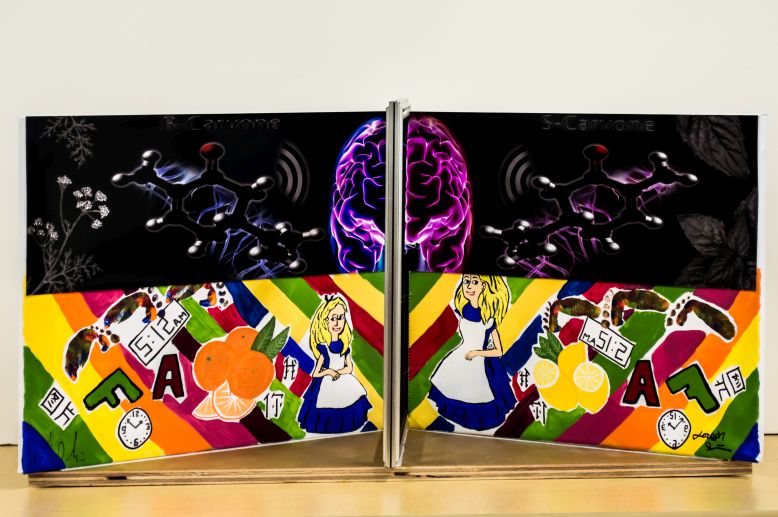
In addition to enantiomers’ deflection of polarized light, they can also have drastic effects on perception, specifically with regards to smell and taste. Our olfactory receptors can interpret almost identical smells from very different looking molecules, as well as very different smells from similarly looking molecules. Our artwork portrayed the effects enantiomers have on perception such as R-carvone versus S-carvone and R-limonene versus S- limonene, as well as other concepts with regards to mirror images. R-limonene smells like orange to us, whereas S-limonene smells like lemons. Also, R-carvone tastes like spearmint, whereas S-carvone tastes like caraway, a common ingredient used in rye bread. We also portrayed the concept of symmetry by painting diagonal lines in exactly opposite directions of each other on either side of the mirror frame, to give an overall effect of a mirror image.
There are many molecules that do not have enantiomers. These molecules are called achiral, whereas chiral molecules have enantiomers. Our artwork explored life in a land where everything was the mirror image of our world. Here we saw that many things we take for granted, such as the digestion of enzymes, and usage of nausea medication, rely on the correct enantiomer being present. Enzymes that we can digest all deflect polarized light to the same side. Many drugs we use, thalidomide for example, are chiral molecules, and so their enantiomers could possibly have drastic effects on our health, such as having negative effects during limb development of unborn babies. Furthermore, some letters we use to write would be different, and telling what time it is would have to change. Almost every means of communication we have would need to be altered in some way.
Peter Atkins’s nine big ideas in chemistry offer insight into the importance of enantiomers. Molecular shape is a crucial feature in organic chemistry, since if we lived in a world where everything was the mirror image of our world, we would not be able to digest many foods, and the foods we could may taste or smell differently than what we’re used to. This all comes down to the molecular shape of the molecule, as well as the way the bond is formed. In some chemical reactions, a bond can only be formed on one side, forming only one enantiomer. This effect was also proposed as a big idea in chemistry by Atkins, as chemical bonds form when electrons pair. The way a bond is formed relies on the pairing of electrons, and determines the shape of the molecule. This formation also determines the way the molecule is perceived, and this is dependent on the residual forces between molecules; another big idea proposed by Atkins. The idea that matter is made up of atoms is also an important one, since most of life on earth is dependent on carbon. Carbon forms four bonds due to its valence shell electron configuration, and this atom allows for many enantiomers to exist within organic molecules.
On another note, artistic representation was crucial in expressing important ideas proposed by Peter Atkins with regards to enantiomers. Purely learning new concepts can not allow one to fully understand unless there is some sort of visual aid or representation. Atkins proposed a ground-breaking simplification of chemistry into just nine ideas, which encompass what chemistry is all about. However what is absolutely necessary to continue the profound significance of these ideas is that their artistic interpretations continue to be explored.
Works Cited
Chaudhuri, Avijit. Fundamentals of Sensory Perception. Don Mills, Ont.: Oxford UP, 2011. Print.
Smith, Janice G. Organic Chemistry. Boston: McGraw-Hill, 2008. Print.
Riley, Bridget, and Paul Moorhouse. Bridget Riley. London: Tate Pub., 2003. Print. "Official Website of Victor Vasarely." Official Website of Victor Vasarely. N.p., n.d. Web. 07 Dec. 2014. link.