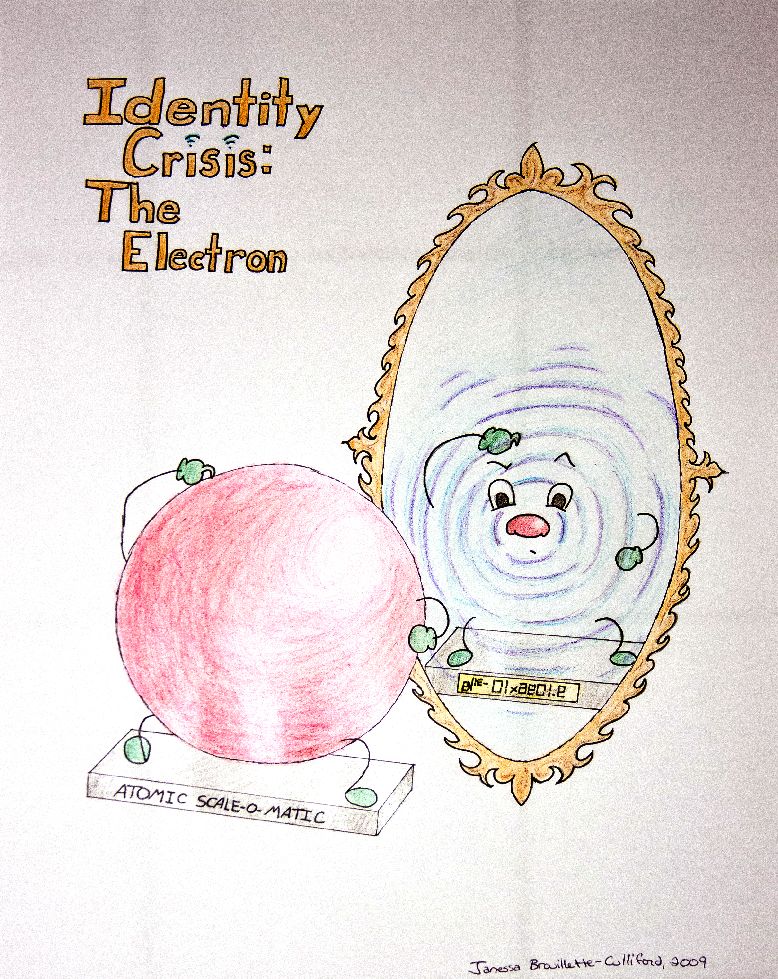


This image features a personified electron observing itself in a mirror. In the electron’s “reality,” it is a solid sphere that can stand on a scale and have mass, meaning that it is a particle. However, when it goes to observe itself in a mirror, it sees a wave in the air around it resembling a material wave in a medium like water. The puzzled look on its face shows that this electron does not understand how this can be possible.
In Chapter 7, we learned about an experiment conducted to determine the nature of electrons. Electrons were fired through a single slit in a sheet of some sort, and a straight line of the same shape as the slit was formed on a screen behind it. The behaviour exhibited by the electrons in this case, rectilinear motion of the electrons, is a property of matter. To further investigate the situation, electrons were fired through two slits side by side, and the expected result was two lines of electrons forming on the screen. However, what really happened took scientists by surprise: The electrons formed a wave interference pattern on the screen, which meant that there were many lines of light and dark alternating all the way across the screen. Interference is a behaviour exhibited by waves, not particles.
Scientists thought that this may have occurred because the electrons repelled each other in a way that produced a pattern resembling a wave interference pattern. The experiment was then repeated while single electrons were fired at the slits one by one, yet the same wave pattern appeared. This puzzled the scientists: How could one single electron interfere with itself and produce a wave pattern? A monitoring device was placed by the slits in the screen, like a camera, to observe the electrons as they passed through the slits, but when the experiment was repeated with this device nearby, the electrons behaved like matter rather than like waves and produced two lines on the screen; The camera’s presence must have interfered with their behaviour.
This drawing illustrates how an electron can behave differently than what is expected upon observation. Mirrors reflect light back and produce an image of the real object in front of them: This drawing shows a real, solid electron producing the reflection of a wave. Seeing the solid electron standing there represents how we know for certain that electrons behave like matter, but seeing the reflection of a wave in the mirror (which is supposed to reflect exactly what is in front of it) represents that we also know for certain that electrons can behave like waves. This drawing represents the particle-wave duality of electrons, and how our perception of electrons is limited, leading to it being very difficult for us to understand how one thing can behave like two separate but real things at once. We would like to deduce, based on behaviour during experiments, that the electron is either a particle or a wave, but the reality is that we cannot classify electrons as either of those because electrons exist just beyond the limits of our perception.