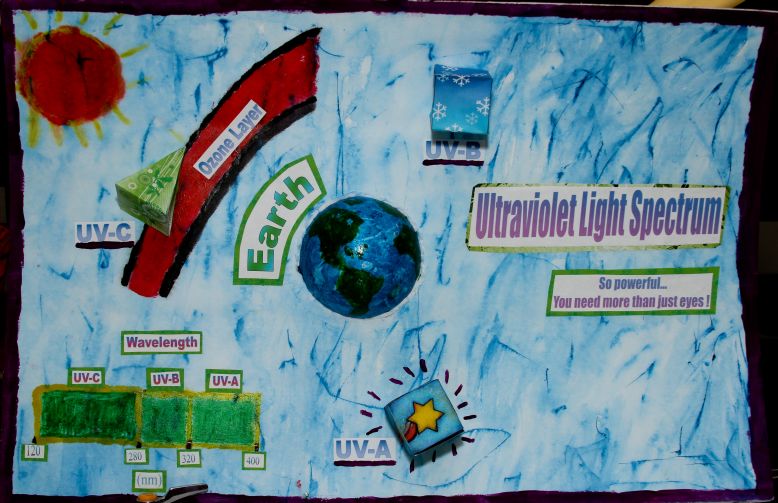


The artwork presented is an illustration of a specific area of the electromagnetic field called the ultraviolet light spectrum. The artwork represents ultraviolet light with the use of the sun as the reference frame. With the observation of this artwork, it can be stated that the ultraviolet light spectrum can be related to the quantum theory. As the quantum theory explains the behaviour and nature of matter and energy on the atomic and subatomic level, the ultraviolet spectrum can be defined.
The human eye is able to perceive wavelengths of 390 nm to 750 nm. This range of this wavelength defines the visible spectrum as one can distinguish the results with their eyes. The ultraviolet spectrum ranges between 120 nm and 400 nm. Although the range somewhat intersects with the human eye’s perception of waves, it is extremely difficult to identify ultraviolet light with the naked, human eye. In association with the quantum theory, it will be possible to clarify the uncertainties that are imposed form this of light.
The ultraviolet light spectrum is relevant to the quantum theory because it enables one to comprehend the uncertainty of its behaviour and nature. “Colour” is a word that one can use describe what they see (visible spectrum). What is used to describe ultraviolet light spectrum? Since it is something we cannot observe, “anything” can be used to provide an explanation for its existence. In the artwork, it is demonstrated that although, “colour” isn’t used to define the ultraviolet spectrum, it is divided into three categories; UV-A, UV-B and UV-C. The artwork illustrates that the sun emits ultraviolet light in the form of UV-A, UV-B and UV-C. The light can either be blocked by the ozone layer or make its way into the Earth’s atmosphere depending on the intensity of the wave. Since UV-C light encounters molecules at higher layers of the atmosphere, it carries enough energy to break apart the molecule and absorb the energy. Therefore UV-C rays have enough energy to break down molecules, O2 and O3. Therefore, the artwork demonstrates that the UV-C ray does not enter the earth. Furthermore, since it is not viewable by the naked eye, a triangular structure with circular patterns is replaced to portray the lack of “colour” known as UV-C light.
Next, the UV-B light is another complex ray. It can “either” reach the Earth’s surface or not enter its atmosphere. Due to its lower level of energy, UV-B usually is not able to break through O2 and O3 molecules. As a result, only some rays of UV-B actually reach the Earth’s surface. Therefore the UV-B was situated in between the Earth and ozone layer showing the uncertainty of its position.
UV-A rays, having the least amount of energy, is not absorbed by the ozone layer. Hence it cannot break through O2 and O3 molecules. UV-A rays achieve in hitting the Earth’s surface. The wavelength of UV-A rays range between 320 nm and 400 nm. It is possible that one can observe UV-A rays, but it is quite difficult without the use of technology. Hence it is always observed in the form of a different “colour” if visualized with the human eye. One would expect it to be violet due to its name, but the colour is often blue and some have seen it as green. The artwork portrays that the UV-A rays pass through the Earth’s atmosphere.
Therefore the three rays, UV-A, UV-B and UV-C define the ultraviolet light spectrum.