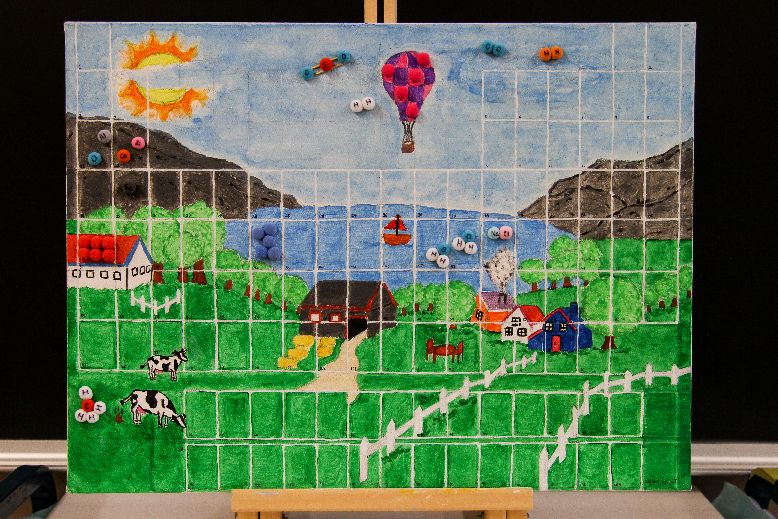


What is nature''? We can define ''nature'' as the existing system of thing, the universe, the natural world, the material world, or the phenomena of the physical world. It can also refer to life in general. The world is full of surprises that lead scientists (chemists) to discover new things in science. My art project is a painting of a landscape that includes the elements of the natural world, such as mountains, trees, animals, and seawater. It is done on white canvas with acrylic paint. For my artwork, I was inspired by some acrylic paintings of an anonymous artist.
Based on Dalton's theory, everything in the universe is made of matter and all matter is composed of small particles called atoms. Since the visible matter is composed of atoms too tiny to see, I use pompons to represent them. By knowing that all material on earth exists in three states (solid, liquid and gas), the pompons are packed together on a solid matter such as the roof of a house. On a liquid matter such as the seawater, the pompons are less closely glued together. Then, on a gas matter such as the envelope of a hot air balloon that contains heated air, the pompons are widely spaced from each other. Moreover, the pompons are in different colors to make the element easier to identify since atoms of different elements have different properties. I also include a periodic table on the background of my landscape. The atomic number of each element is written in the corner of each box to show that the periodic table organises the elements according to their chemical and physical properties.
In general, I only show some examples of element in nature that can be found in the periodic table. An example would be the particles in the air. Air is mostly composed of oxygen and nitrogen (found in the right side of the periodic table), and it contains a small amount of CO2. Another example would be the five most common elements found in rock such as oxygen, silicon, aluminium, iron and calcium. Furthermore, when an atom chemically combines with other atoms, it forms a compound. They are held by chemical bond, and the attractive force within a molecule is called intramolecular forces. For instance, an oxygen molecule is made up of two oxygen atoms, and the intramolecular force is therefore holding them together. CO2, O2, N2 and H2 are examples of covalent bonding. They involve the sharing of a pair of valence electrons. The methane (CH4) emits by cow is an example of non polar covalent bonding. When one atom or more lose electrons and other atoms gain them in order to produce a noble gas electron configuration, this type of bond is called an ionic bond. Sodium chloride (NaCl) is a typical example of ionic bonding. Then, when hydrogen atoms are joined with an atom of high electronegativity (O, F or N), it is called hydrogen bonding. In this case, H2O molecules are an example of hydrogen bonding. The force of attraction between two water molecules is the intermolecular forces. Again, I use pompons to represent the atoms bonded together.
On the other hand, the three-dimensional arrangement of a molecule is the molecular geometry or structure. A water molecule has two pairs of bonded electrons and two unshared lone pairs; it has therefore a bent geometry. CH4 has a tetrahedral molecular geometry and CO2 has a linear geometry.
Moreover, the universe is also made up of energy. According to the law of conservation of energy, "The amount of energy in a system will stay constant whole time. It does not depend upon the amount of matter. Energy is able to transform into some other different form like a chemical energy can become kinetic energy but nothing can destroy or create the energy.''1 In my painting, the energy flows from the sun and the wind is conserved. Another example would be the trees. The trees take light energy and convert it to chemical energy but do not destroy the energy.
Then, the idea involves in the concept of entropy is that the nature tends from order to disorder in an environment. For example, gases are all around us. We can feel gas when the wind blows. The wind is moving air. Air has molecules that are in motion and it is composed of many gases mixed together. As a result, there is a lack of order.
The use of bright colors in my painting has the purpose to make people feel that it is a sunny day (hot summer weather). The sun and the vegetations such as the trees/plants have a relationship. Plants need light energy, CO2, and H2O to make sugar. The process of converting light energy to chemical energy and storing it in the bonds of sugar is called photosynthesis. The chemical reaction involves in photosynthesis is 6CO2 + 6H2O (+ light energy) → C6H12O6 + 6O2.
The inspiration to draw a landscape comes from some paintings of an anonymous artist but the idea is my own. I am pleased of my work. I hope that based on a landscape/nature, people will have a better understanding of the different chemistry topics.
References:
Internet:
https://en.wikipedia.org/wiki/Nature; May 01 2013.
http://www.jedicreations.com/acrylic-paintings.php; May, 04 2013
(website: My inspiration came from some of these paintings)
1 http://chemistry.tutorvista.com/nuclear-chemistry/energy-conservation.html; 2010
http://en.wikipedia.org/wiki/Entropy; May, 01 2013
http://www.emc.maricopa.edu/faculty/farabee/biobk/biobookps.html; May 18, 2010
Book:
With special contribution by Robert S.Boikess, Chemistry: A molecular approach, Dan Kaveney, New York, 2008