

Enzymes are biological catalysts which are substances that accelerate a certain chemical reaction. Enzymes are usually large protein molecules with complex structure but within that structure is a specific area called the active site (1). The way the active site is shaped is in such a way that the reactant molecule, usually called the substrate, binds perfectly into the active site just like a lock and key mechanism. Through intermolecular forces such as hydrogen bonding and dispersion forces, the activation energy of the reaction is greatly lowered, thus allowing the reaction to occur at a much faster rate (1). Sucrose for example, is a substrate that binds into the active site just like a key fits perfectly into a lock, where the molecule is held in place due to intermolecular forces and then released from the active site after the reaction has occurred. Therefore, molecular shape plays a crucial role for the reason being that if the molecular shape does not correspond to that of the active site, it will not bind properly and a reaction will not occur. This then leads to the fact that chemical bonds form when electrons pair in order to create that molecular shape.
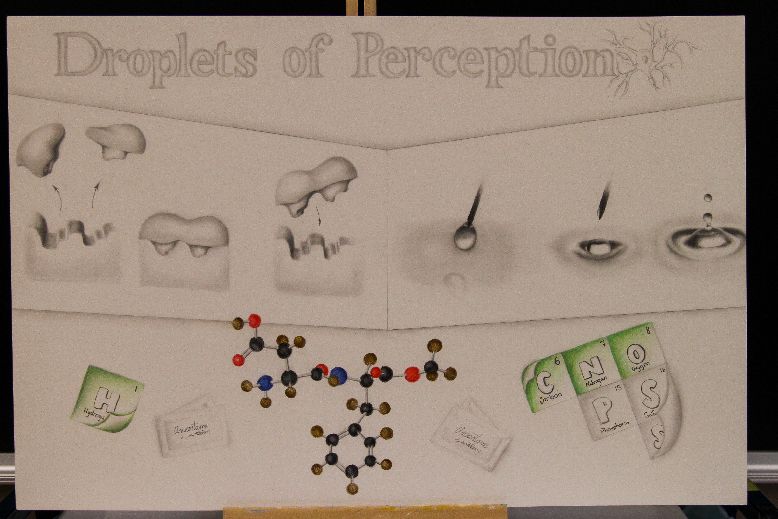
With this being said perception is one of the most important factors to consider in science and when looking at the world around us. I believe that every one of us have our own perception on everything we see and feel, and when given an idea or thought, our mind is only able to retain what it wants to and creates its' own perception with what it retained. For example, the chair you are sitting on right now can feel and seem so much more different to another person sitting on the same exact chair due to perception and how you allow yourself to see and feel things in different ways. Moreover, for my art project, I created an art piece in which it portrays an enzyme and how an enzyme functions through droplets of perception.
I chose to represent enzymes as analogous to a droplet of water where the process of a droplet falling into water would be similar to that of a substrate fitting into the active site of an enzyme. When viewing a rain drop falling from the sky at 2000 frames per second, it can be observed that when the droplet encounters a puddle, it seems as if it is being sucked into water and the droplet sits on it for a few milliseconds due to a very thin layer of air between the rain drop and puddle. But as the air is pushed aside, most of the droplet connects with the puddle below. As this process occurs, waves are created at the point of contact and the puddle sweeps upward applying a force on the droplet causing the rain drop to bounce up just like the products are released from the active site. It is also due to surface tension in which the droplet has the ability to pull itself back up form the waves being created. I also chose to illustrate part of the periodic table in which the other non-metals can be found in artificial sweeteners, for an example, to show the process of enzymes and the reaction that takes place. I decided to color only certain elements of the other non-metal groups to exemplify the elements present in artificial sweeteners.
Instead of the typical lock and key mechanism of enzymes that are usually taught and read by many, I wanted to give people a different perception on this phenomenon. My project portrays the idea that the procedure of enzymes can be viewed in many different ways like a droplet of water falling into a puddle. We shouldn't be limited to only ideas that are being taught and we shouldn't be limited from choosing what is right and what is wrong. To be more precise, we should open our minds and creativity as well as immerse ourselves into a world full of imagination as we are learning. I believe that this is how we'll allow ourselves to learn and in particular, acquire an experience of what we're learning at the same time, because we as humans only remember mostly from what we understand profoundly and not just through listening and memorization.
Reference
- Tro NJ. Chemistry A Molecular Approach. 2nd ed. Upper Saddle River (NJ): Pearson; 2011.