

On a daily basis, we use our sense of touch in order to perform everyday tasks. Without our sense of touch, we would never be able to know whether our body is in pain or not, thus showing how crucial it is for our body to possess a central nervous system in order for our body to react to feelings such as pain. However, the process in which our brain interprets these sensations that we experience thousands of times daily, is often overlooked. Therefore, the best way to make everyone understand the process in which our body interprets feelings such as pain without the use of complicated textbook phrases is to show this process through the use of art.
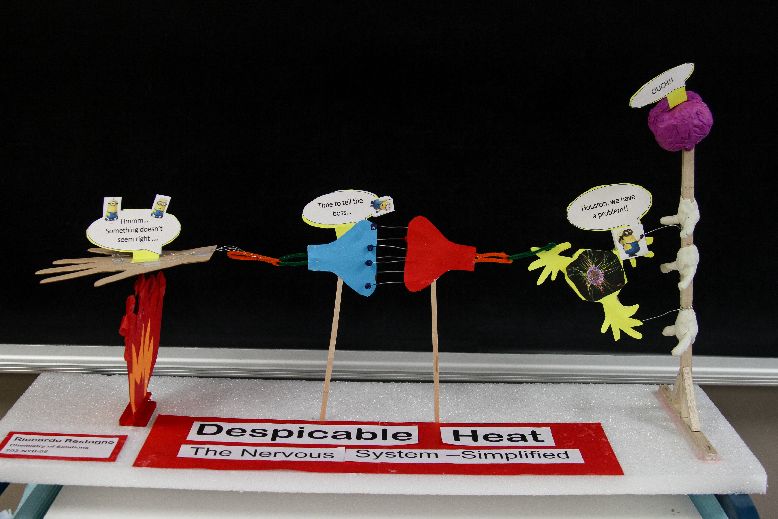
My artwork attempts to simplify the complicated process in which chemical impulses transmitted by the sensory neurons received from the sensory organs such as the skin, to the central nervous system (brain and spinal cord). To do this, I constructed a nerve cell with arts-and-crafts supplies and used this nerve cell to connect the spinal cord with a hand. I then attached the hand to a bright red flame which is supposed to represent heat and pain. To show that the chemical impulse is being relayed to the central nervous system such as the spinal cord and the brain, I used speech bubbles and cartoon characters to demonstrate that the message is being relayed to the brain by the pain felt by the hand. Focusing more on the message sent to the brain by the nerve cell opened my doors for the amount of big ideas in chemistry I am able to reference.
The main big idea in chemistry that I focused on when creating this artwork was molecular shape. This artwork was able to show the importance of the shape of the nerve cell since the shape it holds helps it in order to transmit the chemical impulses from the sensory organs to the central nervous system. Knowing that the basic function of a nerve cell is to send chemical impulses across the body to the central nervous system, the shape of this cell is extremely important for it to function in this way. The reason that the shape of the nerve cell is long and thin is so that the chemical impulses are able to travel a long way across the body for the message to be delivered. Although this is a cell, and the big idea being looked at refers to molecular shape, the same properties of this cell can compare to a molecule since the shape and structure of any molecule is also very important for its function.
Another big idea in chemistry that my artwork focuses on is intermolecular forces between molecules. In the middle of my artwork, there is an exchange of chemical impulses between the branches of each nerve cell. The way these chemical impulses are being exchanged is by the neurotransmitters at the end of each nerve cell. The way neurotransmitters work is by the concentration of negatively charged proteins inside the nerve cell being higher than the concentration of the positively charged sodium ions outside of the cell. This is an ion-dipole reaction, the proteins being the dipoles in this reaction.
Other big ideas in chemistry I referenced in my artwork would be chemical bonding, where the dendrites at one end of the nerve cell is chemically bonded to the spinal cord which helps for the message to be relayed to the central nervous system. At the other end of the nerve cell, there are sensory receptors which are bonded to the sensory organs (represented by the hand) which shows that chemical bonding is crucial for the neurons to be able to transmit the message of your body being in pain to your brain.
To conclude, my project depicts the function of a nerve cell in a very simplified way. The use of speech bubbles as well as the cartoon characters make it easier to understand how the chemical impulses are being relayed from your sensory organs to your brain. I focused on two main big ideas in chemistry while creating this artwork, which are molecular shape as well as intermolecular forces. I also looked at chemical bonding in my artwork, however, it wasn't my main focus. The nervous system is a very complex function in our body, and although my project depicts the nerve cell rather than a molecule, we can see that there are several molecules involved in the nervous system, which is why relates to the big ideas in chemistry in a big way.
Work Cited:
- Bora, Chandramita. Buzzle. "How does the Nervous System Work". Date of Creation: Feb. 20th 2013. Web. May 3rd 2013.