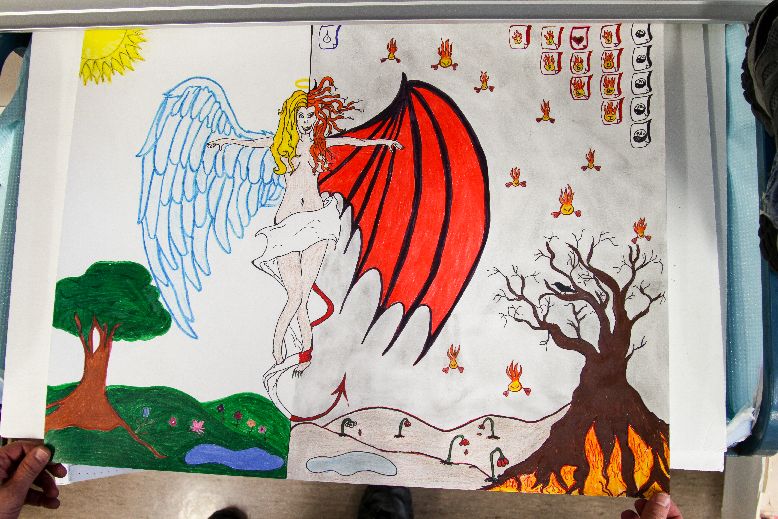


Through the combination of the simplicity of art and the complexity of science, this artwork presents a medium through which one can relate environmental chemistry to reality. Acid Rain is a phenomena that can be described as, precipitation that contains high levels of acid usually, nitric and sulphuric acids. My drawing of a statue illustrates the contrast that exist between an entity in conjunction with acid rain and an entity without. To represent this contrast, the image of a statue, made of limestone was placed at the center of the piece. It is well known that the acid from acid rain weakens the molecular structure of the stone and makes it deteriorate over time. By separating the statue into halves, I was able to depict its original features on one side (with an angel) and its deteriorating half, caused by acid rain (with a demon). Both halves, of the artwork demonstrates the allusion that each feature of the statue represents. The angelic half comprises of typical elements that are associated with a divine setting, for instance, freshwater, green trees, and the sun shining, in other words a friendly and harmless environment. On the hand, the demonic side, associated with acid rain contains vibrant colours such as red, yellow and orange; colours that are affiliated with acid. Furthermore, it embodies, lifeless elements such as wilting flowers, acidic raindrops that composes of sulfur dioxide and nitrogen dioxide. Additionally, acid rain also deprives the soil of its nutrient, making it difficult for the survival of trees, an aspect that I also incorporated into my art, with an image of a dying tree and brownish black soil. In other words, this side represents the evils of acid rain.
Peter Atkins, a British chemist developed nine big ideas in chemistry, five of with I was able to incorporate into my art piece. Firstly, the concept that matter is made of atoms. Since everything that occupies space and has mass is matter (has the ability to exist in three states, solid, liquid and gas); all objects we see are composed of atoms. Therefore every aspect of my artwork portrays this idea.
Secondly, my art piece illustrates the concept that elements display periodicity. On the top-right corner of my artwork is a small representation of the section of the periodic table that is usually acid-orientated. The non-metals that are predominantly found in the top-right corner of the periodic table, when bonded with oxygen usually creates acidic oxides, for instance, Br, F, N,S, C, Si, P, etc. Two of which happens to be sulphur dioxide and nitrogen dioxide. Furthermore, in my art piece these non-metals that tend to create acidic oxides, are represented by fireballs that increase in size to depict that going down a column of the periodic table the elements increase both in size and acidity. Additionally, looking across a row, acidity increases going towards the right. Finally, elements of group VIII (noble gases), for example, Xe, Ar, Ne, Kr, etc., are represented by the ying yang symbol to demonstrate balance and their inability to form oxides.
Atkins, also stated that molecular shape is crucial in chemistry, and indeed it is. To reflect this idea, I created fireballs with hearts attached to them to illustrate the molecular shapes of both sulphur and nitrogen dioxide. The hearts symbolize oxygen, because in order to create acidic oxides, oxygen is the main component and I wanted to convey the love that each element has for it. As it relates to SO2, they are bigger and have a molecular geometry of trigonal planar. Since, the central atom of the structure is sulphur, which has three groups bonded to it, two of which are oxygen atoms (double bonds) and the other is a lone pair of electrons. Furthermore, in determining its molecular shape, we only consider the position of the atoms, not the lone pairs. So, the molecular shape of SO2 is bent. In relation to NO2, they are represented by smaller fireballs because of the periodicity of the elements. NO2, also has a molecular geometry of trigonal planar, with the central atom being nitrogen, having also three groups bonded to it, two of whom are also oxygen atoms (one with a single bond and the other with a double) and a lone pair of electrons. This too also has a bent molecular shape.
Another, big idea that my artwork portrays is that chemical bonds form when electrons pair, a subject that is closely related to molecular shape in this case. As stated above, there exist two double bonds between sulphur and oxygen and both a single and double between nitrogen and oxygen. The symbolic hearts that represent oxygen and the fireballs that represents sulphur and nitrogen are hold together by these bonds; these covalent bonds that are a result of electrons pair.
Ultimately, the concept that there are four types of reactions is also tied into my art piece; through radical and acid/base reactions. Radicals are atoms, molecules, or ions with unpaired valence electrons on an open shell. And once again, utilizing the fireballs/heart illustrations, there exist unpaired electrons in both the NO2 and SO2 models (one pair each) I was able to demonstrate radical reactions. On the other hand, also illustrated by my famous fireball/heart drawings, is the reaction that takes place between oxygen and sulphur and nitrogen to form NO2 and SO2 , these then react with water to form HNO3 and H2SO4 (nitric acid and sulphuric acid) respectively (both of which are the main ingredients for acid rain). Below are the acid/base reactions that shows the formation of both acids:
2SO2 + O2 + 2H2O → 2H2SO4
4NO2 +O2 +2H2O → 4HNO3
Conclusively, this artwork presents these big ideas in chemistry, on a level that everyone would be able to understand and enjoy.