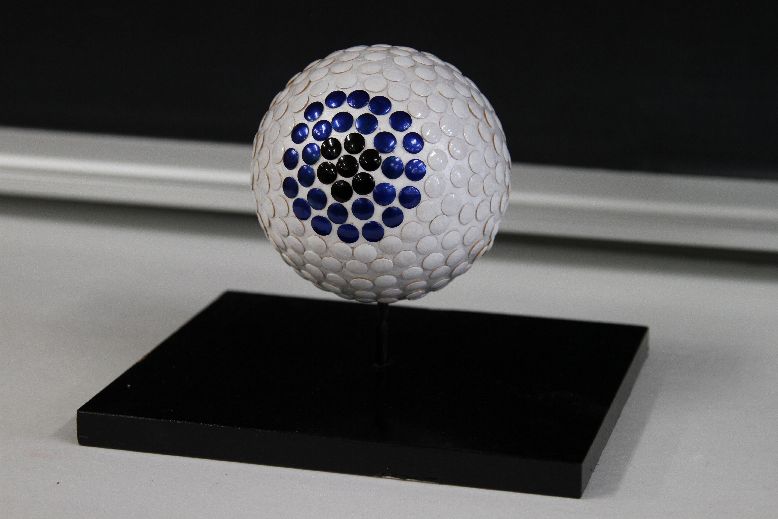


My artwork is a sculpture of an eyeball made out of Styrofoam and pushpins. I was inspired by René Magritte's surrealist painting entitled The False Mirror for the artistic and symbolic aspects. I drew on the change in perspective derived from the double slit experiment, as well as the idea that atoms are comprised of mostly empty space.
The idea that had the biggest impact on me that I learned in this class was that of the emptiness of the universe. Atoms are made up of mostly empty space, which means that our universe is also mostly empty. Ernest Rutherford first discovered the structure of the atom in 1909, by performing the Gold Foil Experiment. He aimed beam of alpha particles from a radioactive source at a circular fluorescent screen. He then placed a thin sheet of gold foil in the path of the beam. Most of the particles passed straight through the gold foil, hitting the back of the fluorescent screen and made it glow. Some particles, however, scattered or bounced back and hit the screen in a number of different places. This proved that the nucleus of an atom is made up of mostly empty space since the vast majority of the particles pass straight through the gold foil as if it was not there. I wanted to show this emptiness somehow in my artwork and the idea that I came up with was to use pushpins to represent atoms. The heads of the pushpins are round, so they do not line up perfectly to cover a flat surface. There is a space between every pushpin to represent the space in the atoms.
I chose to use the pushpins to make an eyeball because of Magritte's The False Mirror, but also because of the role of the observer that came out of the Double Slit Experiment, which found that light behaved both as a wave and as a particle depending on if it was being observed. When a beam of particles passes through a screen with two slits, the image on the back screen should be of two lines. When waves are directed at the screen with two slits, the image on the back screen will be of many lines caused by an interference pattern. This is because the initial wave hits the slits and forms two new waves on the other side. The crests of these two waves coincide with each other and hit the back screen where the line appears. But because there are multiple waves being created by the double slits, multiple lines appear on the back screen. Before the Double Slit Experiment, light was thought to act like particles and therefore should appear as two lines on the back screen when shone at the double slits. When Thomas Young shone light at the screen with two slits, he discovered an interference pattern on the back screen, consistent with wave behaviour, not particle behaviour. Mathematically, the physicists could not determine what was happening to the electrons to make them behave in such a way. The decided to use a device to measure which slit each electron passed through. When they measured it, the electrons changed their behaviour to be like particles, making two lines on the back screen. It did not make any sense to the physicists that the electrons could "choose" to behave either as a particle or as a wave depending on if they were being observed or not.
This experiment marked a change in attitude from the scientific community towards the role of the observer. In the classical view - from Aristotle to Newton - the universe was objective. The world was not affected by those in it. After the Double Slit Experiment, it became clear that the observer did, in fact, impact the outcome of the experiment. The light behaved as a wave until the measuring device was put into use, at which point the light behaved as a particle. From this we can gather that the world is not objective, but subjective to our presence as observers. We do have an impact on the world around us. Just the act of observing interferes with the outcome of the experiment. This is the reason I chose to use the eye as a symbol of the observer. It is a representation of the importance of the observer in a subjective universe.