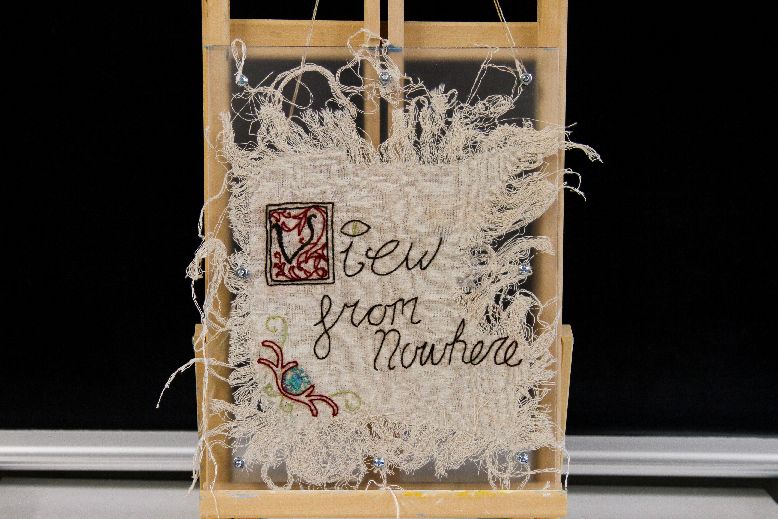


The Term 'View from Nowhere' was a phrase I came across in feminist philosophies which were critiquing an old style of thinking. The idea that an observer could have a 'view from nowhere' implied that it almost had an omnipresent ability to study a subject from a neutral territory. The observer would be capable of objectivity, as it was not weighed down by the biases of a situated observer. A situated observer's work is not only affected by its surroundings, i.e. its class, gender, race and privilege, but also by its perspective. Its physical situation would limit its perspective, and therefore provide the observer with a single angle of a three-dimensional subject. For example Eratosthenes needed the observations of a man in Syene to discover the Earth's circumference, while Eddington needed to study the solar eclipse in Principe to prove Einstein's theory of relativity. Both experiments depended on the observers situations in order to develop truth. A view from nowhere, however, describes a view that is not limited by geography or resources. This view is of course impossible. It is a viewpoint which thinkers like Descartes and Kant professed to have achieved, however, to completely distance oneself from the world is a nigh on impossible task. The 'View from nowhere' is simply a theoretical viewpoint, preferable but impractical. All observers and all knowledge are part of the internal, rather than external, world.
This theme applies just as easily to science as it does to philosophy. Objectivity was a primary goal for scientists; however, it became so overemphasized that the actual subjectivity of their work was ignored. Newton and Aristotle for example, treated their scientific works as free from subjectivity. However, each theorist allowed their works to become influenced by their own personal religious and moral views. They both described the planets motions as being controlled by an external player and part of a perfectly ordered system, because they saw the hand of god at work. The planets motions as far as we understand today, are not controlled by external forces, but by internal forces which play off each other. The motion of the planets is determined by the shape of space, while the shape of space is determined by the mass of the planets. Each interacts with the other to produce what Newton and Aristotle wrote off as the work of the immovable mover.
Subjectivity and the role of the observer as an internal player gained much more relevance in the scientific world after the development of the wave particle theory. It turns out that particles will act in certain behaviours depending on whether or not they are being observed. When not being observed electrons will react like waves, however, when being watched, they take on the properties of a particle. Never has a piece of scientific knowledge become so dependent on its observers positions.
My embroidery of a view from nowhere is the representation of an old ideology unraveling in light of new discoveries. While the actual piece of embroidery is a representation of the old ideology, the theoretical ideology of a view from nowhere, the framed piece as a whole is a representation of a subjective reality. I wanted to embroider my words onto something reflective of the two-dimensional world, so that it could reflect the limitations of words-on-paper literally. Even in an art piece, the idea of a view from nowhere is so un-transferable to the practical world that it remains a 2-D representation. However, the piece viewed as a whole is not simply the words 'view from nowhere' but the words stitched onto an unraveling fabric framed for the observer to view from any angle. The unravelling fabric is representative of not only the unravelling of the old ideology, but also a demonstration of its inability to exist within the practical world without falling apart. The ability to view the piece from any angle makes it more interactive with the observer, which promotes the new ideology, of the observers role in the existence of knowledge. The observer may perceive the piece from the front, in which the words are clearly depicted, or they may see the piece from the back, where the stitching becomes a pale imitation of the image on the front. Though each angle will supply the observer with a different piece of knowledge, no angle is less true than any other. These of course are only two angles; however, there exist endless more, each for the observer to discover themselves.
Knowledge is not simply a piece of information one can stumble upon in any situation. We are observers, and our knowledge depends on our observations and situations. Aristotle could not have conceived of Newton's forces, just as much as Newton would not have been able to conceive Einstein's theory of gravity. Each observer was limited by their perspective, by their bias. To escape from bias is as unachievable as it is to find the view from nowhere. We are the situated observers, and what I see and what I know is not, nor will it ever be, what We see and what We know.