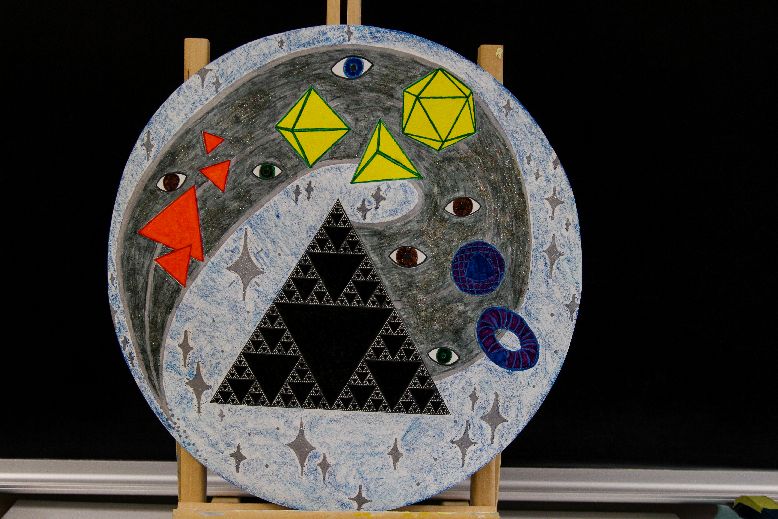


My rational for this project was to represent the progression of science throughout the ages, using different forms of geometry as symbols. I wanted to interpret the movement from Newtonian science to quantum physics by emphasizing the influence that perspective has on our ability to understand the universe. My artwork reflects the shift from Euclidean geometry and platonic forms, to Non-Euclidean geometry, and finally, to fractal geometry. This seemed appropriate since the language of science is Mathematics, and when it is applied to the world it takes the form of Geometry. I felt that the use of this form of artistic symbolism made for a complex and meaningful, yet esthetically pleasing interpretation of the scientific concepts we have explored this semester.
I decided that space would make a good setting for my piece since it represents the expansion of our perceivable world, and is also a symbol of great scientific achievement. I also felt that the seemingly infinite nature of space, which cannot be perceived or even conceived of in its entirety, would be a good symbol for the great conundrum that quantum physics has presented us with. I placed the different sets of geometric symbols in a cyclical pattern, not only to represent the chronological order in which these concepts and theories were developed, but also to demonstrate how fractal geometry and quantum physics force us to go back to the beginning of the cycle and re-examine our mathematical and scientific roots and assumptions. Artistically, this looks like a comet passing through space, with the head being the fractal geometrical shape known as the Sierpinsky triangle. The Sierpinsky triangle can also be interpreted as an arrow head pointing back towards Euclidean geometry, which in turn represents Newtonian physics.
The first and second sets of geometric shapes in the cycle represent Euclidean geometry and platonic forms respectively, geometries that do not take perspective into account on the grand scale. This represents Newtonian physics, which was developed before Einstein had revealed the importance of perspective and its influence on time and space. Next is the representation of how triangles appear in Non-Euclidean geometry, such as when shapes are drawn on a spherical object, as in topology. Non-Euclidean geometry is also important for physics, since it takes curved planes into account and Einstein theorized that space itself is curved. This represents the scientific period most greatly influenced by Einstein in which other perspectives started to be considered, and the objectiveness of our perceptions questioned.
Finally, the Sierpinsky triangle, which is a form of fractal geometry, is used as the centerpiece as it represents quantum physics. Fractals are shapes constructed of infinitely repeated patterns of self-similar shapes. For instance, if you have an equilateral triangle and you draw another triangle inside it at the points at the median of each line in the original triangle, you can theoretically repeat this pattern on forever. However, fractals can never be completely perceived by humans at one time, or even over an infinite amount of time, and in this way they represent a fringe geometry which is inaccessible to even the most educated scientists. This final geometric interpretation mimics the mystique of quantum physics, and the way that we are unable to perceive everything quantum physics describes at the same time. Just as we can only view light either as a wave or a particle, but not both at the same time, so too are we unable to fully grasp the complexity of a fractal geometry. Palmer (2009) goes as far as to argue that fractal geometry is key in understanding the contradiction of quantum physics, arguing that "attempts to formulate unified theories of physics within a conventional quantum theoretic framework are misguided, and that a successful quantum theory of gravity should unify the causal non-Euclidean geometry of space time with the a temporal fractal geometry of state space". This is to say, that this new form of geometry might be the key that allows us to understand the universe that seemed too complex for our brains to comprehend. Or, like is represented by the cyclical arrow of the piece, it may turn out to be nonsense, thus leaving us no better off than we were in the beginning.
Work Cited
Palmer, T.N. (2009). "The Invariant Set Postulate: A New Geometric Framework for the Foundations of Quantum Theory and the Role Played by Gravity". Proc.Roy.Soc.Lond. A465 (3187-3207).