

In the fourth semester of the Liberal Arts program, students have been able to correct any misconceptions they may have had with regards to science. More specifically, they have understood how science and art share an important link. In fact, as Liberal Artists, seeing the scientific world from an artistic view-point may even be more beneficial, as Sir Ken Robinson, world-renowned education and creativity expert agrees in his RSA talk. To demonstrate an aspect of Robinson's theory, students of the Science, History and Methodology course of the Liberal Arts program made artistic representations of scientific concepts to help clarify quantum mechanics and the Theory of Relativity to a wider audience.
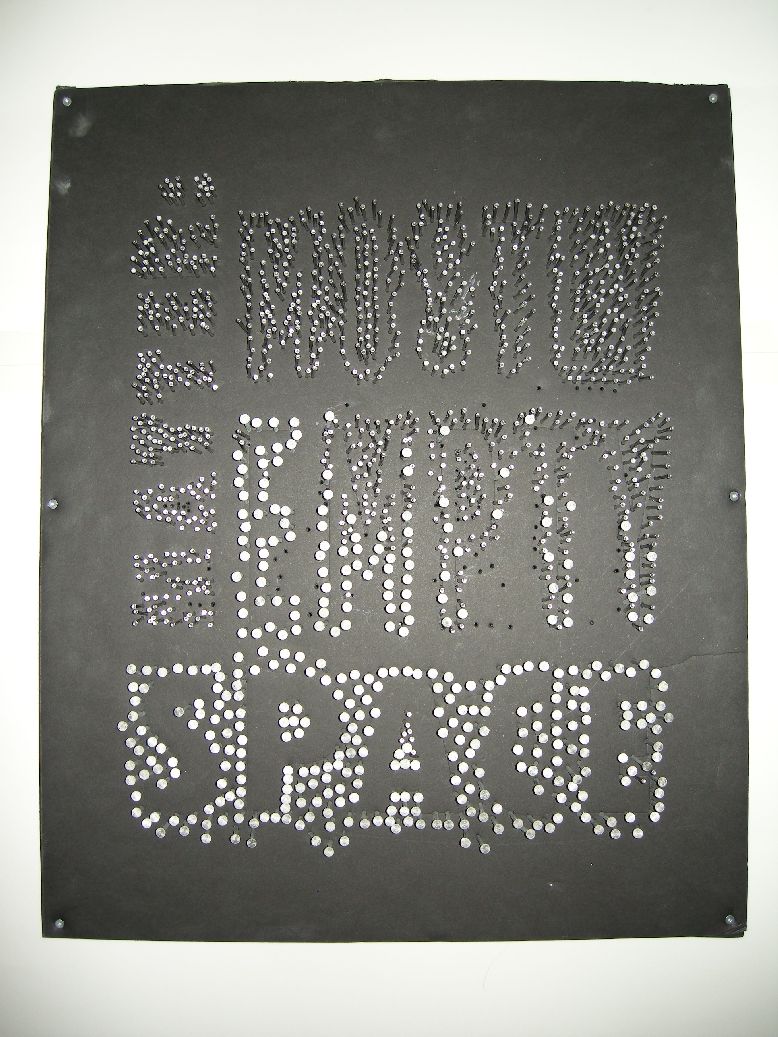
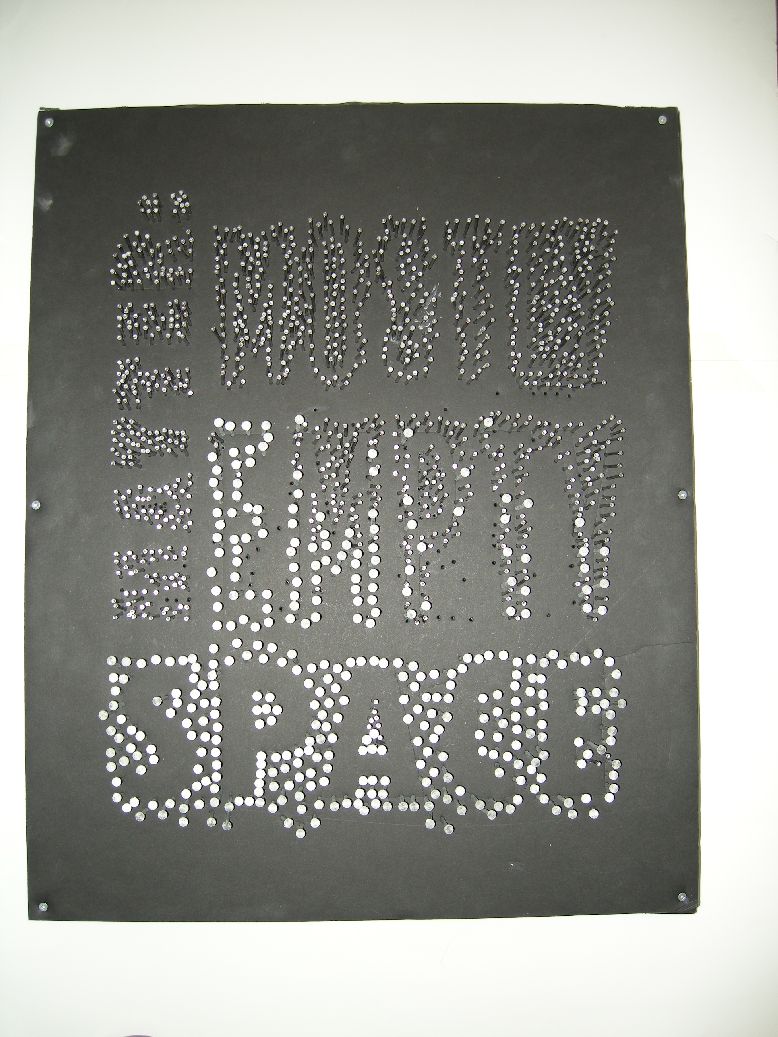
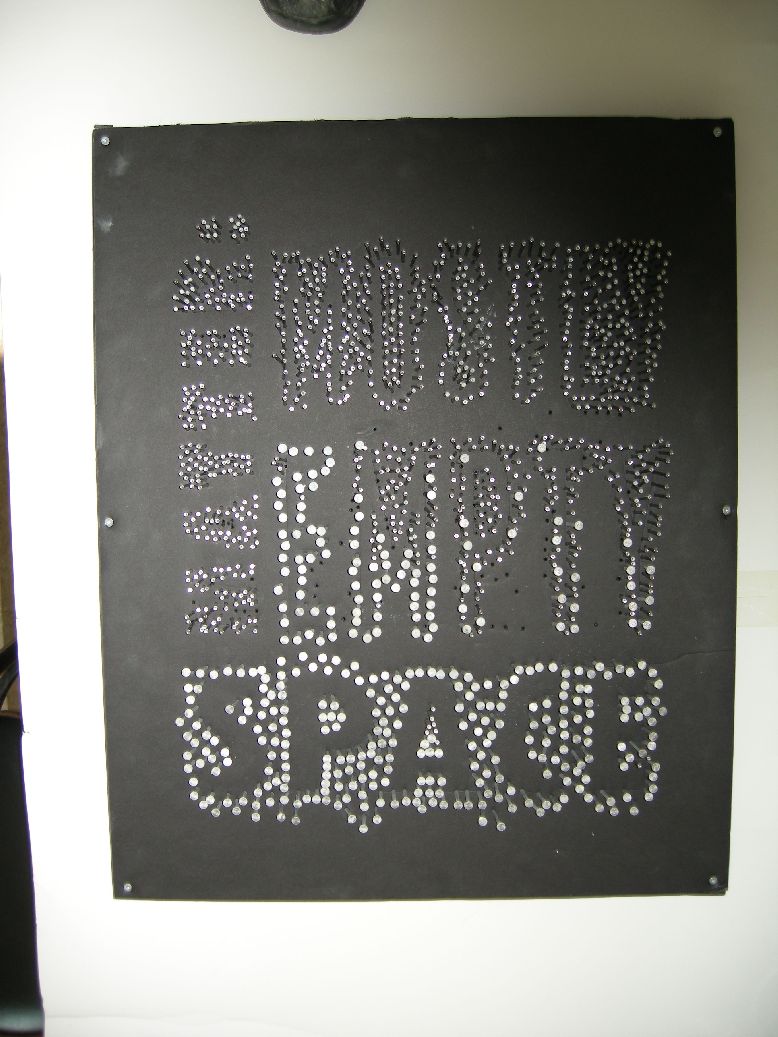
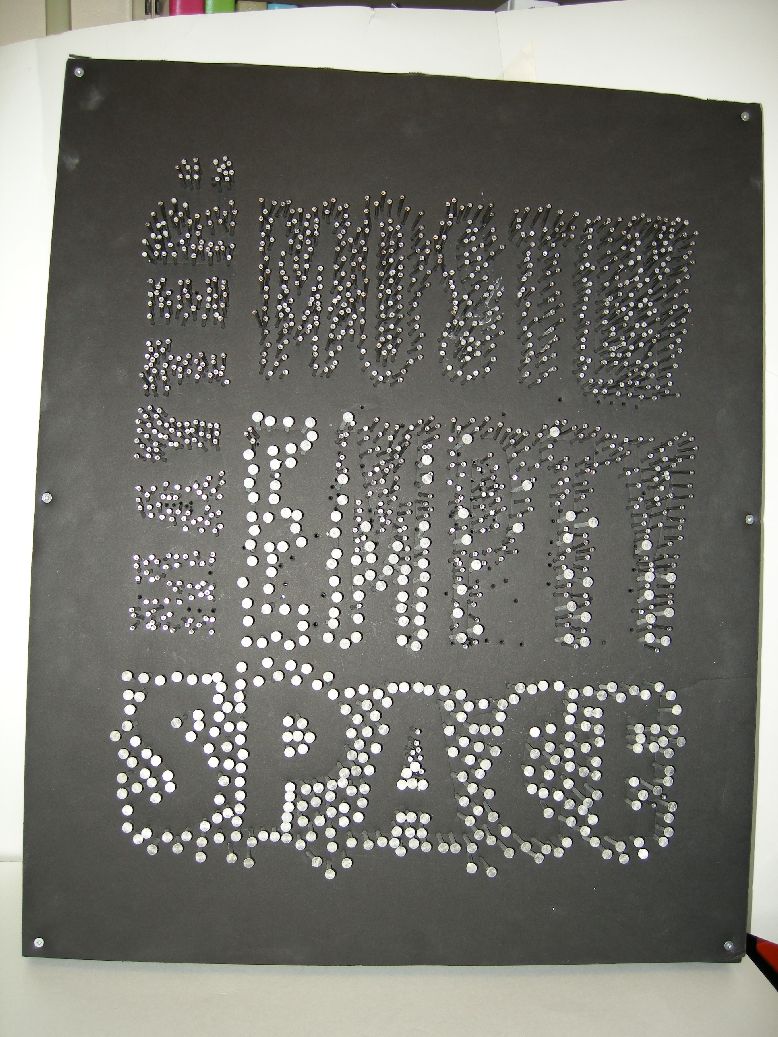
My art project, entitled "Empty Space" is a representation of both the macrocosmic and microcosmic worlds. It links the ideas of both quantum and relativity by ascribing the fact that the universe is made up of mostly empty space, be it with matter, like a piece of gold foil, or beyond terrestrial objects in space. Each letter of the phrase that the work depicts is made up of nails, and for that reason it is not continuous, like matter. Quantum theory holds that matter is not continuous and so my art is made up of empty spaces between the nails to depict this phenomenon. This concept was first explored with the Rutherford's Gold Foil Experiment in 1909 and forms the basis of Quantum theory. In his paper from 1911, Rutherford proposed that matter is mostly empty space as he observed the behaviour of alpha particles hitting a gold foil.
The second aspect of the art project is its relation to space and relativity theory, which proposes the groundbreaking idea that the universe is an ever-expanding space. In 1912, astronomer Vesto Slipher was the first to notice the expansion of the universe by observing that M104, the Sombrero Galaxy, was moving away from the Milky Way. In the late 1920s, Erwin Hubble confirmed that most galaxies are in fact moving apart from our galaxy, but questioned why they were receding at such a furious pace. The answer to Hubble's question came when Albert Einstein uncovered his general theory of relativity where he explained gravity and showed how space itself is expanding and carrying galaxies along with it. Galaxies themselves are not moving through space, but rather the space between galaxies is expanding, or stretching like rubber (Clark, 96). Apparently, since the Big Bang, galaxies have been receding and the further the galaxy is from the Milky Way, the faster it is receding. This expanding universe and the phenomenon of galaxies moving apart must mean that there is an ever increasing amount of empty space (Clark, 88-104). This is the second concept I incorporated into my art project.
The art project took a total of eleven hours to complete. The phrase – Matter: Mostly Empty Space – was arranged on Adobe Illustrator, printed and outlined onto a black foam board with the aid of an x-acto knife. I chose black as it is most inconspicuous and elegant colour to use when representing space. The foam board was a good option for this project because it did not dent the surface when punctured with nails, but stayed clean and rigid. It also kept the nails steadily in place.
There were some complications with the project. The number of nails used was beyond what had been expected. Mid-way through the project, I realized I wouldn't have enough. A total of 1,500 nails were used. This in turn made my project much heavier than anticipated and was therefore cumbersome for transportation. However, I still like the idea I worked with. In order to make it easier and more cost efficient, I could have used a different material but would have to work with a different idea. I like the way I represented the concept in a representative manner. To improve my work, I would like to add a coat of glow-in-the-dark paint to the surface of the nails to make it appear like the night sky, for the words to shine like stars. I originally had also wanted to add a few more nails in the background as the outline of a few constellations to further illustrate the “space” aspect of my work, but I simply had no additional nails to work with at the end. In fact, that is the reason why the word “empty” uses two different sizes of nails. Originally, I had wanted the entire project to use one size of nails. I had bought two sizes but intended to return one of them, according to which size seemed to fit best. I figured that my first box of 750 nails were more than enough. However, I ended up using both sizes and even had to return to the hardware store to buy more. If I could redo the project, I would use the larger nails as they make a clearer image. I would also use a single font. The words “space” and “matter” both use Futura LT Extra Bold, while the words “mostly” and “empty” use Universe Thin Ultra Condensed. It seems easier to decipher the words in the former font. However, I chose these fonts specifically to highlight the word space and to create an even and square-shaped layout.
Overall, I am quite pleased with my Science art project. While I was at first skeptical of the assignment, I think it helped me understand the theories of both Quantum and relativity more clearly, especially when writing this rationale. Despite my restraints and complications, it was a pleasure working creatively and using my imagination. I much prefer doing a project of this kind than writing an essay, as it is a far more pleasant way to research a topic. After all, I guess this is the reason why I've chosen to be a graphic designer!
Works Cited
Clark, Stuart. "The Expanding Universe and the Big Bang." Deep Space: the Universe from the Beginning. London: Quercus, 2008. Print.