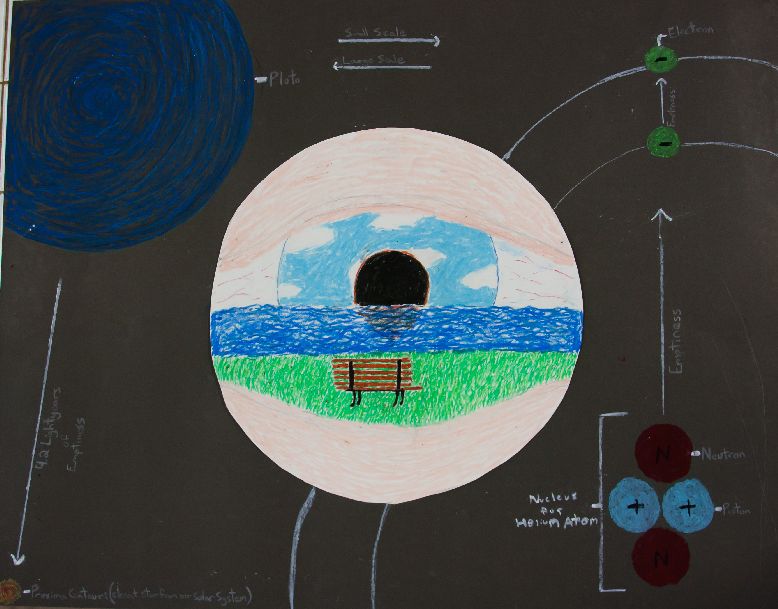
For my art work, I decided that I would try to demonstrate the fact that human perception is extremely limited, and influenced by our own senses. To do so, I portrayed the Rutherford-Bohr model of the atom, while emphasizing the empty space found in-between the nucleus and the electrons. Similarly, I portrayed Pluto and the nearest star from our solar system, Proxima Centauri, while emphasizing the empty space separating these celestial bodies. Between these two, however, I portrayed a human eye, which is inspired from Magritte’s The False Mirror, and which is peering at the ocean, a field of grass, and a bench. Here, the atom serves to represent how matter consists mostly of emptiness, and how things on the extremely small-scale are separated by vast empty spaces. Pluto and Proxima Centauri, on the other hand, serve to represent the fact that the universe consists mostly of emptiness, and that things on the extremely large scale, i.e. planets or galaxies, are likewise separated by vast empty spaces. The eye represents our own unique perception; instead of viewing everything around us as consisting of mostly emptiness, we see the universe as being extremely busy, and we perceive matter as being whole. It is only recently, through the discoveries of scientists such as Rutherford and Einstein, and through Quantum theory, that we have come to realize that our perception is truly limited, and that there are certain aspects of the universe which we cannot comprehend. Indeed, we are not able to fully understand ideas such as the wave/particle duality of light and electrons, because our senses cannot envisage such a form, and we have a hard time imagining quantized, because everything for us is continuous. The eye is therefore looking at something which is unique to human beings, and the fact that the landscape is part of the eye itself means that it is shaping its own view of the world through its senses.
Click for a larger view