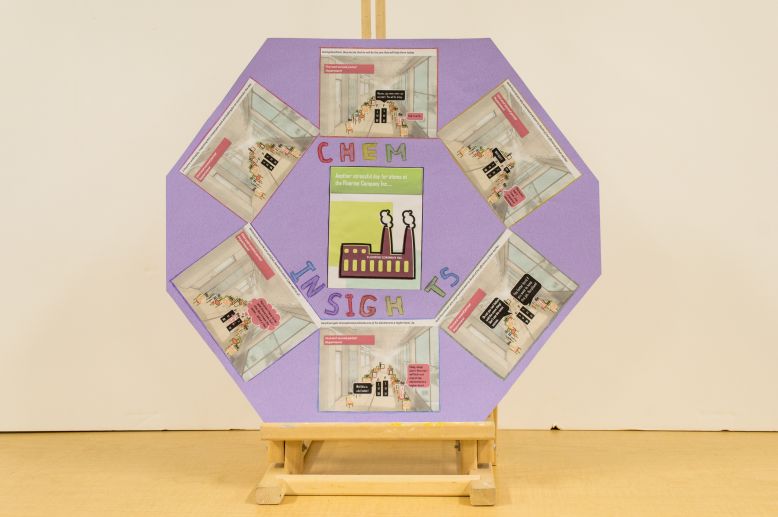


My artwork presents a story of a bond formation. It shows how not every element can bond with another one even if this element is fluorine, the Godfather of all elements. The Godfather who is the most electronegative element of all has the capacity to react with most of the elements, even with some noble gases from the last group. However, in my comic, I show an exception to this rule by portraying helium as the non-reactive element. In fact, from the periodic table, we see that this noble gas is in the first period which means that it only has one orbital that contains both of his electrons. Because of this, helium is in the impossibility to send one of his electrons to a higher level since he doesn’t dispose any other orbital; he only has one, 1s2.
To create a bond, elements need at least one unpaired electron. When two unpaired electrons pair up, a chemical bond is created. I demonstrate this idea in my short story where two fluorine atoms (which have one unpaired electron each) want to form a bond with beryllium. At the ground state, beryllium has no unpaired electrons since his four electrons are equally distributed in 1s and 2s orbitals. Thus, at this state beryllium cannot do any bonds.
To be able to create a bond with 2 fluorine atoms, beryllium needs two unpaired electrons. To do this, beryllium sends one of its electrons from the 2s orbital to the 2p orbital. Having two unpaired electrons, beryllium is able to connect with two fluorine atoms.
In order to complete the process of sending an electron to a higher level, beryllium needs to absorb energy. This energy has to come from the environment: vibrations, heat or any other form of energy that would permit an electron to jump to a higher level. This fact portrays the principal of the energy conservation. The famous quote by Einstein states that “energy cannot be created or destroyed, it can only be changed from one form to another.” Since energy is conserved, it is has to be absorbed, and then released. It is absorbed during the electron level change and released during the bond formation, since it is an exothermic process.
BeF2 is one of the molecules where there is less than octet for one of the atoms. In this case beryllium is left with 4 electrons valence instead of 8 electrons, which demonstrates the exception to the octet rule.
My artwork has four big chemistry ideas of the nine Atkins’s big ideas in Chemistry. The first one affirms that “matter is made of atoms.” In fact, I portray in my comic story many atoms that compose everything that surrounds us in everyday life. Since my story happens in the “First and Second period Department” we only see elements from the first two periods. Beryllium, Helium, Hydrogen and Lithium are some examples that are presented there. The next big idea consists of the fact that “elements display periodicity.” I demonstrate in my artwork some trends that occur in the periodic table. The main one is electron configuration. In fact, I portray the way that the electrons are distributed among orbitals, by choosing the square representation of the orbitals. Each of the elements has its proper electron configuration. Then, “chemical bonds form when electrons pair” is a big idea that I explained in the first part of the rationale. Finally, the last big idea that I included in my artwork is that “energy is conserved”, that I also described above.
Works Cited
http://www.nyu.edu/classes/tuckerman/adv.chem/lectures/lecture_2/node4.html
http://www.goodreads.com/quotes/4455-energy-cannot-be-created-or-destroyed-it-can-only-be
http://www.avogadro.co.uk/h_and_s/bondenthalpy/bondenthalpy.htm
http://www.artandchemistry.ca/bigideas.html
Zumdahl, Steven S. Chemistry. 9nd ed. Lexington, Mass.: D.C. Heath, 2014. Print.