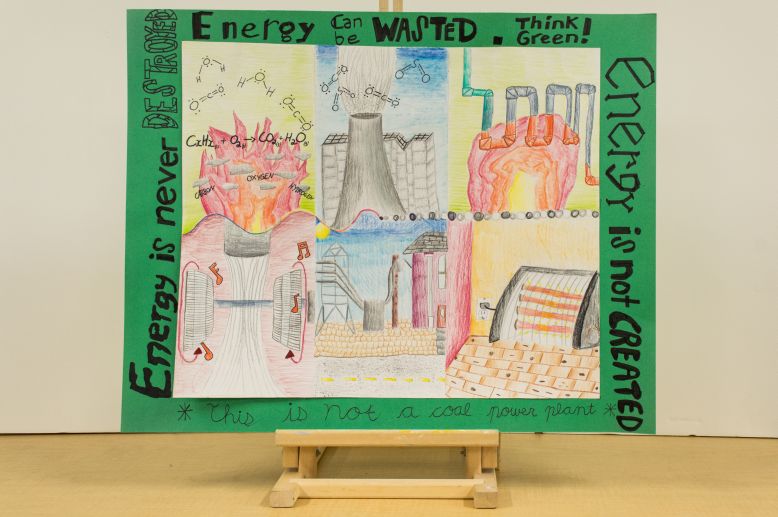


To begin, all the ideas portrayed in the artwork are wrapped around writing that indicates the premise of the design. On the right and left borders, the iconic dictum related to the conservation of energy is stated; “Energy is never destroyed, energy is never created” in eye-catching typography. At the top, a statement says that “Energy can be wasted”, as displayed in the scenes drawn in the artwork. Right next to that sentence, there is a call to action, suggesting that the observers should “Go Green”. This is done to capture the attention of a viewer. On the bottom part of the boundary, as inspired by “The Treachery of Images” produced by Rene Margritte, it is stated that “This is not a coal power plant”, the design is a representation of one. The poster is green, to make a connection with environmentalism. Mediums used include colored pencils and sharpies.
Now, the scenes themselves. The order of which the images flow is from left-to-right, line-by-line.
The first image reveal the combustion of coal in a furnace. The ideas of how “matter is made up of atoms”, that “molecular shape is a crucial feature in chemistry” and “chemical bonds form when electrons pair”, along with how energy is conserved, are being showcased. Also featured is how there are “4 types of chemical reaction”. Energy in this scene is converted from chemical potential energy stored within coal to thermal (infrared) energy. However, some energy is squandered as visible light. Furthermore, much of the coal remains unburnt due to insufficient surface area, which leads into the next design. Also presented is how molecules have bond shapes and angles. CO2 is linear, whereas H2O is angular in shape, with an angle of 104.5 degrees. A redox reaction is taking place here. The gross green background symbolizes how “dirty” the fuel is.
The second image features a smoke stack spewing out unburnt coal, along with other pollutants such as SO2, which causes acid rain, and CO2, the root cause of the rise in climate change. However, it is important to advertise how much of the heat is wasted and sent out into our air, meaning that the coal fire isn’t very efficient, considering how much energy is stored in coal. The plant’s colors are dull, to portray how lifeless the future may be if we continue to use this dirty fuel.
The third scene is a rather interesting one; the water pipes are seen getting heated up within the furnace, heating the water within the pipes. . Energy is squandered here due to how the electrons in the metal of the piping are excited and then emitting visible light. This in no way contributes to the production of electricity. Quantum concepts of how much energy is needed to excite metal’s electrons can be viewed. The color choices here are to showcase the heating of pipes and how water flows through the pipes.
In the fourth design, the steam produced is causing turbines to spin. As one may notice, there are many small musical notes around the turbines. This is to illustrate how some of the energy of the steam isn’t being perfectly transformed into electric energy by the spinning turbine. Rather, it is wasted on friction, which is then converted to sound energy, which in no way aids in the production of electricity, but rather hampers the process. Also, this step portrays how barriers of physical reaction are broken to get the turbines to spin in the first place. Red is to showcase how energy is wasted.
For the fifth image, energy going from a power plant to the home is demonstrated. This part displays how far the energy has to travel. By traveling that amount of distance, some energy is lost due to the wires’ resistance. Transformers help recover some energy, but there is never a full recovery of lost energy in the transportation aspect of electricity. Also, the ground has undergone desertification, as a result of climate change and the damaging effects of acid rain.
Finally, demonstrated is a plug-in heater, emitting heat. However, the heater elements illuminate. More quantum are present here, right in the residence. The electrical energy is transformed into thermal energy and light energy, further increasing energy waste.
Lastly, of note is the divider of the top and bottom; half is a wave and half is made up of particles. This is done not only for elegance, but in homage to the wave-particle duality of photons and electrons, and even the multifaceted nature of energy in general. The wave part is colored like the visible light spectrum.
Works Cited:
Zumdahl, Steven S., and Susan A. Zumdahl. Chemistry. 9th ed. Belmont, CA: Brooks/Cole, Cengage Learning, 2014. Print.
"Redox Reactions." Concepts in Biochemistry. Wiley. Web. 13 Dec. 2014..