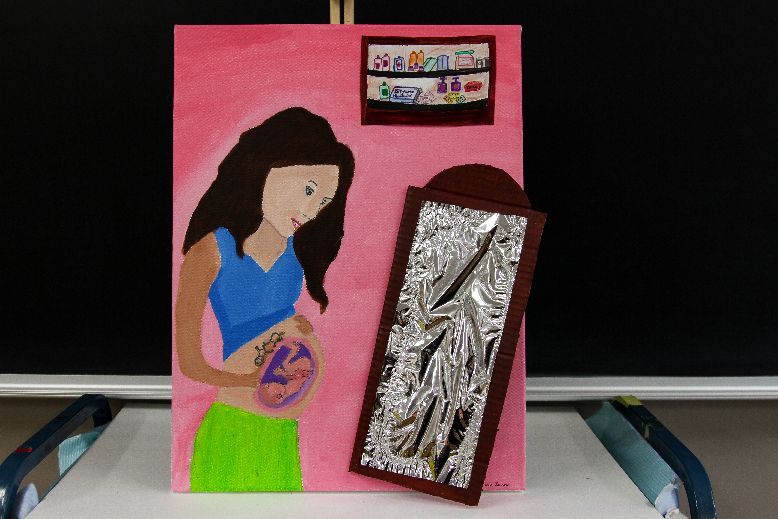


Stereochemistry in pharmaceuticals drugs is an important aspect in the development of medicine. About half of the drugs marketed are chiral and within this group, there are mixtures of enantiomers (racemic) and single enantiomers. Because living systems consist of enantiomeric molecules, the chiral drugs react differently with the chiral receptors and enzymes in the human body. One enantiomer of a drug may react effectively to treat a disease, while the mirror image may be unsuccessful. On the other hand, one enantiomer may generate one biochemical response, whereas the mirror image would reveal a completely different response which was the case of thalidomide. The thalidomide tragedy was an important event in the history of medicine. In the late 1950s, this drug was introduced to treat morning sickness in pregnant women. However, it caused over 10 000 birth deformities all around the world.
In my artwork, I portrayed this tragic event and showed the consequence of using thalidomide. The materials used were a canvas, a cardboard, acrylic paint, and a silver gift wrapping paper. First, I used a pink background to show the feminine side of the artwork because it is related to pregnant women. In the background, there is a medication shelf where many drugs including thalidomide and other medications are shown. The thalidomide box is left open which means that the lady recently took the drug. However, the main focus of the project is on the pregnant lady and the mirror. The lady is painted with the baby inside her uterus and a thalidomide molecule around her placenta. The lady is looking at herself in the standing mirror and she sees a deformed image. On one hand, the concept of mirror represents the fact that enantiomers are mirror images of each other. For example, on the canvas, one enantiomer of the thalidomide molecule is shown, while on the cardboard standing mirror, the mirror enantiomer is shown. On the other hand, the deformity of the baby is shown through the deformed image of the mirror. The deformed mirror was created by using silver gift wrapping paper that reflected an unclear mirror image. Thus, two important aspects of chiral drugs were shown through this artwork: the deformity of the baby when a mother takes thalidomide and the mirror image concept of enantiomers. Furthermore, the reason behind the standing mirror sticking out of the canvas is to create a three dimensional and realistic effect. Hence, my goal was to create an artwork that would be subtle, and yet portray the tragic outcome of using thalidomide. The subtleness illustrates the fact that negative side-effects of various medications cannot be discovered immediately after administration and that at the end, these side-effects can be very harmful.
Organic chemistry was originally defined as the study of life and compounds created by living organisms. However, its definition now encompasses also the artificial synthesis of substances. It plays a significant role in our everyday lives because organic compounds are important in the creation of medications, plastics, fibers, insecticides, petroleum derived chemicals, etc. For example, the role played by organic chemistry in the pharmaceutical industry has a great impact on the discovery and development of drugs. Nowadays, harmful side-effects and rapid changes in drugs are influencing the decisions of medical chemists involving the synthesis of certain drugs, for example chiral drugs. However, with new synthetic methods and technologies being available, medical chemists are able to improve drug metabolism and chemical toxicology. Hence, the study of organic chemistry is a key in developing new products and improving them. Its discoveries are not only helpful in improving medicines, but other fields such as agricultural and even biology.