

Try to imagine a world without order. Chaos seems to be the first thing that comes to mind, although the world was not chaotic before the human species evolved. The truth is that this is impossible, for everything is capable of being classified in some sort of order, whether it be ascending order, a function describing an order, or even “random order”. Take the idea of statistics to prove that there is order within randomness. When throwing a dice, there are 6 equal possible outcomes. The more rolls, the more the odds per possible outcome will tend to 1⁄6. After a large amount of rolls, this idea can be used to predict future rolls as the outcome in the minority. This idea of order truly describes chemistry. With the endless amount of molecules that can exist, each has its unique order.
Let’s start with the idea that matter is made of atoms. Just like a house has its inner contents, so does matter. Matter is thus composed of unique elements, which we call atoms. Each atom contains its distinctive properties such as boiling point, chemical stability, color, etc. Consequently, when various atoms interact with each other, they too obtain their distinct properties. This can be observed from the two compounds, (S)-Carvone and (R)-Carvone, which are nearly identical but have completely different smells (Caraway and Spearmint respectively). This sense of uniqueness between molecules and atoms can be systematically ordered to distinguish one from another.
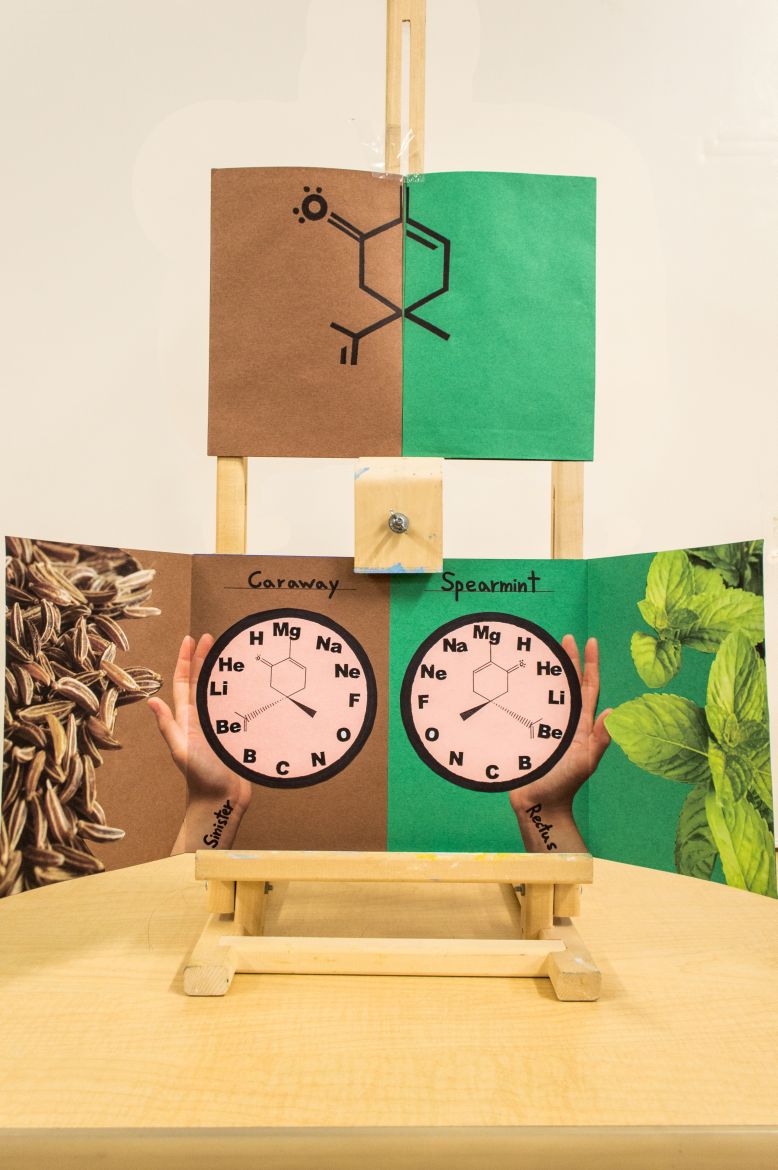
This brings us to the idea that elements display periodicity. In 1869, a Russian chemist, Dmitri Ivanovich Mendeleev, showed exactly this by beginning to formulate the famous Periodic Table. This table arranged the atoms in relation to their key properties, such as atomic weight, valence electrons, and alikeness. This order also led to predicting new elements and new ideas. About a century later, three chemists by the names of Robert Sidney Cahn, Christopher Kelk Ingold, and Vladimir Prelog created their own nomenclature system for mirrored, non-superimposable molecules, also known as enantiomers. This system involved the order of the periodic table as a priority list: the greater the atomic number, the greater the priority. With this, enantiomers could be determined through the case where a carbon of four distinct branches tended to an increasing priority in either the clockwise direction (“Rectus” for straight) or the counter-clockwise direction (“Sinister” for left). This is shown in the clocks where the hours are replaced by the first 12 elements, and where in spearmint the priority order is clockwise (R-Carvone) while in caraway the priority order is counter-clockwise (S-Carvone). So again while each molecule is so similar, they are completely different, and still capable of having an order.
Lastly, molecular shape needs to be addressed, for it the most crucial example of order within chemistry. Molecular shape is so important because it explains the limitations of atoms resulting as their properties. Just like (S)-Carvone and (R)-Carvone are non-superimposable mirror images of each other, so are our hands. And just like a left hand cannot shake hands with a right hand, both enantiomers interact differently. This is the reason for which they smell differently, as they fit differently in the receptors in our nose. It is also the reason for which they look completely different. As they interact with different matter, they each grow out uniquely. This is shown where both are emerging from their respected sides in their own unique colour, and overall appearance. So just like the saying goes, “A place for everything and everything in its place” (Benjamin Franklin), even enantiomers have their own uniquely fitting place. This ties together the overall sense of order.
To sum up, chemistry has order. From matter, to its inner elements, to the way they fit with one another, they all represent this idea of order. Although this goes against the second law of thermodynamics that everything tends to a more disordered state, this shows that even “disorder” has bounds that can be used for order. And as explained, this is all represented by the components of this artwork. So again, try to imagine a world without order. Doesn’t seem like it would be able to exist at all.
Works Cited
"Benjamin Franklin Quote." BrainyQuote. N.p., n.d. Web. 05 Dec. 2014. link.
"Cahn–Ingold–Prelog Priority Rules." Wikipedia. Wikimedia Foundation, 29 Nov. 2014. Web. 05 Dec. 2014. link.
"Caraway." Www.google.ca. N.p., n.d. Web. 05 Dec. 2014. link.
"Carvone." Www.google.ca. N.p., n.d. Web. 05 Dec. 2014. link.
"Hands." Www.google.ca. N.p., n.d. Web. 05 Dec. 2014. link.
"The Origin of the Periodic Table." Www.colorado.edu. N.p., n.d. Web. 05 Dec. 2014. link.
"Randomness." Wikipedia. Wikimedia Foundation, 12 July 2014. Web. 05 Dec. 2014. link.
Smith, Janice G. Organic Chemistry. New York, NY: McGraw-Hill, 2011. Print.
"Spearmint." Www.google.ca. N.p., n.d. Web. 05 Dec. 2014. link.
Zumdahl, Steven S., and Susan A. Zumdahl. Chemistry. Belmont, CA: Brooks/Cole, Cengage Learning, 2014. Print.