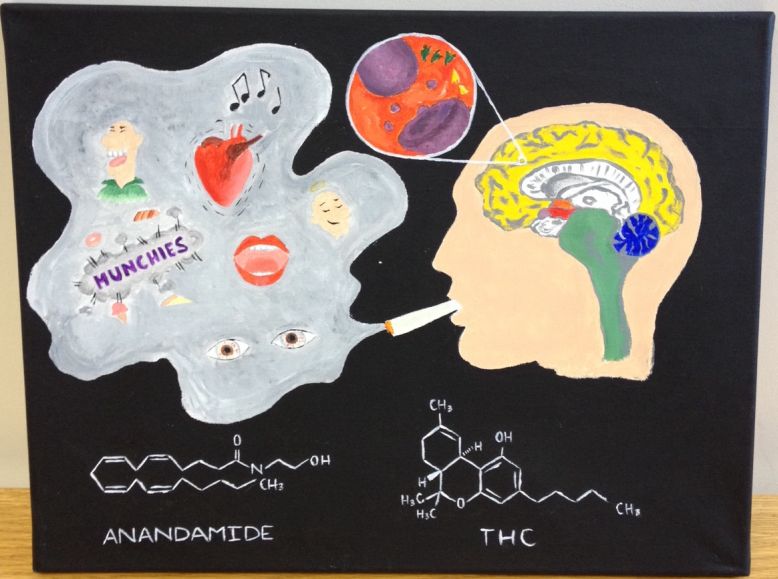


My art project is about the effects of THC, or more commonly know as marijuana or weed, on the human brain. People usually only know the feeling and symptoms that marijuana gives you when you ingest it. However, I wanted to find out how it works on our brain and why we have those feelings. That is why I included in my art project the human brain. I painted a human that is smoking a joint. In the smoke, I drew the symptoms of the drug that are visible: red eyes, munchies (increase of appetite), love for music, laughter, feeling of relaxation, increase of heart rate, and dry mouth. The parts of the brain that are affected by marijuana are in different colors. The drug affects each part differently. The hypothalamus (orange), when affected by THC, causes an increase of appetite. The cerebral cortex (yellow) can alter consciousness, perceptual distortions, memory impairment, occasional delusions and hallucinations. The brain stem (green) can decrease nausea, increase heart rate, and reduce blood pressure. The hippocampus (red) can bring impairment in memory. The cerebellum (blue) can reduce spasticity and give impaired coordination. The amygdala (purple) can give anxiety and panic or reduce anxiety and hostility. I also drew a “zoom-in” on the brain. There, you can see how THC activates the cannabinoid receptors, which are usually activated by endocannabinoids such as anandamide. I also added the molecular shape of THC and anandamide at the bottom of my painting.
The big ideas of Atkins included in my art project are that matter is made of atom, elements display periodicity, chemical bonds form when electrons pair, molecular shape is a crucial feature in chemistry, and energy is conserved. I show that matter is made of atom by demonstrating that marijuana, a plant, is made of atoms of C, H and O. Since THC and anandamide are composed of C, H and O, the usual “suspects”, I show that elements display periodicity. Further more, by drawing those two molecules, I proved that chemical bonds form when electrons pair and molecular shape is a crucial feature in chemistry. Lastly, the energy is conserved from when marijuana is ingested to when the first symptoms are shown. No energy is lost; it is only transformed throughout the process.
My art project shows the effects of THC on the human brain and the symptoms that it causes. It also includes four big ideas of Atkins: matter is made of atom, elements display periodicity, chemical bonds form when electrons pair, molecular shape is a crucial feature in chemistry, and energy is conserved.