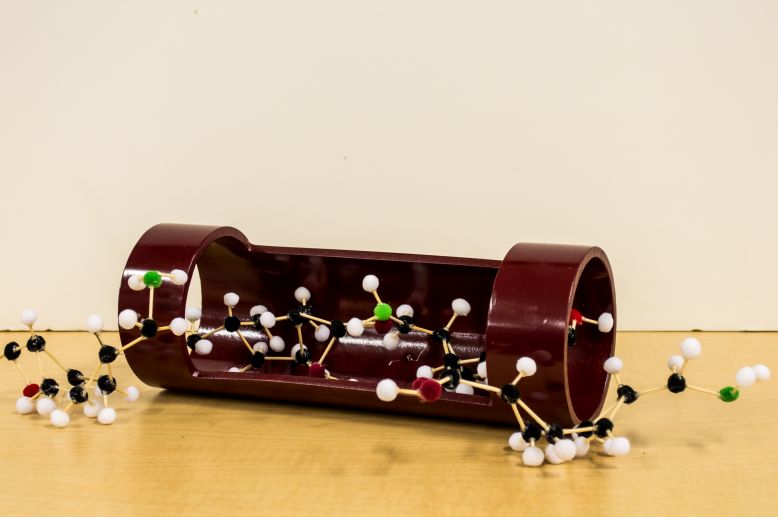


Antifibrinolytics are used in every day medicine. Might it be heart surgery, dentistry or even relieving simple things such as menstrual bleeding, this category of drugs can be lifesaving. Tranexamic acid is not a compound that has been recently discovered, in fact it has been discovered over forty years ago, yet it is still greatly used to this date. This is due to its simplicity, great efficiency, and safety when used for the treatment of excessive bleeding. Tranexamic acid inhibits the activation of plasminogen by binding itself to the kringle domains of the enzyme. This reduces the amount of plasmin converted from plasminogen, which in sum reduces the rate of degradation of blood clots in the blood stream. This is particularly useful for any wound which induces an excessive amount of bleeding in people. In fact, in this presented piece, the opening through which we can see the tranexamic acid is actually a wound. The agglomeration of clots that forms from the lack of fibrin decay permits the body to seal off any wounds much quicker and reduce the chances of fatal blood loss.
As I started this project, I was very interested in something relating to medicine. The idea of the various conformers of cyclohexane, a practically comical representation of such a facet of chemistry, was extremely appealing and I felt the necessity to interlink both subjects together. The image that stayed with me the most was the movement of a boat sailing through an ocean. The perfect molecule to be my boat was tranexamic acid. A di-substituted cyclohexane with a para orientation, making it perfectly represent a boat with a mast and a sail. The metaphorical ocean in this piece is the blood through which it is sailing, to reach and bind to the nearby plasminogen enzymes. For the piece, this is represented through the blood vessel that the drug is traveling through. Although the boat conformation is the least stable, and least probable conformation for the molecule to be in, I still chose to represent the molecules as that conformer to convey the importance of my artistic vision and essentially reinstating the importance of molecular shape.
The important big ideas of Atkins in this project are number three and number four. Molecular shape, and residual forces are extremely important to induce the wanted effects of tranexamic acid. Due to the substituents and substituent’s location on the cyclohexane ring, tranexamic acid is able to perfectly bind itself to the five or six lysine binding sites of plasminogen and henceforth almost completely halt the activation of the enzyme. This binding however, is only possible due to the residual forces because of the possibility of hydrogen bonding from the amino group and the carboxyl group attached on the both sides of the ring. If it wasn’t for these two, this molecule would serve no purpose. Of course, these two ideas are not the only ones that are present. The first idea, that matter is made of atoms, is clearly demonstrated through the usage of colored atoms. The third idea, that chemical bonds form when electrons pair, is as well expressed with the respect of all the bonds in the molecule; sigma and pi bonds are properly represented within the models.
This comes to show, that no matter what is presented or demonstrated in chemistry, at least a couple of Atkins’s big ideas will always be present. These ideas permit us to understand chemistry at an elementary and complex level. In the end, everything related to chemistry in some sort of way, can relate to Atkins’s big ideas.