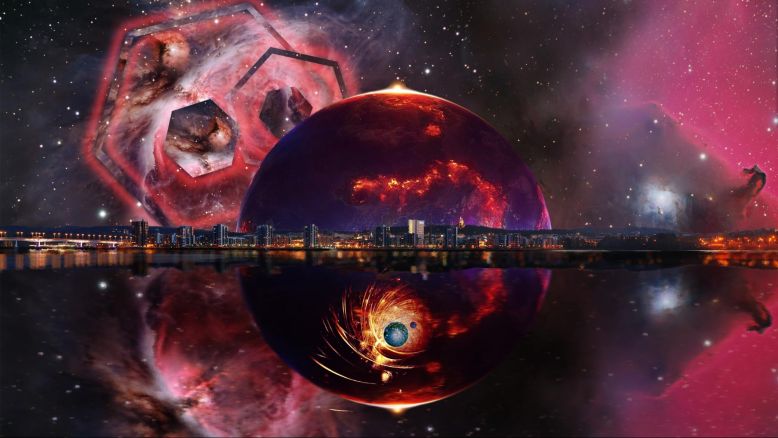


Ever since Antiquity, philosophers have reflected on man's place in the universe. For a long time, they believed that our planet, Earth, was at the very center of the cosmos. This belief was first challenged by Galileo and has since been clearly disproved. However, centuries of scientific discoveries have revealed not only that our universe is unbelievably immense, but also that its complexity is ever-present up to the infinitesimal dimensions found at the quantum level. On this scale ranging from the smallest subatomic particle to galactic superclusters, it so happens that mankind and its creations are situated in the middle. It is on this basis that I created my artwork, proposing to the viewer a new and personal take on what it means to be "at the center of the universe".
This notion of center is first conveyed by the positioning of the cityscape, symbolising mankind, as the axis of symmetry of the image. Above it is a colorful night sky and an imposing planet with a sun rising behind it. This appeals directly to the human millennia-old fascination with the heavens and at the same time informs him that the scenery may be set in the future, or on a different world altogether. The sky is reflected in a serene river below the city, giving the illusion that the planet is complete.
On the left side of the sky is the Orion nebula, a distant gaseous cloud that is known for the formation of stars, but also for the synthesis of organic molecules. I represented these molecules with hexagonal shapes reminiscent of the carbon rings found in many of them. These hexagons are also surrounded by a red glow meant to symbolise the intermolecular forces that have an important role to play in some organic reactions, as well as the spectroscopy methods used to analyse the composition of stars and nebulas. Nevertheless, this is not the only way of interpreting the abstract elements of the artwork. Indeed, the hexagons, containing magnified parts of the Orion nebula, also illustrate gravitational lensing, an effect occurring when massive celestial bodies distort the surrounding space-time fabric which then bends the light of an object behind it. Furthermore, the surrounding glow is reminiscent of the red shift that occurs when the wavelengths of light from a distant source is lengthened as a consequence of the expansion of the universe. This expansion is a cause to the increasing entropy of the universe, and it is theorised that eventually matter will be so scarcely spread that all forces will be too weak for it to conglomerate into bigger structures such as stars, molecules, or even atoms. But, essentially, the hexagonal shapes stand in my artwork as the main symbol for both organic molecules and the general theory of relativity.
In the lower center of the image is one of the main focal points of the artwork, grabbing the viewer's attention thanks to a great contrast with the dark reflection of the planet in the background. It is an antimuon, a positively charged fundamental antiparticle that has approximately one ninth of the mass of a proton. The antimuon is orbited by an electron, and it consequently forms an exotic muonium atom that would chemically behave in a similar way to hydrogen atoms. The antimuon is surrounded by bright sparks of light representing Cherenkov radiation. This radiation is produced when a charged particles travels in a medium faster than the speed of light in that medium. It is mainly observed in the water surrounding nuclear reactors, but Cherenkov radiation can also occur in the vitreous humour of the human eye. It is analogous to sonic booms and demonstrates the wave nature of light. Because of that, and because of the scale and the exotic properties of the antimuon, this part of my artwork acts as a major symbol of the quantum world.
Upon further observation, the viewer realizes that both the hexagons and the antimuon are unique to their respective half of the picture. The reason for that is scientists have yet to produced a unifying theory of quantum relativity. Indeed, the two best models we currently have – general relativity and quantum mechanics – are totally incompatible. I wanted to represent this break in our theories in order to bring back the idea that everything is depicted from a somewhat incomplete human perspective.
Finally, the whole artwork also contains multiple key notions present in chemistry and in physics. To name just a few, we can notice the optical phenomena of reflection in the river and of diffraction of the sunlight around the planet, as well as the bright red pools of magma on the planet that get their color from photons ejected during electronic transitions in the atoms excited by the heat.
The overall artwork, as stated previously, is meant to offer a different and intriguing vision of how we, humans, can perceive the world from our position which is, in terms of scale, at the center of the universe.