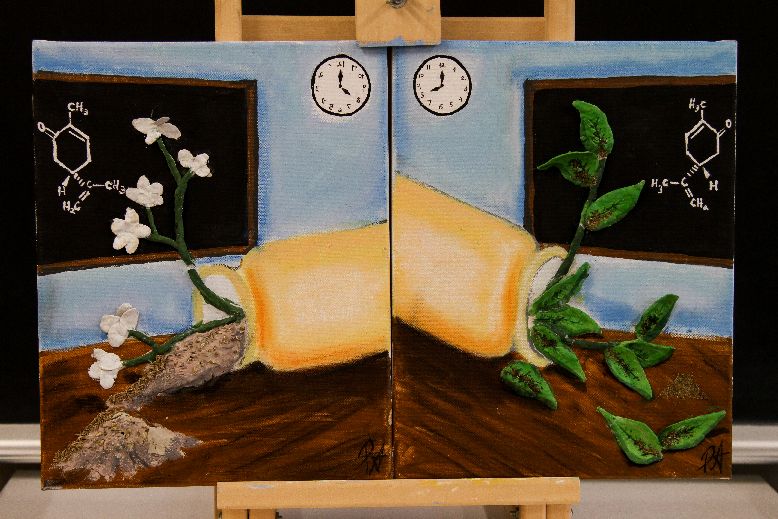
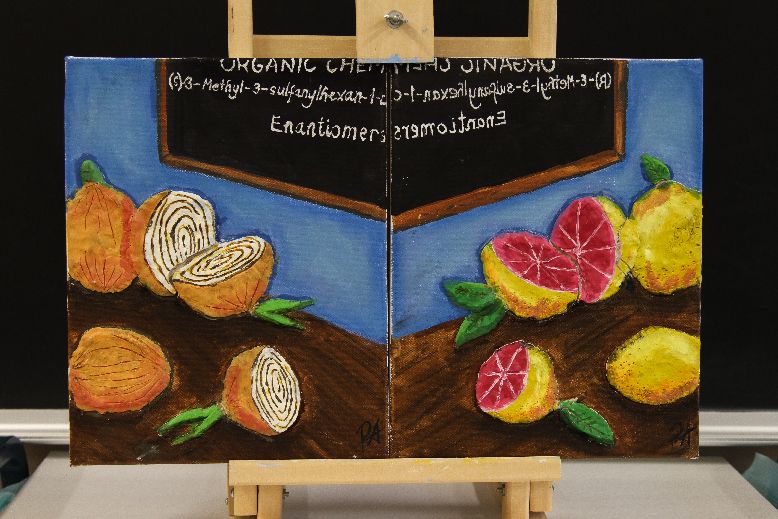
This artwork portrays how enantiomers differ in smell. On the first two images, I illustrated spearmint and caraway seeds. Although spearmint and caraway may not look like they're physically related, their chemical structure is very similar to each other. In fact, the only difference in their chemical structure is that one is the mirror image of the other. These are known as enantiomers. There might not be very scientific concepts on the paintings, but look closely at the chemical structures drawn on the blackboard. This simple structure is what causes the specific smells of spearmint and caraway. They were purposely drawn as if one of them was facing a mirror, since it is the enantiomer of Carvone that has the odour of caraway. The main idea in these paintings is to draw them opposite of each other, in other words, they have to look like one is a mirror image of the other. This is why the spearmint and the caraway seeds are in the exact same yellow jar, and the table is made of exactly the same material and the clocks are both red. The only difference that should be visible is what the jar contains. For the next two canvases, I illustrated onions and grapefruits. Just like spearmint and caraway seeds, they are not physically similar, but their smells are both based on the same chemical compound: 3-Methyl-3-sulfanylhexan-1-ol. The enantiomers of this compound which are (S)-3-Methyl-3-sulfanylhexan-1-ol and (R)- 3-Methyl-3-sulfanylhexan-1-ol differ in the smells they project: one has the smell of onions, and the other has the smell of grapefruits. You can see on the painted blackboard the UPAC names of the chemical compounds, where on the first painting is (S)-3-Methyl-3-sulfanylhexan-1-ol, and (R)-3-Methyl-3-sulfanylhexan-1-ol on the other, which is written backwards (since it is supposedly the mirror image). To really visualize the organic chemistry in this artwork, you have to look at all four paintings together where you can see the chemical structure and UPAC names of the compounds, and also the distinctive odours each of the enantiomers give. The choice of color was very important to bring out the essential parts of the artwork. I chose to use very dull colours for the background such as blue, gray and brown so that the bright colours "pop out". The use of the blackboard really helped bring attention to the chemical structure, and the name of the compounds. I then thought that since white on black were colors that are very noticeable, I had to use even brighter colors to bring most of the attention towards the spearmint, caraway, onions and grapefruits. I then thought of using clay to give a three dimensional effect, which would surely attract the most attention. Over the clay, I tried using different shades of bright and vivid colours to give a better effect. Finally, to make it easier to understand the topic that is related to my artwork, I added real dried mint leaves and real caraway seeds over the clay to really express the different odours of the enantiomers. Organic Chemistry has many interesting concepts that we can relate with our everyday lives. Just like the topic of this artwork which is how a simple compound that is basically a mirror image of another can express a completely different smell. Without organic chemistry, no one will be able to find any relationship between an onion and a grapefruit, or spearmint and caraway, when in fact, they share almost the same compounds.
Click for a larger view