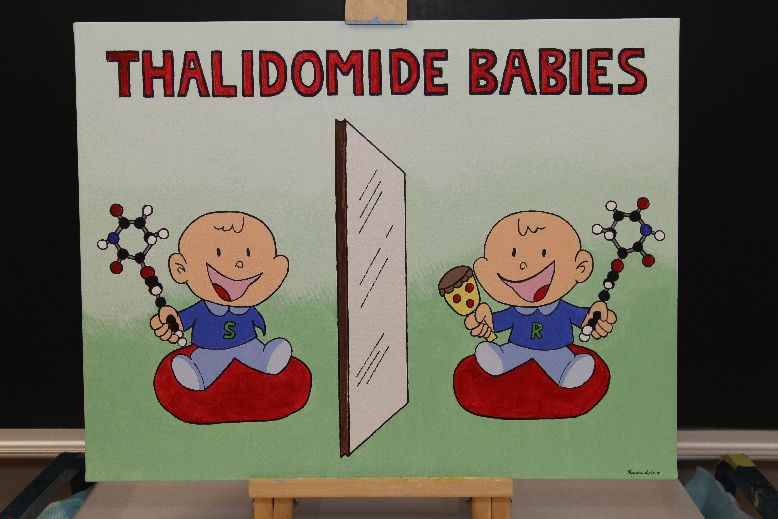
The pharmaceutical industry is constantly working on methods and ways to enhance their drug's efficacy, as well as its safety for the consumer. The hurdle that they are constantly being slowed by is the chirality in a majority of the drugs being produced. Chirality is the asymmetry or handedness of a drug. The most common way chirality can arise is through an asymmetric carbon. A carbon atom is said to be chiral when it is attached to four different atoms or groups. This being the case, there can be two enantiomers (right and left handed) produced that have similar structures but differ in spatial arrangement. In other words, the two enantiomers are mirror images of each other and are not superimposable, similar to our hands. Therefore, since the body is able to identify between enantiomers, it is crucial for the pharmaceutical companies to separate them, making a chirally pure sample of the drugs. In the case of this painting, the thalidomide chiral drug was produced in order to help pregnant women with morning sickness. However, at the time of its production, the scientific community had not yet learned about chirality and its handedness. Because of this lack of knowledge, many babies, whose mothers had consumed the thalidomide drug during pregnancy, were born with malformations. In the painting there is a mirror in the center standing vertically, and there are two babies to either side of it. Each baby is smiling and enjoying itself as babies normally do. They are holding, what look to be, identical models of the thalidomide drug. However, being that the thalidomide drug contains a single chiral carbon that is spatially positioned to produce non-superimposable mirror images, one is actually holding the 'S' enantiomer while the other is holding the 'R' enantiomer. The babies holding the 'S' and 'R' enantiomers have an 'S' or 'R' on their shirts respectively. Consequently, the baby holding the 'S' enantiomer represents the baby born to a mother who took thalidomide during her pregnancy and was affected by that enantiomer, causing her child to be born without a left arm. On the other hand, the baby holding the 'R' enantiomer represents the baby born to a mother who also took the thalidomide drug during her pregnancy, but instead either took it at a different time during the pregnancy or was simply not affected by the 'S' enantiomer, and therefore gave birth to a normally healthy looking child. The header on the painting clearly states "Thalidomide Babies" to help the observer to understand what the painting is about. The babies on both sides of the mirror, as well as the cushions they are sitting on, are drawn in such a way so as to give off the mirror effect. In other words, one side is painted as the mirror image of the other, with the exception of the missing arm. The colors in the painting, were not chosen for a specific reason other than to make the painting visually appealing, except in the case of the thalidomide models painted in the babies' hands, where the colors used follow the convention of colors given to the elements.
Click for a larger view