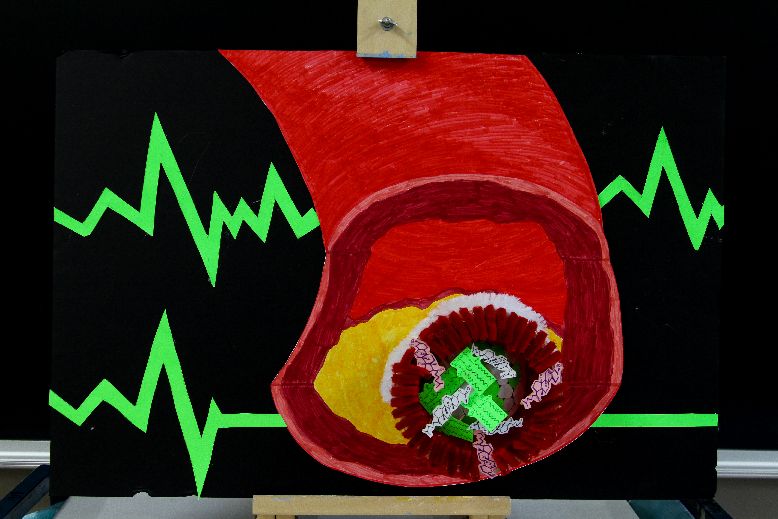


Atherosclerosis is a very complex condition that involves hindered blood flow in the arteries caused by the buildup up of plaque. Plaque originates from cholesterol that is transported throughout the body with a low density lipoprotein (LDL) molecule as a transport medium. If the growth of plaque is severe, blood clots may form causing reduced blood flow, and therefore insufficient supply to the heart or the brain. This is a grave problem in the twenty first century as people are unaware of the consequences of their poor lifestyles and are not willing to make changes.
My artwork represents the cross-section of an LDL molecule, which is the structure that is coming out of the poster. The circular red pieces on the exterior represent the hydrophilic heads of the phospholipids and of cholesterol. The reason I picked these colours, is to demonstrate that LDL is in the artery, which is different shades of red. A thick white pipe-cleaner was used as the apoprotein B. I made sure it was very dense to demonstrate that it takes up a large surface area on the molecule.
Thick red pipe-cleaners where used to represent the hydrocarbon chains in the phospholipid layer. Amongst them, cholesterol molecules were embedded, which were drawn on a pink background. The hydroxyl groups (-OH) are directed outwards to demonstrate that the exterior is polar. Having a highly polar exterior ensures the transport of the molecule from the liver to other organs through the blood stream, which is mainly composed of water (a polar molecule). In the hollow part of the sphere, are the triglycerides and the ester cholesterols that were drawn on flashy and different colour paper. Both of these molecules are non-polar explaining why they are present in the core of the LDL.
LDL is inserted in a cross-section of an artery lined with plaque (drawn in yellow). The different shades of red represent the exterior of the artery, the interior and the intima, the innermost part of the artery. The LDL model is placed within the plaque to demonstrate that when LDL is found in big quantities in the cell walls, plaque begins to form. The LDL molecule seems quite large in the artery. However, this disproportion is intentional as the molecule should be the main focus since LDL is the number one culprit for plaque build-up. Also, its size is a way to demonstrate that a lot of lipoproteins have the potential to accumulate in one small artery.
On the background of the black poster are two different electrocardiogram (ECG) traces. The first represents a healthy heart rate whereas the second demonstrates an irregular ECG showing that the cardiac muscle contraction and relaxation progression was uneven. Then, this ECG continues into a straight line, which shows cardiac arrest or death. This is a drastic way to demonstrate that atherosclerosis often leads to death if left untreated or if there are no subsequent lifestyle changes.
Organic chemistry plays a key role in atherosclerosis. This branch of chemistry focuses mainly on the structure and properties of compounds comprising of at least one carbon atom. Triglycerides, phospholipids and cholesterol are examples of organic compounds where their properties determine the behaviour of the entire LDL molecule. Without the polar exterior and non-polar interior, the molecule would not be able to travel through the bloodstream and integrate itself into the intima to form plaque. On a more general note, organic chemistry is extremely important because diverse molecules can have different effects on health and contribute enormously to the field of medicine and pharmaceutics.