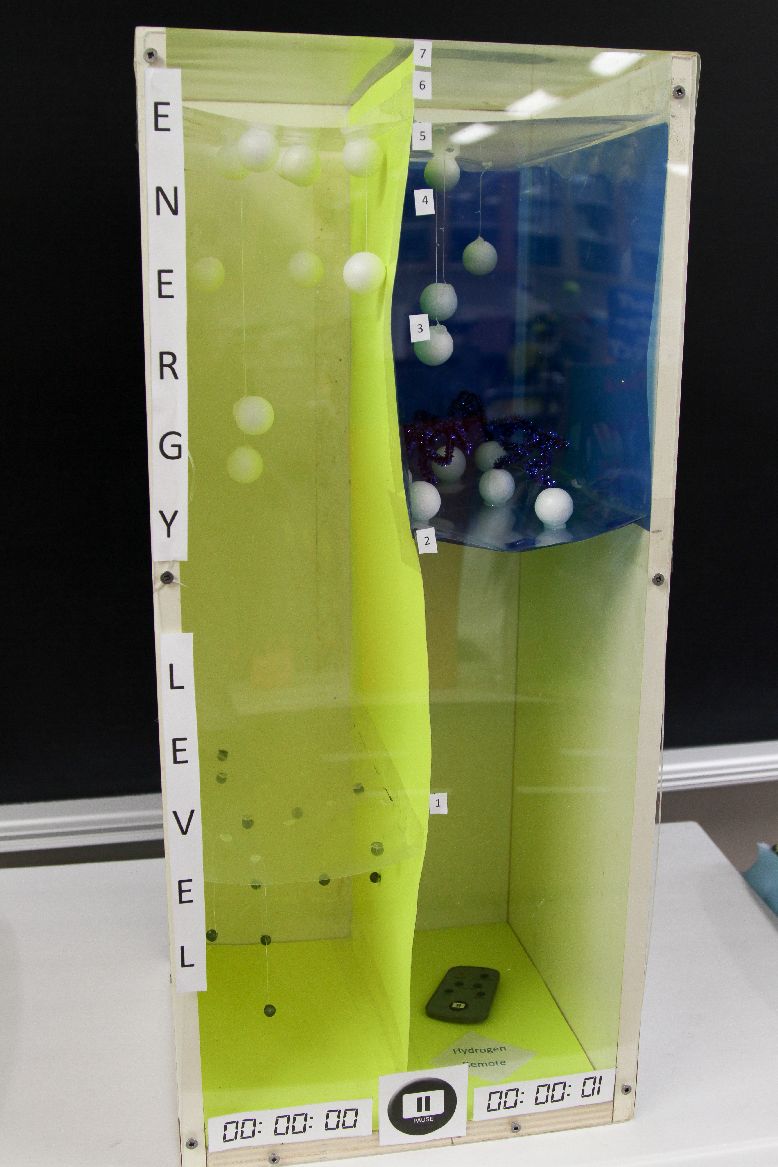


My artwork is a representation of the photoelectric effect as well as to the ideas that come along with the emission spectrum of hydrogen. Firstly, I chose to build a 3-D model of these ideas because I felt that to do so through means of painting or drawing would not be as effective, as it would not show the ideas as clearly. Another principle that was included (but was not necessarily the main theme of the artwork), was the idea of light being composed of photons, but acting as waves at the same time. These quantum ideas were the backbone of my artwork and how they relate will be explained through this rationale.
The first thing that there is to notice, is the pause button/icon in the center of the artwork. This was included to demonstrate the fact that we cannot see what is occurring during the displacement of electrons within an atom, due to the short amount of time in which it occurs. Two separate time zones are viewed (00: 00: 00 and 00: 00: 01); one being a shorter view into the future than the last. These pauses (on both sides of the time zones) show the way that electrons work in order to move up and down shells, thereby emitting wavelengths of light.
The photoelectric effect is the principle that electrons are emitted from matter when they absorb energy, which is represented through the left-hand portion of my artwork. On this side, it can be seen that small, very tiny balls at the bottom of the artwork are attached by strings (signifying that they are travelling upwards) are hitting a layer. This layer represents a series of hydrogen atoms, while these tiny balls characterize photons, as they are tiny and theoretically have no mass. As we know, when a photon hits an electron in an atom, this photon might provide enough energy for atoms to move up to the next shell (or energy level). This is seen in the portion directly above the series of hydrogen atoms (i.e. the clear layer) showing the electrons travelling to the fifth orbital. The electrons are much larger than the photons however because they have a mass, no matter how negligible the mass of an electron is. That brings us to the next point in time.
On the right-hand side, it can be seen that electrons are going down to a lower shell (that shell being energy level 2). Through this, it can be seen that when the electrons get to the second orbital, they release light of a certain wavelength. When an electron travels from the fifth energy level to the second in the hydrogen atom, the colour of light that is emitted is blue. This can be seen not only by the blue background, but also by the fact that the electrons are giving off “waves” of blue light, represented by the wavy arrows coming out of the electrons. This plays into the idea of light being viewed as both particles and waves.
As previously mentioned, the photons travel and hit a series of atoms in the left-hand portion of the model, however, in the right hand side of the model, there was no sign of particles, giving a slight “ode” to the idea of wave-particle duality, since in the same representation, both particles and waves can be observed.
Another idea that was present in my model was the idea that as you travel up energy shells, more energy is needed to go to a higher shell, but less energy to go from shell to shell as energy level increases (e.g. it takes more energy to go from 3 to 4 than 5 to 6). With the labelling of the energy levels in the model, there was a proof of this, since there were larger gaps between energy levels as you approached the bottom of the artwork. Although in reality there is the same distance between energy shells, the energy required to travel to the next shell is different, which is representatively shown through this labelling of energy shells.
There is also a yellow divide in between both the “future” and the “past”. I decided to make this part yellow since yellow is the colour that is the most noticeable to the human eye. This divide shows how humans cannot see both waves and particles at the same time (photons and waves), since this is the way light acts. Since yellow is the most noticeable, I thought it would be ironic to have the most noticeable colour linked to the most complex theory for the human mind to understand, wave-particle duality.
This entire artwork is an ode to more or less the majority of what we have learned about quantum theory this semester. The ideas presented included the photoelectric effect, the emission spectrum and wave-particle duality. Along with this, there was a reference to what we see and what we believe, and the impossibility of doing both at the same time. Finally, although my original idea did not work out, I am more than pleased with this idea and what I was able to represent through my artwork.