

Wave-particle duality is easily the most complex, yet most simple idea in the Quantum Theory. Wave-particle duality states that light and electrons move in both a wave and in particles at the same exact time. This was observed during the double slit experiment, where a beam of light was pointed at two slits. The results showed that an interference pattern was formed, which means that the light was moving in waves. However, when the experiment was performed again there was no interference pattern which would mean that the light was behaving as particles. Therefore, this experiment yielded both results, that light could act as a wave or as a particle.
The quantum theory also explains the hydrogen emission spectrum. The hydrogen emission spectrum is the pattern in which light is emitted when energy is released into a hydrogen atom. When the electron is “excited” (when it gains energy) it jumps from lower-energy shell level to higher-energy shell level, and wavelengths are emitted when the excited state is deactivated which we can either see (wavelengths within the visible spectrum) or not (either in the infrared or U.V region of the electromagnetic spectrum). When the shell level starts from either shell number 6, 5, 4 or 3 and goes down to 2, there is visible light. The other levels will make either UV or infrared waves, which are invisible to the naked eye.
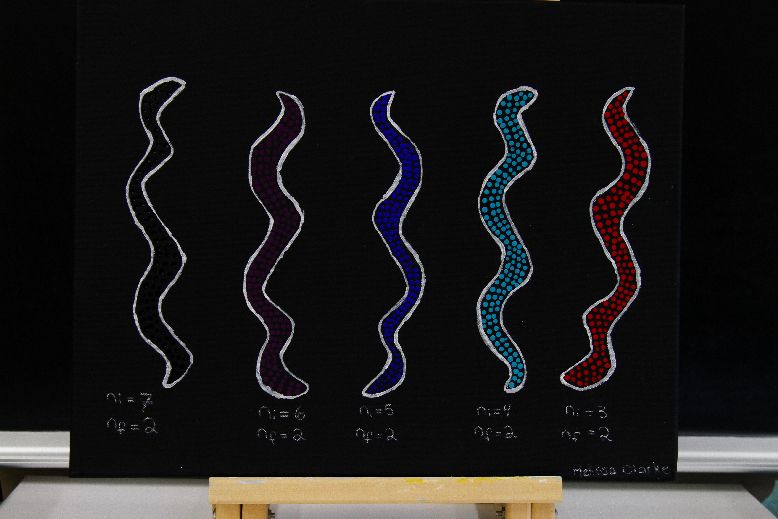
This piece of art tries to make obvious these two obscure phenomena and tries to make simple the complex. The picture shows five different waves, however inside the wave are particles. This represents how the particles and the waves are found within each other in light and how light is not one or the other, but both. Each line is labeled from left to right, ni=7 to nf=2, ni=6 to nf=2, ni=5 to nf=2, ni=4 to nf=2, ni=3 to nf=2. This series of numbers is the initial shell of the electron to the final shell of the electron. Colours are assigned to each of these based on the energy which in turn predict the wavelength. The first line is an ultraviolet line, therefore invisible, the second is purple, the third blue, the fourth turquoise and the last is red. These colours are specific only to hydrogen; therefore if any other element was used, the colours would have been different. These five lines are not the only lines in the emission spectrum for hydrogen, there are in fact at least ten more, however they are all ultraviolet or infrared and invisible to the naked eye which would make a piece of art rather boring.
If taking a closer look at the art work, it is observable that it is not the cleanest piece of art created. This was done on purpose to attempt to present that science itself is not exact and is not “clean”. It can have flaws and it can get very messy. When looking at this artwork and trying to connect it to everyday life, we can now start to wonder where all these colours we see everyday are coming from. There is colour all around us, and now we have an idea that it’s not simply just a wavelength but a specific chemical element that emits this light.
This seemingly simple theory is actually quite complex and opens the world to many more questions and ideas. This artwork was attempting to show the simplicity in science and I believe that it makes it look simple, but only at first glance. When actually contemplating the main ideas it becomes more obscure and more complex than one could ever imagine from taking a glance at the artwork. Furthermore, someone who was never taught these theories would never really be able to grasp the fundamental ideas behind the picture. These people would not get the bigger picture, the same way the scientists today are uncovering more and more of the big picture which is our world. We think we know so much and we assume simplicity; however as time goes on we are just finding out how little we see of the bigger picture.